Tiger Woods says penalty didn't affect his play
AUGUSTA, Ga. - You could say the 2-stroke penalty assessed Saturday morning to Tiger Woods kept him from making a serious charge at the leaders on Sunday in the Masters.
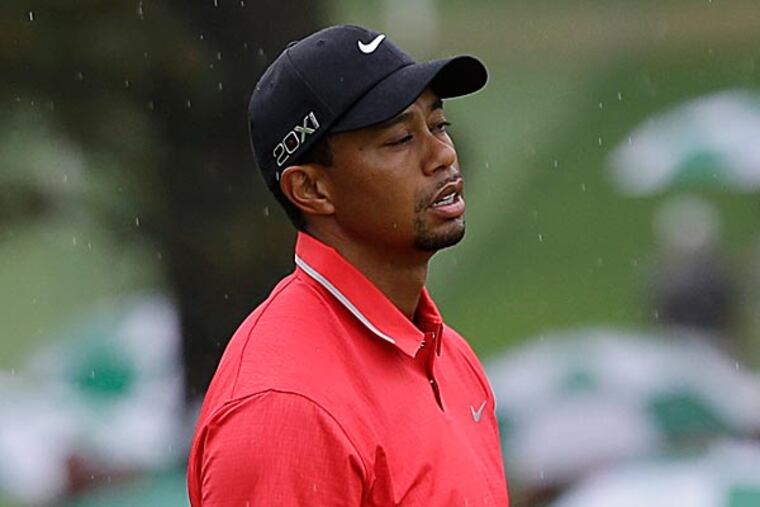
AUGUSTA, Ga. - You could say the 2-stroke penalty assessed Saturday morning to Tiger Woods kept him from making a serious charge at the leaders on Sunday in the Masters.
But you could look at the other side and say Woods was extremely fortunate to have been competing at all on the weekend after signing an incorrect scorecard following the second round.
One of the strangest Masters in memory concluded with Woods' falling short in his attempt to win his fifth green jacket and his first major since 2008. At least his closing 70 left him 4 strokes off the 9-under number needed for the playoff with Angel Cabrera and Adam Scott, and not 2 - the difference being the penalty he received for an illegal drop.
After his round Sunday, Woods, who tied for fourth place, said he never thought about the lost shots.
"Well, we could do a 'what-if' on every tournament we lose," the world's No. 1 player said. "We lose more tournaments than we win. But I certainly had my opportunities to post some good rounds this week.
"I thought I really played well. I missed a few putts this week but also made my share as well. I made a bunch of 10- to 15-footers. So overall it was a pretty good week."
Woods left the course Friday thinking he was just 3 shots off the lead despite a bogey at the par-5 15th hole when his third shot clanged off the flagstick and ricocheted into the water. But a phone call led to a controversy over whether he had taken an illegal drop on the hole, a series of decisions that drew criticism of both Woods and the Masters competition committee.
The final decision Saturday morning was that Woods would be assessed a 2-stroke penalty - putting him 5 shots behind - for not dropping in the area of his original shot, a violation of the Rules of Golf. But he was not disqualified for signing for an incorrect score under a relatively new rule that protects a player who did not know he violated a rule and later was reported to have done so by people watching on television.
Three-time Masters champion Nick Faldo, speaking right after the decision, called on Woods to do the honorable thing and withdraw, comments he later softened. The rules, however, said that Woods could stay, and he stayed, though he never made a serious run at the lead.
If what seemed to be thousands of replays of Woods' shot and his drop from Friday weren't enough, side-by-side photographs of the two strokes surfaced Sunday that may have indicated Woods' drop was closer to his original spot. Some examined the images as if they were the Zapruder film.
But in the end, Woods, who saw the photos, did not change his feeling about the penalty.
"I was one, two yards," he said. "But it certainly was not as close as the rule says."
In his final round, Woods shot himself out of contention by going 2-over par on the first eight holes. Even though he was 4 under from that point, he never got closer than 3 strokes behind the leaders, and wasn't able to rouse the crowds with an eagle on either of the two reachable par-5 holes on the back nine.
"It's just the way it goes," Woods said. "I played this week the way I've been playing all year, and that's a good sign."
Until Sunday's finish, the most memorable shot of the 77th Masters was Woods' third shot into the pond on Friday. So you figured tournament officials had to be silently thanking Scott and Cabrera for the clutch approaches and big putts as darkness fell, knowing that golf won out over controversy.