Merion has brought out the best from the best
Merion was unwilling to reveal itself to Tiger Woods last week.
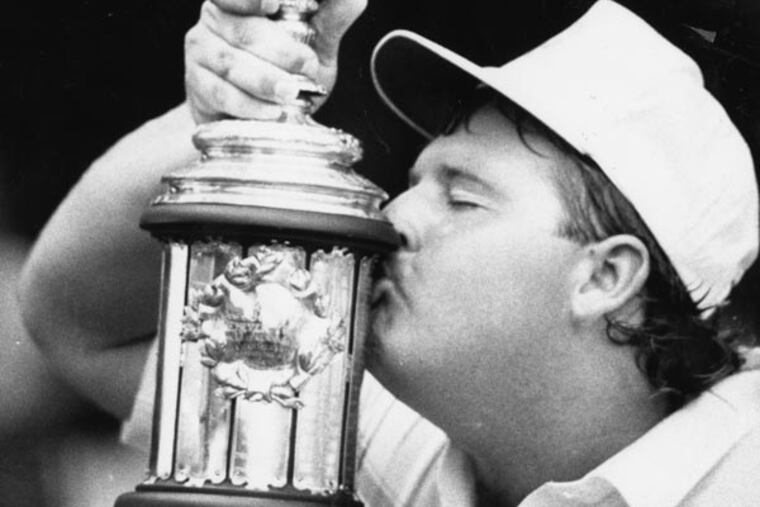
Merion was unwilling to reveal itself to Tiger Woods last week.
Persistent rain and wind shrouded the famed course's true nature Tuesday, obscuring the efforts of the world's best golfer to decipher Hugh Wilson's creation during his debut round there.
How well the powerful and cerebral Woods will handle Merion's subtleties remains a tantalizing mystery as the Ardmore layout once described by Jack Nicklaus as perhaps "the best test of golf in the world" is readied for its fifth U.S. Open later this month.
If history is an accurate forecaster, Woods, who has not won a major since the 2008 U.S. Open, should be the overwhelming favorite. After all, Merion has always been kind to legends.
Ever since Bobby Jones won the 1924 U.S. Amateur, the list of those who have captured significant events there reads like a Who's Who of golf history. The compact course, its record would suggest, yields itself only to the most deserving.
"I measure a great course by the kind of champions it produces," '73 U.S. Open winner and NBC golf analyst Johnny Miller said of Merion.
By that measure, few courses can match Merion's Murderers' Row.
The three greatest golfers of the pre-Woods era all won significant tournaments at the 101-year-old course that straddles Ardmore Avenue.
Jones took the 1924 and '30 U.S. Amateurs, memorable end pieces of his 13 major triumphs. Ben Hogan's '50 Open triumph was so remarkable it was dubbed "The Miracle at Merion." And Nicklaus, who would lose a '71 Open playoff there to a slightly lesser legend, Lee Trevino, posted the lowest score at the 1960 World Amateur, an astonishing 11-under 269.
Another Merion Open winner, David Graham in 1981, was a two-time major champion who turned in a flawless final round to garner his signature victory.
Yes, it's true that in 1934 Olin Dutra upset a less-than-spectacular field in Merion's only other Open. But to do that, the little-known Californian had to edge out another golfing demigod, runner-up Gene Sarazen.
Merion is not like Augusta National, where short hitters typically have no chance. With its sloping fairways, slick greens, deep rough, and a length below 7,000 yards, it is, in Trevino's phrase, "a thinking-man's course." And because of that, it's accessible to any style.
Jones, for example, was a naturally fluid golfer who could out-putt anyone in his generation. Hogan was a precise-hitting machine. Nicklaus was power and steely determination, Trevino guile and homemade versatility.
So what is it that accounts for this impressive roster of champions? Are elite golfers always more likely to win, no matter the venue? Or is there something about Merion that demands a special greatness from its champions?
"I think it's a combination of the two," said NBC golf analyst Gary Koch, who played in the '81 Open there and will broadcast this year's event. "Obviously, great players are great players for a reason. They're usually superior at several aspects of the game, much more so than their fellow competitors.
"But I also think that the greatest players are able to adapt to whatever is put in front of them."
Pete Dye, the respected golf course architect, had his own answer.
"Merion is not great because history was made there," Dye once said. "History was made there because Merion is great."
Still, not every golf legend has made history there. Many, in fact, have been severely punished.
Twenty-two-year-old Byron Nelson missed the cut in the 1934 Open. Sam Snead finished 7 shots behind Hogan in '50. Arnold Palmer was 8 strokes to the rear of Trevino and Nicklaus in the '71 event and failed to make the cut when the Open returned a decade later. Gary Player ended up 9 back in '71 and tied for 26th in '81. Tom Watson finished 12 shots behind Graham in his only Merion Open.
Of course, Merion last hosted an Open 32 years ago and this is a radically different golfing era. Today's top players are defined as much by their ability to boom 325-yard drives as anything else. But power alone, Roger Maltbie predicted, won't be enough to tame Merion.
"I think there are going to be a lot of young guys that potentially get schooled here," said Maltbie, who like Koch played Merion in '81 and will return to broadcast this year's Open. "Obviously, the courses they play now are bigger in scale, longer, much longer, and they're used to bombing away.
"[But Merion] is more about finesse. This is about using your power effectively. And the rest of the time you'd better use your head and be precise. . . . It's a very unique golf course."
Head games
Merion's affair with greatness really began with the first national men's event it hosted, the 1916 U.S. Amateur.
That's where Jones, a polite but hot-tempered 14-year-old prodigy from Atlanta, first bobbed into the national consciousness.
For the teenager at Merion, it wasn't love at first sight. Used to the Bermuda-grass greens prevalent in the Southeast, Jones couldn't easily decipher the much slicker greens. During one practice round, a putt rolled off the sloping sixth green and into a creek.
Merion, he also learned, required a patience he did not yet possess. He threw clubs regularly and often couldn't contain his anger. One sportswriter described him as an "unbroken colt" who had "difficulty restraining himself from doing things with undue haste."
Jones' behavior was so bad it later warranted a warning letter from U.S. Golf Association president George Herbert Walker, grandfather and great-grandfather of the Bush presidents.
But Jones adjusted well enough to Merion to reach the quarterfinals, where he lost to Robert Gardner.
Eight years later, when he returned for the 1924 U.S. Amateur, Jones found a course that, much like himself, had matured to greatness.
"It was either a fine shot or nothing," sportswriter Grantland Rice wrote of Merion. "To be pretty good didn't help. When one erred, he usually lost a stroke, sometimes two strokes, and sometimes three."
In capturing his first significant championship, Jones showed the world how to win at Merion. He hit fairways and greens. He respected the speed and break of its greens. More important, he focused on every shot.
"[He] was paying no attention to what I did or where my ball went," said Francis Ouimet, one of Jones' match-play victims. "He just kept plugging for par after par and two times out of three he was putting for birdies only eight or 10 feet away."
Six years later, Jones would win another Amateur at Merion in his final competitive appearance, shellacking the field as he famously completed golf's Grand Slam.
In 1950, Hogan, still gimpy from the injuries he suffered in an auto accident, proved again that when it came to tackling Merion, a good head is more essential than healthy legs.
Like Merion, Hogan was small but incredibly tough. He liked the course so much, he would say, because it perfectly suited the precision that was his trademark. Finding the fairways was enough at most courses. But at Merion, he knew, where you hit them was even more crucial.
"[You] have to really, really use your head going around there," Miller said.
As impressive as Jones' and Hogan's triumphs there were, no one has ever conquered Merion the way Nicklaus did as a 20-year-old competing for the U.S. in the 1960 World Amateur Team championship.
Hogan's winning total in '50 had been 7-over 287. Nicklaus shot 11-under 269 in his four rounds - 66-67-68-68. With him in the lead, the American team's winning margin was a mind-boggling 42 shots.
His long drives found the narrow fairways. His long irons were hit high enough that they held Merion's compact greens. And, by his own admission, his putting was unconscious.
"Every golfer experiences, usually out of the blue, a spell when everything feels absolutely right," Nicklaus said. "And that week . . . it enveloped me for four days."
But, as he pointed out, Merion wasn't set up the way it's been for Opens.
"Merion in any condition is a marvelous golf course and a testy one," Nicklaus said. "[The USGA] had taken the course to a point only about halfway between in difficulty how members normally play it and how it confronts an Open field."
As he predicted, the next Open field to test it, in 1971, found a much different Merion. So it was no great surprise that probably the two best minds in golf at the time wound up tied at even-par after 72 holes - Nicklaus and Trevino.
Trevino would go on to win Monday's 18-hole playoff by 3 shots, 68 to 71, for his second Open title. Merion and the crafty Texan were a perfect couple.
"I hit the ball really, really straight with my driver," Trevino told The Inquirer last month. "When I get to a golf course that's small and tight and the rough is extremely high, it's to my advantage. . . . It also gave me an advantage that I was a better wedge player than most of them."
Those demands - accuracy; patience; a great short game; and, most of all, brains - explain why so many of the best are eager to be tested by the best.
"If I had just two weeks to live," Tommy Armour once said, "I'd want to go to Merion and play there every day."
EndText