Lying down on job is part of this sport
Andrew Sherk knows luge is not for the faint of heart.
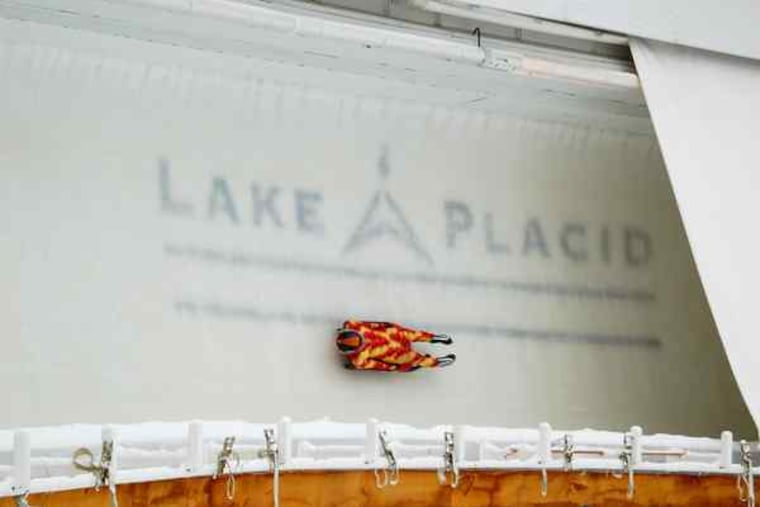
It all began when Ellen Sherk saw a newspaper article about luging. This, she thought, would spark her son Andrew's interest because it offered risk and speed.
USA Luge, the national governing body for the sport, was conducting a "slider" search for boys and girls 11 to 14 in the summer of 2005. Aspirants were invited to experience luge on wheels using a paved track in Philadelphia's Fairmount Park.
The luge, a one- or two-person sled, usually is piloted down an icy run. The slider, or driver, lies face up with feet first. Steering is done by flexing the sled's runners with the calf of each leg or exerting shoulder pressure to the seat.
The best performers in that slider search would be invited to train on ice the following winter in Lake Placid, N.Y. They also would be considered for the 2005-2006 USA Luge development team.
"He was really excited about it," said Ellen Sherk, recalling her son's reaction to the article in The Inquirer. "He has a need for speed, and he has no fear."
About a month after the tryouts, the Fort Washington resident was selected to attend a screening camp in Lake Placid. But Sherk was not chosen for another winter camp.
"I was pretty disappointed," Sherk said.
Determined that his luge career wasn't finished, Sherk looked for another slider search. He found one, but it was in Connecticut. He went anyway.
"This time, I did well enough to get to a winter training camp [on ice] at Lake Placid," said Sherk, who will be 17 in April. "That really sparked my interest in the sport."
Sherk then was selected for the USA Luge junior development team. That meant training for up to three months a year in Lake Placid, one of two training sites operated by USA Luge. The other is in Park City, Utah. Working out on the junior-development level also meant opportunities for Sherk to travel.
But first there was the matter of schooling. So Sherk underwent a major shift, leaving Upper Dublin High last spring after his sophomore year to take subjects through a cyber charter school. He is connected to the school by computer and takes his school-provided laptop on his travels.
"I have had to negotiate a daily flat fee for the computer [connection] time," Sherk said. "Otherwise, it can get rather expensive at 12 cents a minute in some places."
Sherk also pays a portion of his training expenses, since they are not entirely underwritten by USA Luge.
Sherk recently returned from competing in six Junior World Cup youth division events in Germany, Italy, and Austria. His best finish in the International Luge Federation-sponsored races - he is ranked 10th in his age group - was seventh place in Cesana, Italy. He also raced doubles, but crashes and injuries to his partner kept them out of several races.
Home for just about a month, Sherk and his mother next head to Utah for the Junior National Championships that are set for Monday to March 2.
Speeding along the track at speeds of up to a mile a minute - that's 60 m.p.h. - for nearly a one-mile run, Sherk said he has had only one crash while competing by himself.
"I hit a wall and flipped," the 5-foot-7, 140-pound Sherk said. "It was pretty exciting. I didn't break any bones. I couldn't wait to call my mom."
Ellen Sherk was not surprised. She once found him 40 feet up in a tree when he was much younger. He didn't get hurt that time, either.