Marc Narducci: Ex-Eustace star working his way through minors
FREDERICK, Md. - No professional sport can put a player in his place as quickly as baseball can. One day a player can be a first-round pick earning a seven-figure signing bonus, and the next day he's beginning in the lowest depths of the minor leagues.
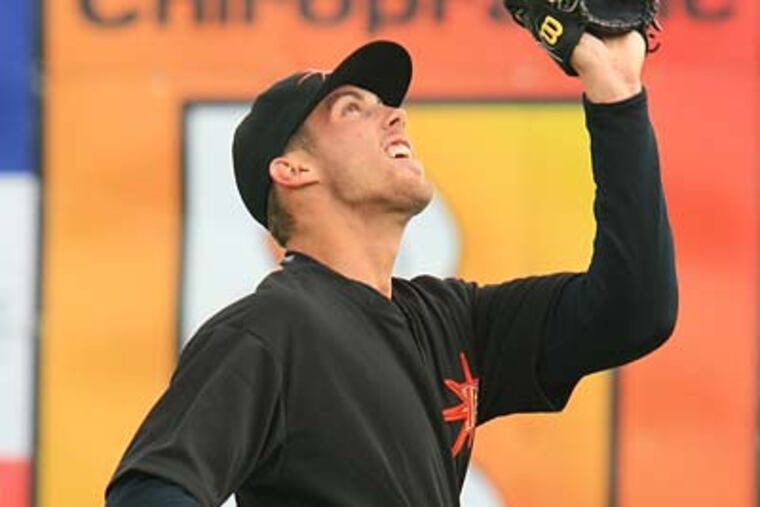
FREDERICK, Md. - No professional sport can put a player in his place as quickly as baseball can. One day a player can be a first-round pick earning a seven-figure signing bonus, and the next day he's beginning in the lowest depths of the minor leagues.
That's the scenario for Billy Rowell, a two-time Inquirer South Jersey player of the year from Bishop Eustace and a first-round draft choice of the Baltimore Orioles in the 2006 draft.
Rowell signed for a $2.1 million bonus in July 2006 and has been climbing the Orioles' ladder ever since.
His current address is the same as last year's, with the Orioles' advanced single-A team, the Frederick Keys.
Rowell hasn't enjoyed a meteoric rise in the farm system, but there has been tangible progress. Still, he has had to be patient.
"It's not what you expect out of high school, and it's a lot different," Rowell said before last night's rain-delayed doubleheader against the Winston-Salem Dash.
"I love what I'm doing, but it's a grind and a marathon, and there is a lot to get used to. But I am feeling comfortable with the lifestyle."
He's also learning a new position.
A shortstop in high school, Rowell played third base in his first three minor-league seasons and is in his first year as a rightfielder, where he has displayed a gun for an arm.
"They wanted to take a little pressure off me defensively and concentrate on my hitting," said Rowell, who will turn 21 in September.
Rowell was part of what has become a highly celebrated first-round draft class in 2006; it included last year's American League rookie of the year, Evan Longoria of Tampa Bay, and last season's National League Cy Young Award winner, Tim Lincecum of San Francisco. Both were college players, with Longoria taken third out of Long Beach State and Lincecum drafted one spot behind Rowell, at No. 10, out of the University of Washington.
It would be natural for Rowell to look at his first-round brethren and put extra pressure on himself. He says that isn't necessarily the case.
"I don't feel pressure from outside sources, but I expect a lot from myself and put a little pressure on myself to do well," he said. "There isn't any added pressure by that [first-round] label."
This is Rowell's second season at Frederick. Last season, he batted .248 with seven home runs and 50 RBIs in 375 at-bats.
Rowell ended last season hitting in 11 of 13 games. Entering last night, he had a nine-game hitting streak and was batting .286 (24 for 84) with seven doubles, a home run, and eight RBIs.
"He has done pretty well learning a new position, but his hitting has to pick up a little bit," said Frederick manager Richie Hebner, who played first base and later coached with the Phillies. "He just has to play and learn the game."
In admiration, Hebner added: "You don't see too many [near] 21-year-olds' bodies like that. He is big and strong and will only get stronger."
Rowell is 6-foot-5 and weighs 215 pounds, and says he feels much stronger because of an increase in his weightlifting regimen.
Hebner said that Rowell and many other young players struggled because of pitch selection.
"Billy gets out a lot on bad pitches," Hebner said. "If he swings at strikes, he can do some damage."
Hebner gives all his players the simplest advice on how to hit the most difficult of pitches, the curveball.
"When kids ask me how to hit a curveball, I say, 'Don't miss a fastball,' " Hebner said.
If only it were that easy.
Hebner, who is as subtle as a hurricane, didn't mince words when telling Rowell how important this year was for his development.
"I told him in spring training that your honeymoon is coming to an end and you have to start doing things," Hebner said. "I think last year the organization realized he was in over his head, so this is a big year for him."
As for a timetable, Rowell insists there isn't one.
"I just want to improve each game," he said.
Since there are 140 of those games this year, that's the best view Billy Rowell can have at this stage of a career that is still being defined.