Sharrif Floyd relieved recruiting is over
Every recruiting trip, Sharrif Floyd got the VIP treatment. He'd earned it. After tearing apart the competition at various scouting combines, the George Washington High senior was generally rated the top defensive tackle in his class nationally.
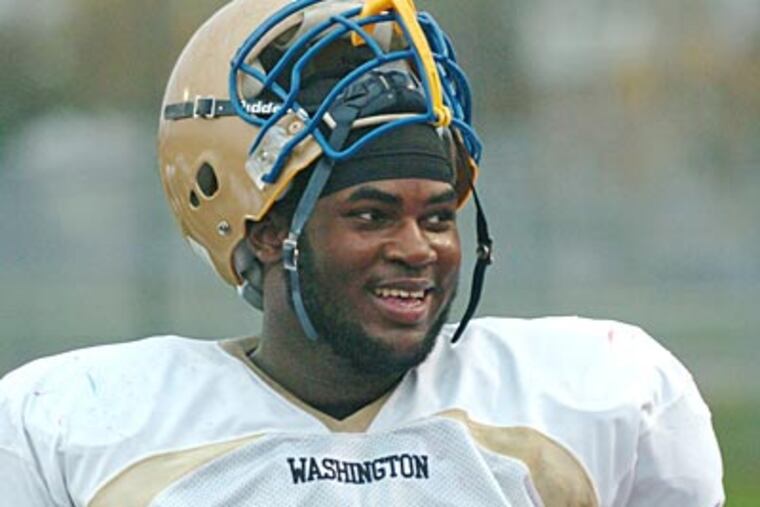
Every recruiting trip, Sharrif Floyd got the VIP treatment. He'd earned it. After tearing apart the competition at various scouting combines, the George Washington High senior was generally rated the top defensive tackle in his class nationally.
When Floyd visited one big-time football school, the defensive-line coach even carried his bags.
"Don't get used to this," George Washington head coach Ron Cohen remembers telling Floyd. "If you go to this school, I wouldn't want to be you the first day. You'll pay the price, believe me."
Floyd plans to sign a letter of intent Wednesday with Florida - choosing the Gators over Ohio State, North Carolina, and South Carolina, with serious recruiting heat also coming from Southern California and Penn State, and dozens of other scholarship offers.
Consider Floyd an expert on the recruiting process, on the tricks of the trade that coaches use as well as all the peripheral craziness - like the claim that Florida coach Urban Meyer had a dream that he was coaching Floyd, that he told Floyd the dream was a sign from God.
"That never came out of my mouth, and never came out of his mouth," said Floyd, who made a point of tracking down the source of the rumor.
The hardest part of the whole process?
"Not committing early, sticking it out to the end," Floyd said as he sat in Cohen's office last week at George Washington. "Because you get a lot of phone calls - a lot of reporters, a lot of 'we want you' type of speeches. Going through it as long as I did, I'm happy I did, because you can sniff out a lot of B.S., and there's a lot of it in this game."
Although Floyd announced his decision earlier this month, two Florida assistant coaches visited the school on Wednesday. These days, oral commitments aren't always worth much. For instance, USC tried to get back in with him this month after Lane Kiffin took over for Pete Carroll.
"They said, 'Sharrif, come on, come be the best defensive tackle in California, and maybe the country. Come start for us,' " Floyd said. "The whole nine yards. But I didn't pay it any attention. I let them go through the whole spiel. I didn't disrespect them. They're doing their job. I understand that."
There was reason for other schools to test Floyd's commitment to Florida since Meyer had originally announced last month that he was stepping down for health reasons, before the Gators' coach switched to taking a leave of absence. Now, Meyer seems to be back full time.
When Meyer had announced he was stepping down, Floyd already had made up his mind that he was going to Florida, although he wouldn't announce it for two more weeks. Floyd didn't tell anybody but his closest circle that Meyer's move made him switch gears. He decided he'd go to Ohio State, he said. But he didn't announce that either. And the more he thought about it, he said, the more he didn't want to choose a school based on a head coach.
"I switched back," Floyd said. "I'm going to be a Gator, with or without Coach Meyer. I love the guy. But if he's going to leave because of his health and no other reason, I respect that. I agreed with the fact that he was going to take that leave of absence, but that's nothing to worry about now. He's back in the office, and coaching the spring game."
That time period did get crazy, Floyd and Cohen said. Florida assistant coaches were calling all the time.
"They had to keep him in the fold. They called everyone they could call," Cohen said.
"He helped save Florida in some ways. He didn't [publicly] waver. When another kid dropped and went to Florida State, Sharrif stayed. And other kids called him. That helped them decide."
Other schools kept trying.
"They're still calling me, up to the very end," Cohen said, "They're saying, 'Oh, [Meyer's] not coming back, he's really sick.' "
On Jan. 15, six days after Floyd announced he would go to Florida, a man who said he was from Jacksonville, Fla., e-mailed Cohen, telling him about the story making the Internet rounds.
The story went like this: "Sharrif was really confused and put a call into Coach Meyer. When they spoke Coach Meyer told that he had a dream the night before, and that Coach Meyer saw himself on the sideline coaching Sharrif. Told him that this was a message from God that I should come back and coach, as I guess if it's my time to die, I'd rather die on the sidelines coaching you than anywhere in the world."
Cohen read the e-mail and immediately called Floyd, he said.
"I looked at that as disrespect," Floyd said. "Urban Meyer and me, we built a relationship. Him saying something like that - I wouldn't even think of him saying something like that. We just talked. We didn't talk about God. We just caught up on everything."
Floyd said he immediately called Meyer, who hadn't heard of the report yet. Floyd wanted him to know he'd never said that. Then Floyd said he called someone he knew at Rivals.com, the online site, who tracked down the source of the report.
"It came from the [Ohio State] Buckeye Web site, and then it got to the South Carolina Web site," Floyd said.
The Web sites focusing on recruiting became another inescapable part of the rigmarole.
"Everybody wants a piece of you, everybody wants to know what you're thinking," Floyd said. "The school sites that are calling, really trying to just pick your brain. A lot of the questions are just the same. You [get to] the point where, 'All right, I'm going to change my number.' They don't care what time they call you, where you're at. . . . I got a phone call about 12:30, 1 o'clock from one, and it was a weekend."
Floyd learned to detect slipperiness from recruiters, too. One assistant pulled a penny from his pocket and said he'd just found it - and the only time he picked up a penny was when he recruited some all-American. That just sounded lame. He was at another school with his coach when "a big-time pro player just happened to walk in," Cohen said.
"Things that turned me off were coaches saying, 'Come in, play, and we've got a spot sitting for you right here right now,' " Floyd said. He'd compare recruiting pitches with other players and found they were often getting the exact same words from the same people. I just wanted to hear what they can offer, what I can offer them. Just build a relationship. Those were the main keys."
Florida's practice of rotating defensive linemen was a negative at first, but Floyd eventually came to think of it as a positive, his coach said.
"He wanted to be on the field the whole time," Cohen said. "I said, 'Sharrif, in college they'll run 50 plays, 60 plays. You can't play 60 plays. You're better off not playing 60 plays.' "
They seriously studied which schools produced the most professional players, breaking it down by position. Although in addition to Meyer, he was being recruited by such coaching luminaries as Joe Paterno, Pete Carroll, Jim Tressel, and Steve Spurrier, the star appeal of the coach wasn't a factor, Floyd said.
"If they did their homework, I didn't know anything about college football, or college coaches," Floyd said. "So that wouldn't have mattered to me. That actually would have been a turnoff. The head coach plays a factor in the decision-making, but don't try to boast about him before I can meet him, because I know nothing about him."
In Floyd's mind, he wasn't just choosing a college, but also deciding where he might want to be for the rest of his life, he said. To him, that was a real positive for Florida. Meanwhile, Penn State didn't make the list of finalists.
"I already knew I wasn't going to stay in Pennsylvania," Floyd said. "I've been here for 18 years. I don't need to stay here."
Was it hard to say no to Penn State?
"No," Floyd said. "Penn State to me was a linebacker school. I learned that doing my homework. It wasn't hard to get them out of the loop."
Cohen said the schools weren't trying to do anything under the table. But he also said, "Hey, it's a business. I told Sharrif at the very beginning, 'Understand one thing. This is a business. You're signing a contract. It's work. You're going to get $150,000, depending on what school you go to, $300,000 if he goes to a school like Stanford. That's what the education's worth. But guess what? They own you.' "
Floyd understood all that. Florida was the school that he got the most excited about, that he stayed excited about just thinking about playing there, he said.
Another of Cohen's concern, about Floyd being able to deal with all the recruiting pressure, turned out to be a nonfactor, the coach said.
"No question about it," Cohen said. "He handled it all great."
On Wednesday, it will be over, when Floyd signs his NCAA letter of intent in the school's library. The recruiters will finally stop recruiting.
"I still got e-mails, and in the last couple of weeks I still got phone calls trying to recruit me," Floyd said. "But I'm not going anywhere. I'm a Gator."