Episcopal Academy rowers carry on without teammate
Paul Pratt was killed in a car crash in May, but his crew teammates have kept him in their memories.
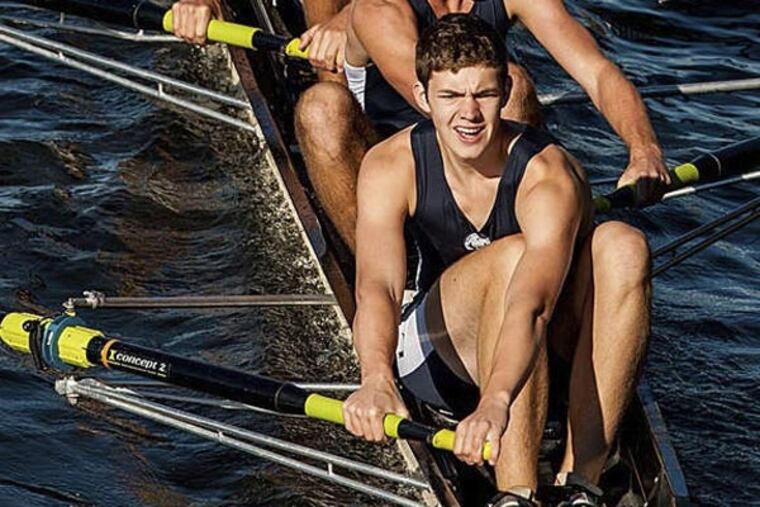
HE HAD A WAY of touching everyone around him. With his smile, with his quick wit and snappy remarks. With his candor and spontaneity. Paul Pratt had a way of impacting lives. It's why those who knew him, rowed with him, saw him every day, find it hard to fathom that he's gone.
Two summers ago, Pratt once accidentally severed two fingers and part of another on his left hand. The Episcopal Academy junior was never supposed to row again. He did, not only making the Churchmen team, but making it onto their top boat.
On May 16, Pratt was killed in a one-car accident on a curvy, dark road in Radnor. The next day, his friends and teammates decided to carry on without him in the prestigious Stotesbury Cup Regatta on the Schuylkill.
After finishing third at the Stotesbury, they went on to win the Scholastic Rowing Association of American National Regatta on the Cooper River in Pennsauken on May 24-25. Three weeks after that, they finished seventh in the USRowing Youth National Championships (June 7-9) on Melton Hill Lake, in Oak Ridge, Tenn.
Though his teammates had lost Paul, what cannot be lost is the memory of a kid who found his niche rowing. And just as quickly as he found it, it seemed, it was almost taken away. The first week into the summer vacation between his freshman and sophomore year, he lost half of two fingers and a third of another on his left hand in a wood-splitter accident behind his home.
Pratt went into the summer with hopes of making the Churchmen's heavyweight four boat in his sophomore year. He went from that to suddenly wondering whether he'd ever be able to even hold an oar in his hand.
"Paul had an incredible amount of strength, mentally and physically," said Episcopal crew coach Molly Konopka, who's been the Churchmen coach since 1997. "There was some doubt whether or not Paul would row again after he lost his fingers. My first thought was if Paul was OK. My son first heard about it on social media, and I ended up calling the school if they had heard about Paul.
"It was pretty clear his freshman year that Paul loved rowing and it's what he felt he could excel. It was the whole jumping the hurdle that his [recovery] would be substantial after the accident. But Paul stuck by it and came out his sophomore year - and not only that, he made the top boat on the team. We had some top kids in that boat, but Paul didn't accept his situation. Paul wasn't a kid who took 'no' very well."
Pratt never did.
"Paul was like my heart. He was like my sidekick," said Kimberly Pratt, his mother, who has six other children. "He had a charismatic personality. Paul was a character who loved life. He was passionate about everything. Paul was an unfiltered, bull-in-a-china-shop kind of kid. We would go on 5-mile bike rides and he would want to ride a little more. He would say he wanted to do a little more. He went off one time, he came back and did 70 miles. He had that passion to love every day like it was his last. He had a bigger-than-life personality. He led a worthwhile life."
He was a workout machine. It was what spurred teammates Nick Mead, James Konopka (Molly's son), Jack Alden, Guillaume Furey and coxswain Jimmy Larkin.
After losing his fingers, Pratt began his road to recovery on an ergo rowing machine, showing his father how to use it. He found out he could still row.
"Paul realized then he could still row," Furey said.
"Paul liked to talk. He was idealistic and liked to engage people in long discussions about deep topics sometimes. Paul was also hilarious. He was never afraid to speak his mind, which gave him a funny edge."
Then Furey laughed for a moment. He recalled a story from last winter. The two had gone to a Friday practice on a day it snowed. Few showed up that day. The next day, practice was optional. Pratt and Furey decided not to go.
At least that's what Furey thought.
"There was Paul that morning; he found a way into my house, found me in the basement, woke me up to go to practice," Furey said, laughing. "It must have been about 6, 6:30 in the morning. I woke up to this kid above me shaking me, 'Wake up, 'G,' wake up.' After about a 10-minute discussion, I decided not to go. That was Paul. He loved rowing and loved going to practice. He wanted me to get better. He wanted us all to get better. He worked so hard that he made everyone around him work hard. It's been hard without him. We all miss him. It's why it's so hard to talk about him."
This year was the most trying season in Konopka's coaching career.
"Paul's coordination had to catch up to his strength, and when it did, he took off," she recalled. "A lot of strength can take you far in this sport. Rowing is painful. He was OK with the pain - he loved it. He used to say he knew the pain was coming, and he said it made him push harder - that he could push more when it hurt.
"To be honest, after Paul died, it was hard for them to push their boat off even off the dock. But it's a testament to what these kids wanted to do in memory of Paul. We won't forget him. You never forget someone like that."