In 1949 meeting, the hints of scandal
On Oct. 20, 1951, when the headlines roared with news of a college basketball game-fixing scandal involving Kentucky, a two-time national champion, Villanova players tried to recall their loss to Adolph Rupp's Wildcats two years earlier in the opening game of the 1949 NCAA tournament.
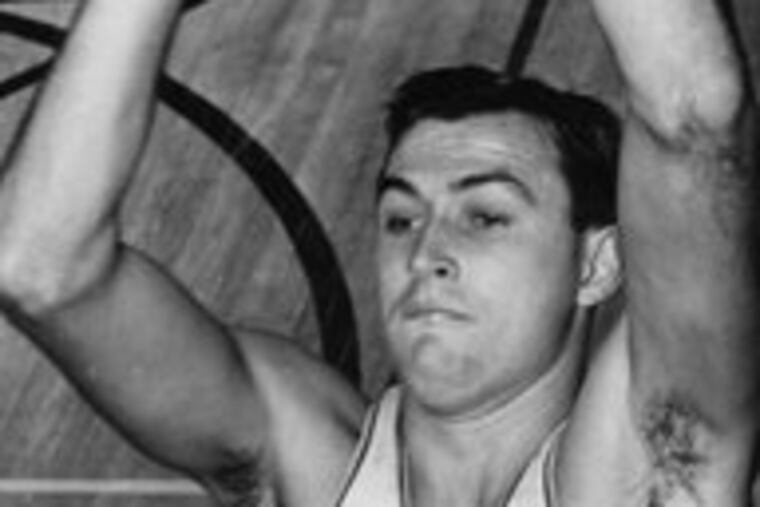
On Oct. 20, 1951, when the headlines roared with news of a college basketball game-fixing scandal involving Kentucky, a two-time national champion, Villanova players tried to recall their loss to Adolph Rupp's Wildcats two years earlier in the opening game of the 1949 NCAA tournament.
According to the headlines, three of Rupp's players, two of them then in the NBA, had been charged with accepting $1,500 bribes to throw a first-round game against Loyola of Chicago in the 1949 National Invitation Tournament. In that March 14 matchup at Madison Square Garden, Loyola had ended Kentucky's 22-game winning streak with an incongruous 67-56 victory.
Exactly one week after the upset, in the same New York City arena where gamblers and point-shavers then operated brazenly, Kentucky faced Villanova in the NCAA tournament's East Regional, in the first meeting of two basketball-rich schools that will match up again tomorrow night in the first round of the tournament.
Kentucky, which despite its early NIT departure would win the five-day, eight-team NCAA tournament for a second straight year, beat Villanova easily, 85-72, in that regional opener on March 21, 1949.
But two years later, when they learned that the fix had occurred so near their own meeting with Rupp's team, those Villanova players, many of whom had by then graduated, were puzzled. They knew they had played hard and well against an opponent teeming with all-Americans.
"After the fact, we of course looked back on that game and wondered if there was anything funny going on," said Joe Hannan, 79, a South Philadelphia native who played guard for 22-3 Villanova that night. "I guess there were a couple of things. But how are you going to prove it?"
The four fouls Villanova's star, junior Paul Arizin, picked up in the first 14 minutes were foremost in the players' minds. Arizin, who sat out the remainder of the half and then fouled out with two minutes to play, still scored 30 points, a figure matched by Kentucky's star, bruising center Alex Groza.
"They couldn't stop Paul," Hannan recalled. "Once he was gone, we weren't the same."
No one recalls that game's point spread, but Kentucky's 13-point margin likely surpassed it. Still, once the scandal broke, people speculated on how much fixing and shaving Kentucky had been doing that season.
"There was no way to know," Hannan said. "There for a while it seemed like everybody had been doing it [shaving points]. When you were in New York, you would hear talk of the point spread while you were playing. There were even, as I recall, a couple of referees who got arrested for taking bribes."
Until New York District Attorney Frank Hogan blew the lid off the practice by arresting several dozen players and fixers in the early 1950s, point-shaving - and less frequently outright game-fixing - was commonplace at the Garden and elsewhere.
Investigators determined that between 1947 and 1950, gamblers altered the outcomes of 86 games in 33 cities. It seemed as if no team, no place, was immune.
In fact, one of the biggest names implicated in the 1950 scandal, Sherman White, a star at Long Island University, had begun his career at Villanova before transferring.
"When Sherman was a freshman, we all thought that with him and Arizin, Villanova was going to be a national power," Hannan said. But White "was dirt poor. He came back to campus after a weekend at home wearing this expensive suit. When we asked him about it, he just said he was going to be transferring to LIU."
Curiously, as Rupp prepared his No.1-ranked team to meet Villanova in the '49 tournament, those around Kentucky's legendary coach sensed a peculiar unease.
It had nothing to do with Villanova. Even though Al Severance's 14th-ranked Wildcats featured the high-scoring Arizin and were riding a nine-game winning streak, most observers agreed with the game-day assessment of Inquirer sportswriter Mort Berry.
"Physically," Berry wrote on March 21, "the Main-Liners are lesser men."
Recent injuries to Hannan and another starter, Tom Sabol, didn't help.
Rupp's discomfort was with his own team, more specifically the loss to Loyola. Though he would experience only 190 of them in 1,069 games as Kentucky's coach, Rupp sensed immediately that the loss in the NIT had been different.
"Something's wrong," Rupp told assistant Harry Lancaster after that game.
Groza and Ralph Beard, all-Americans, had missed easy shots and been out of position for rebounds. Something had disrupted the discipline and fast-breaking rhythm that were hallmarks of any Rupp team.
Against Villanova, Kentucky, bigger and, with Groza, Beard, Wah Wah Jones and Cliff Barker, more talented, jumped out early. Only Arizin, who managed 11 first-half points around his fouls, kept Villanova in range. But once he left, Rupp's team built a 48-37 halftime lead.
"They were very good," recalled Hannan, who finished with seven points. "Groza was slow, too slow to guard Paul. But on the other end, he was a real bull and we had trouble stopping him."
Arizin, despite being saddled with four fouls, scored 19 points in the second half. Still Kentucky cruised to the win.
"He's a great basketball player," Rupp said afterward of the future Hall of Famer. "He's everything they said about him."
The two Wildcats squads set three team tournament records - most points by a winner, most combined points, and most free throws made (23, by Kentucky). Arizin and Groza, the brother of Cleveland Browns Hall of Famer Lou Groza, established a tournament scoring mark with their 30 points apiece.
Villanova defeated Yale, 78-67, in the following night's consolation game.
Kentucky crushed Illinois, which had beaten Yale, to earn a trip to the Final Four that weekend in Seattle. Rupp's squad would beat Hank Iba's Oklahoma State in the championship, 46-36.
(The four teams in the West, the only other region, played in Kansas City, Mo. They were Oklahoma State, Arkansas, Wyoming and Oregon State.)
Nine months later, in New Orleans' Christmas Sugar Bowl, the two teams met again. Groza and Beard were gone but Kentucky, despite Arizin's 24 points, beat Villanova again, 57-56, in overtime.
Whispers about point-shaving erupted into a clamor late in 1950 when Hogan revealed that CCNY, which had won both the NIT and the NCAA tournament that year, had cheated.
Rupp, as smug as he was confident, blamed it on "New York Jews." He said investigators wouldn't be able to touch his boys "with a 10-foot-pole."
Then, the following October, as they sat in the Chicago Stadium grandstands watching a Rupp-coached college all-star team play the NBA's Rochester Royals, Groza and Beard were arrested by federal agents. Kentucky's Dale Barnstable, a sophomore reserve in the '49 game, was picked up in Lexington.
NBA commissioner Maurice Podoloff barred the three players for life. The NCAA, citing a report that painted Rupp's program as rife with corruption, ordered Kentucky to cancel its 1951-52 season.
The coach was bitter. He now assigned blamed to the New York newspapers that printed point spreads for encouraging the gamblers.
This time, writers at those maligned newspapers had the last say. They all chipped in to buy the aggrieved Kentucky coach a gift - an 11-foot pole.
"In just the brief time I saw Rupp, he was like a tyrant-type guy," Hannan said. "He did not seem like a nice man."