Swimmer has it all, except Olympic gold
Michael Phelps is not accustomed to swimming in a wake. So when the sport's pterodactyl-spanned superstar found himself trailing Brendan Hansen during the 200-meter breaststroke during a January meet in Southern California, Phelps' adrenaline pump kicked up a notch.
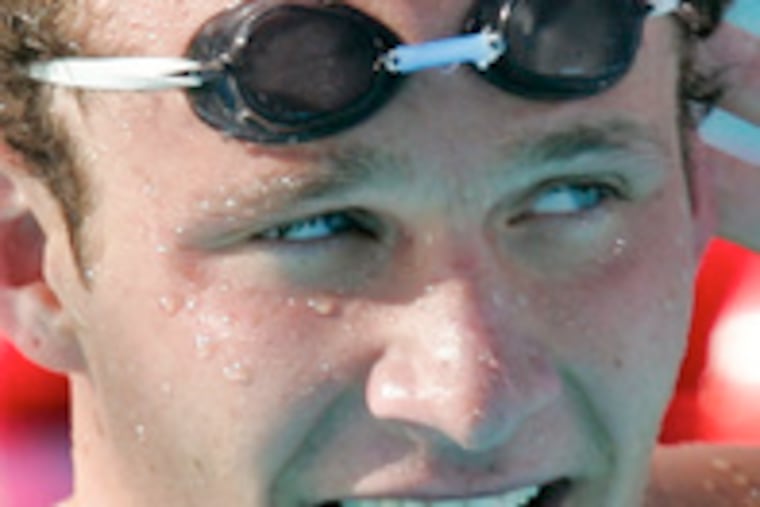
Michael Phelps is not accustomed to swimming in a wake.
So when the sport's pterodactyl-spanned superstar found himself trailing Brendan Hansen during the 200-meter breaststroke during a January meet in Southern California, Phelps' adrenaline pump kicked up a notch.
"I could see him pretty much the whole time," Phelps, who finished 3.12 seconds behind Hansen, said afterward. "I was like, 'Maybe I can catch him.' But then I was like, 'What am I thinking? There's absolutely no way I can catch . . . the best breaststroker of all time.' "
Hansen, a 2000 graduate of Haverford High who discovered the sport and the stroke as a Karakung Swim Club 4-year-old, has earned Phelps' accolade.
He hasn't lost at either 100 or 200 meters since the 2004 Olympics. Last summer, in one astounding 20-day stretch, he set three world records. USA Swimming named him its male swimmer of the year for 2006.
But as Hansen and the rest of a powerful American team head for the 2007 world championships in Melbourne, Australia - the eight-day swimming competition opens next Sunday at Rod Laver Arena, home to tennis' Australian Open - there remains one big monkey on his big back.
The blue-eyed, ruddy-faced swimmer has not yet won an individual Olympic gold medal.
As an 18-year-old in 2000, he barely missed qualifying in the U.S. trials, finishing third in both the 100 and 200 meters. Four years later, in the sweltering Athens sun, the favored Hansen lost to Japan's Kosuke Kitajima in both events, disappointments that left him feeling as if he'd had one too many burritos.
"My heart feels bad to not get that gold medal," he said at the time.
And though he added a team gold medal - as part of the victorious U.S. 400-meter IM squad - to his silver and bronze, the group accomplishment couldn't fully soothe his upset.
It's that blank line on Hansen's resume that has caused the 25-year-old University of Texas graduate - his degree is in kinesiology/communications - to postpone dipping his toes into the real world.
It's why he had the Olympic rings tattooed on his left shoulder. It's why he has trained so hard since his Greek tragedy, swimming 12,000 meters, four hours a day, six days a week, at the Longhorn Aquatics Club in Austin.
It's that dream of redemption in Beijing that now has the four-time Pennsylvania scholastic champion aiming at two more world titles in Australia. But the worlds, he admitted, merely will be a rehearsal for the 2008 Games.
"You get on the international stage to race people," he said this week in a telephone interview. "The more times I do it, the more comfortable I get going into the Olympics. The Olympics, compared to any other meet I've ever been to, is completely different as far as the media, the pressure. The more comfortable you can be, the more successful you'll be."
Disappointment is a powerful motivator for any athlete. Hansen credited it with the unbeaten streak he has run off since Athens. But he noted that being part of a U.S. team that not only includes Phelps but also his world-record-holding Texas teammates, backstroker Aaron Piersol and butterflyer Ian Crocker, also gets his competitive juices flowing.
During the 2005 world championships in Montreal, he was the only one of the four not to set a world record.
"Last summer, my motivation was definitely high coming off the world championships in 2005," he said. "I was the only member of my team not to break a world record, so that pushed me to want to do that. And I just went on a tear last summer."
That tear began in early August, in the U.S. championships, when he smashed world records in the 100 (59.13, nearly two-tenths of a second better than the old mark) and 200 (2 minutes, 8.74 seconds, breaking the existing record by three-tenths). Less than three weeks later, in the Pan-Pacific championships, he lowered his 200 mark again, this time with a 2:08.50 swim.
As he prepared to depart for Australia, Hansen said he might be in better shape than ever.
"I put a lot of hard work in during the fall," he said. "I feel stronger and I'm about two or three pounds heavier than I was last summer. I think a lot of that is just straight muscle. Physically, I think I'm better than I was last summer. It's just what kind of mental state I'm going to be in."
His mental state ought to be honed to a fine point in Melbourne when he sees the 24-year-old Kitajima, whom teammate Piersol claimed cheated to beat Hansen in the Olympic 100 by using an illegal dolphin kick at the start.
Hansen understands that in Australia, as in Athens, he again will be the swimmer Kitajima and the rest of the world's breaststrokers will be aiming at.
"I know that what I did last summer and what I've done since the Olympics has drawn a bigger and bigger target on my chest," he said. "That's what comes with fast swimming and doing well in international meets.
"It's going to be a battle. But that's the fun of sport. That's why I keep training to keep competing. The racing is the fun part. The training part is what's tough."