Ohno wins bronze, Baver eliminated, in 1,500 meters
VANCOUVER - All icy rivalries are not created equal. When Evgeni Plushenko takes a shot at Evan Lysacek after a figure-skating competition, it is in the safety of a news conference. There is no chance for Lysacek to land a triple-toe loop on Plushenko's head.
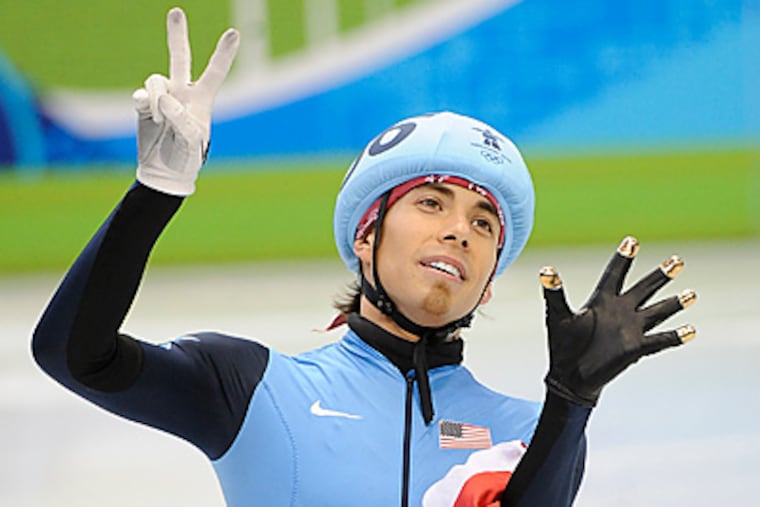
VANCOUVER - Apolo Anton Ohno thought his record-breaking seventh Olympic medal would be gold.
With a little more than two laps remaining in the 1,000-meter short-track final Saturday night, Ohno was cruising in second place, feeling strong and prepared to make his move.
"In my mind, I was going to win," Ohno said after passing Bonnie Blair for most career Winter Olympic medals by an American. "Then I almost fell. I don't know if I hit a block or a bad patch of ice or a rut, but I fell from second to fifth."
Ohno, 27, has a knack for finding his way onto the podium, whether it takes a crash or a foul or a burst of speed from his powerful legs. This time, in a very clean race, he sped past Canadians Charles and Francois Hamelin for the bronze.
Ohno now has two gold, two silver and three bronze medals. Blair, who raced on the traditional longer track, won five gold medals and a silver in three Olympic appearances.
"I never got into this sport thinking about breaking records," Ohno said. "It's a crazy sport. To win one medal in this sport is a major accomplishment for any athlete. So it means a lot to me, especially in a sport like this. I'm proud to represent my country."
Earlier, Reading's Allison Baver fell short in her quest for the first gold medal of her Olympic career, which dates back to Salt Lake City in 2002. Baver finished fifth in her semifinal heat.
Baver and Ohno, once a couple and now friends, went into the night facing rivalries - and all icy rivalries are not created equal.
When Evgeni Plushenko takes a shot at Evan Lysacek after a figure-skating competition, it is in the safety of a news conference. There is no chance for Lysacek to land a triple-toe loop on Plushenko's head.
In short-track speedskating, the rivalries, like the skates, have a much sharper edge. When people really dislike each other, someone is likely to wind up sliding butt-first into the wall.
Sarcasm is one thing. Broken bones and ruined dreams are much worse.
Ohno had to contend with a group of South Korean skaters who were both very good and very angry. Baver had to compete with Katherine Reutter, the teammate she believes instigated the crash that shattered her tibia in a race last year.
Ohno finished behind two skaters named Lee from Korea, where he is known as the "King of Fouls" for his many brushes with Korean skaters. Most recently, Ohno won a silver medal when two Koreans crashed in front of him in the 1,500 meters. The Koreans claim a shove from Ohno provoked the crash.
This time, the final was without controversy. There was a flurry of activity as the two Koreans made their move on the next-to-last lap. Ohno slipped briefly into fifth, then burst past the two Canadian racers for the bronze.
Lee Jung-Su won gold in an Olympic record 1 minute, 23.747 seconds.
Ohno had a relatively uneventful trip to the final. He did no more than necessary to finish second in his quarterfinal heat. In the semis, he zipped from third to first on the last straightaway and won the race.
Baver's medal dream, revived by a remarkable comeback from reconstructive surgery of her leg, was deferred once again when she was eliminated in the semifinals of the 1,500 meters.
"My legs didn't feel like myself," Baver said. "The Olympics is such an awesome event, and you have to feel good on that one day."
Zhou Yang of China won the gold medal, breezing to the finish line ahead of Lee Eun-Byul of South Korea, who earned the silver. Park Seung-Hi of South Korea won the bronze.
Baver, 29, seemed frustrated by the pace of her race, charged to the front midway through, then settled back in fourth or fifth position. By the final laps, she seemed to get caught in the pack, unable to make her move.
"I made a tactical mistake," Baver said. "About seven laps to go, China moved into the lead. Italy was right behind her and I was behind Canada. I wish I would have slapped myself in the face and reminded myself to take control of the race and be in front of certain girls. Usually, I skate more aggressively. Part of it was my confidence.
"I just wasn't sure of myself. I think that comes with my injury a little bit, not knowing my body."
Just to make the sting worse, Reutter advanced to the final despite crashing in the semifinals. The crash appeared to be caused by Reutter's foul - she took the skates out from under South Korean Cho Ha-Ri. But the judges disqualified China's Wang Meng, suggesting they blamed her for creating the crash.
Reutter, trying to become the first American woman to win a short-track medal since 1994, finished fourth.
Baver's Olympics are not over. She has two more chances to earn that elusive medal. The 3,000-meter relay is scheduled for Wednesday, the 1,000-meter final for Friday night.
"I still have two more days of competition," Baver said. "Hopefully, this will be the fire to step it up a notch in those races."
In her semifinal, Baver again found herself bouncing off the padded wall in the final turn. As a tightly bunched trio of skaters vied for one of the top two qualifying spots, German Aika Klein tried to cut inside Baver. Their skates clanged and both athletes spun off into the wall.
After a review, Klein was assessed a foul and Baver was advanced into the semifinals.
"I didn't get hurt at all, luckily," Baver said. "I was trying to hold my position and stay strong. I didn't feel as warmed up as I would have liked to be. Usually, I take the first race as a little bit relaxed, but maybe not at the Olympics."