Canada’s Virtue and Moir win ice dancing gold
VANCOUVER - The patient crowd sat through 20 pairs of ice dancers, politely applauding each, observing costumes both wild and mild, following all the four-minute performances eagerly if not too carefully.
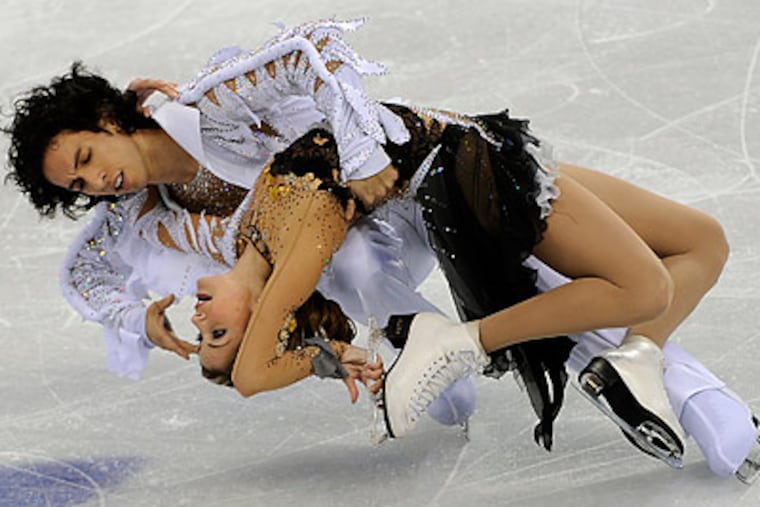
VANCOUVER - The patient crowd sat through 20 pairs of ice dancers, politely applauding each, observing costumes both wild and mild, following all the four-minute performances eagerly if not too carefully.
Until finally, their long wait was over.
And when Canadians Tessa Virtue and Scott Moir concluded their emotional free skate by embracing at center ice last night, the Pacific Coliseum was so noisy you might have thought Olympic officials had reversed the outcome of Sunday's USA-Canada hockey game.
Buoyed by the enthusiastic fans, who began chanting "Can-a-da! Can-a-da!" after their marks were posted, Virtue and Moir held their lead and captured Canada's fifth gold medal of these 2010 Winter Olympics, an ice dance outcome almost no one had anticipated.
Silver went to Americans, but, again, not the U.S. team experts had expected. It was Meryl Davis and Charlie White, not Tanith Belbin and Ben Agosto, who finished behind the winners.
Belbin and Agosto, who train in Delaware County, did not even gain a spot on the podium. They were fourth, beaten out for the bronze by Russia's Oksana Domnina and Maxim Shabalin, who, ironically, skate with them at the Ice Works rink in Aston, Delaware County.
"We're so incredibly happy with how we skated tonight," Belbin said. "We've said all along that this might be our last appearance, and if it is, we're so incredibly glad we skated like we did."
Virtue and Moir, in their simple black-and-white outfits, were more controlled skating to a mournful Mahler symphony than they'd been in the event's first two rounds. But they may have been even more impressive.
Their free-dance score of 110.42 and composite of 221.57 were more than they needed.
"This is such a joy," Virtue said. "We have so many people who helped us along the way."
"I'm exceptionally happy," Moir said. "To be able to do something you always dreamed of . . . I'm just really happy."
The top five pairs skated in the last group, adding to the tension among the contestants and the anticipation among a Canadian audience that was poised to erupt.
Belbin and Agosto, performing to "Ave Maria, Amen" in the next-to-last position, the unenviable position behind Virtue and Moir, were still in a spot to medal.
But the skaters were going to have to leapfrog at least one team to do so. They trailed third-place Domnina and Shabalin by nearly three points entering the night.
They opened with a synchronized twizzle, moved into a circular-step sequence and then a couple of lifts. Their performance ended with a pair of lift-and-transfers that they seemed to pull off perfectly.
Their score of 99.74 gave them a total of 203.07, not enough to medal. Though they wouldn't learn that officially for several more painful minutes, they seemed to sense it instantly, shrugging in "Oh-well" fashion upon seeing their marks.
The five-time national champions had switched Russian coaches more than a year ago. But either they slipped in the transition or others in the field laden with American-trained skaters surpassed them in the interim.
Davis and White, accompanied by music from Phantom of the Opera, began the night's final group. The Americans were energetic, their routine filled with flourishes and cohesion.
The judges awarded them a season-best 107.19 points for a three-day total of 215.74. They were in first place, but had to wait for the next four teams to skate before knowing their fate.
After the fifth-place Italian pair of Federica Faiella and Massimo Scali, who also train in Delaware County, came the Canadians, then Belbin and Agosto, and finally Domnina and Shabalin.
Domnina and Shabalin's elegant free-dance - to music from The Double Life of Veronique - earned them enough to stave off Belbin and Agosto.
Pacific Coliseum filled early and there was a palpable sense of anticipation in the crowded corridor and stands. Canadians had flocked here, no doubt hoping to see an unexpected gold medal after so many they had expected failed to materialize.
Either that or they were trying to stay cool in the unusually warm weather.
What they saw were 23 pairs of skaters, who forgo the leaps, axels and salchows of their figure-skating brethren in favor of style and musical synchronization.
That music, more important than in the sport's other disciplines, ranged from Metallica (Estonia's Irina Shtork and Taavi Rand) to Mahler (Virtue and Moir).
The costumes were more traditionally elegant than the outlandish folk-dance outfits in Saturday's original dance, one of which, meant to evoke Aboriginal life, sparked controversy instead.
The best advice for anyone trying to understand last night's results - or simply attempting to follow the insular world of ice dancing - is to get a program, a map, and a prescription for something that will stop your head from spinning.
There is much in common in the biographies of the top four teams and much that is different.
Let's summarize:
Russians have dominated ice dancing since its Olympic introduction in 1976, winning seven of the previous nine gold medals.
So, naturally, North Americans want Russian coaches.
Canada's Virtue and Moir and Americans White and Davis train under two Russians émigrés, Marina Zoueva and Igor Shpilband, in Michigan.
Michigan is also where Belbin and Agosto used to train and where Belbin, who was born in Canada, lived four years ago when she got her American citizenship but retained her Canadian status.
Belbin and Agosto eventually soured on Zoueva and Shpilband and after the 2007-08 season traded them in for two other Russian teachers, Natalia Linichuk and Gennadi Karponosov, also U.S. immigrants.
"I'm so happy for everybody," Belbin said. "These Russian coaches proved tonight how good they are."
Linichuk and Karponosov teach at the Ice Works in Aston, so Belbin and Agosto moved there.
Meanwhile, the top Russian ice dancers, Domnina and Shabalin, wanted to be coached by Linichuk and Karponosov, too. So they also moved to Delaware County, although they still skate for Russia.
Got that?
"We all know each other," Agosto said. "We all train with one another and travel with one another. But when we compete against each other, we all want to win."
All those connections meant little entering the final night of this competition, whose standings seemed turned on their head.
Domnina and Shabalin are the reigning world champions. Belbin and Agosto are the 2006 silver medalists. Yet they were third and fourth, respectively, entering the finale.
In fact, the crowd-pleasing, original-dance performances of Virtue and Moir and runners-up White and Davis suggested a new order for the sport and perhaps a new capital as well, in North America.
Observers noted that the two leaders' routines had been more lively and contemporary, their costumes nattier than their Delaware County-trained rivals.
"I could not be any happier," Shpilband said earlier, with his two teams standing first and second. "I think that both couples skated the best that they could. To do those performances at the Olympics, with all of the pressure, was fantastic. . . . It's just like having two kids. I'm cheering for both of them."