Jim Salisbury | The $50 Million Mistake
Pat Burrell hasn’t come close to living up to the big contract he once seemed to merit.
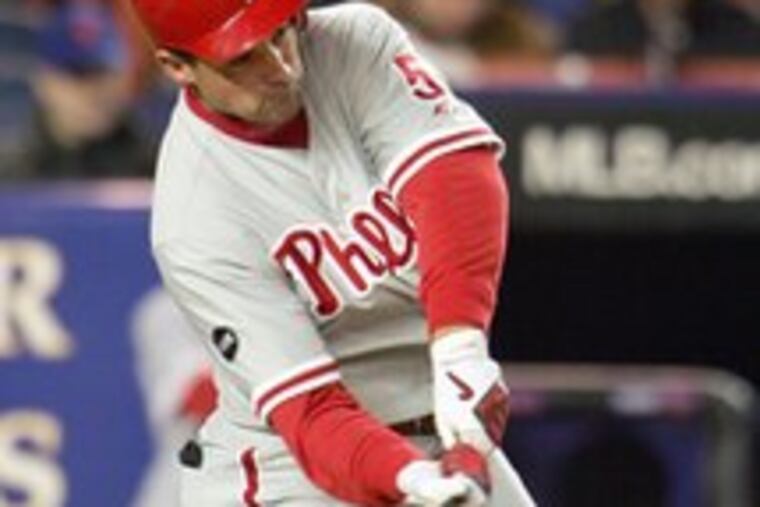
Major League Baseball will stage its annual All-Star Game on Tuesday night in San Francisco, not far from where Pat Burrell was raised and first impressed scouts with his thunderous bat.
What a tremendous homecoming that could have been for Burrell, if things had only gone the way everyone thought they would when he was the No. 1 pick in the 1998 draft.
Almost everyone who had seen Burrell mash balls at the University of Miami and as a young professional in the Phillies' system figured he'd have racked up a string of all-star appearances by now.
But Burrell has never made an all-star team, and that's stunning considering his pedigree, potential and paycheck.
The Phillies awarded him a major-league contract worth more than $8 million before he ever swung a bat as a pro. And before the 2003 season, when it looked as if he was ready to explode and become one of the game's premier run producers, the team locked him up with a six-year, $50 million contract, long before he could have become a free agent.
In MLB history, there have been 74 contracts valued at or above $50 million. Nineteen have gone to pitchers, 55 to position players. Burrell is one of four position players, joining J.D. Drew, Adrian Beltre and Eric Chavez, who have scored deals of $50 million or more and never made an all-star team.
At the time of the signing, Burrell's contract looked wise. He had hit a combined .270 with 64 homers and 205 RBIs in his first two full big-league seasons. The contract afforded the Phils cost certainty for a 26-year-old, sky's-the-limit talent in a sport where salaries were climbing fast.
That contract has proven to be a mistake, one of the biggest in franchise history. The wording in that sentence - proven to be a mistake - is important. At the time ink was put to paper, no one - not the Phillies, the media, nor the fans - had a problem with the deal.
"Given the information we had gathered watching him play and talking to our on-field personnel, we felt it was the right thing to do," said assistant general manager Ruben Amaro Jr., adding that he was totally on board with the decision. "Has it worked out the way we expected? Probably not."
That's as close as you'll get anyone in the Phillies organization to publicly say Burrell's contract was a mistake.
In action, however, the Phillies have been saying it was a mistake for some time. At 30, Burrell should be enjoying the best years of his career. However, there are times when he is relegated to part-time duty. In the second half of last season, as the Phillies played important games in a playoff chase, manager Charlie Manuel kept Burrell out of the starting lineup a staggering 17 times. More recently, Burrell has not started 10 of the team's last 17 games. Manuel says he believes in Burrell, but he has an odd way of showing it when he starts wintertime waiver claim Greg Dobbs over Burrell.
It's no secret that since joining the Phils in November 2005, general manager Pat Gillick has tried to trade Burrell, whose salaries of $13 million this season and $14 million next have become a financial albatross.
These salaries would be pleasantly digested had Burrell blossomed into a consistent offensive force and leader of a winning team. But he has not.
He had a dreadful year in 2003, when he hit .209 and drove in just 64 runs. A wrist injury hampered him in 2004, when he drove in 84 runs. Last season, Burrell hit .258 with 29 homers and 95 RBIs. His supporters point to his 462 at-bats (100 fewer than 2005) and say he would easily have had more than 30 homers and 100 RBIs if he had played more. But that's just the point: In the second half of 2006, Manuel was so fed up with Burrell's .222 performance with runners in scoring position that he couldn't play him consistently.
This year, Burrell is hitting .207 with 10 homers (as many as Shane Victorino) and 34 RBIs. He hit .129 in June and scored just four runs.
"I just haven't been consistent," Burrell admitted during the depth of his June slump.
In fairness to Burrell, he has had some strong seasons, such as 2002 (37 homers, 116 RBIs) and 2005, when he finished second in the NL with 117 RBIs.
But so much more was expected from Burrell.
"Early in his career, he was a top-line offensive run producer who we believed was only going to get better," Amaro said. "Our hope was he'd produce consistently at that level through the end of the contract. Unfortunately, he has not done that consistently."
Injuries (wrist and foot) have set Burrell back. So has an inability to pull the trigger on inside fastballs - scouts marvel that he seldom breaks bats, a sign of his reluctance to swing at those pitches - and lay off teasing pitches that spin off the plate.
"I'd say he's an underachiever," said one scout who has watched all of Burrell's career. "Everybody thought he was going to be a good player, and he was at one time. With the skills he had, you'd think he'd be able to make adjustments, but he hasn't."
Another longtime Burrell-watching scout said: "He needs a change of scenery."
Easier said than done. The Phils would love to deal Burrell this month, but what team wants a below-average defensive outfielder who is hitting .207 and appears to be well on the decline when he's still owed about $20 million? Also, Burrell has a no-trade clause. Even if that could be negotiated away and the Phils paid a chunk of Burrell's salary (which they would), dealing him would not be easy.
Failing to make an all-star team is not a perfect indicator of Burrell's falling short of expectations. But it is remarkable that he has never been to the midsummer classic, especially in recent years, when his peers have gotten a share of the vote.
In scanning the list of baseball's $50 million contracts, there are a number that make you scratch your head and question the return teams are getting or have gotten. Shawn Green comes to mind. The jury is out on Gary Matthews Jr. and David Wright. Andruw Jones is having a terrible year, but his body of work is in a different stratosphere from Burrell's. A number of pitchers have received questionable deals, but pitching is a different animal. Teams are so desperate for it that they'll throw $51 million at Denny Neagle.
Like Burrell, Beltre, Chavez and Drew have not made all-star teams, but if the slates were clear financially, all three would likely have more suitors than Burrell. Beltre has won a home-run crown. Chavez is a Gold Glove third baseman and postseason regular, and Drew, despite his inability to stay healthy and in a team's lineup, is a formidable talent.
Despite his flaws and his occasional part-time status, Burrell remains important to this Phillies team. In four games this month, he has already scored one more run and hit as many homers (two) as he did in June. Maybe he's on the verge of a hot streak.
"We still have a year and a half to fully assess this contract," Amaro said. "And I think we still have the hope that Pat will be a consistent run producer."
But at this stage of his career, it's reasonable to wonder whether Burrell will ever get there again.
The contract that was so easy to understand in February 2003 has proven to be a mistake.
EndText
Tonight's Game
Phillies (Kendrick, 3-0) at Rockies (Francis, 8-5), 9:05.
TV/Radio: CSN; WPHT-AM (1210).