Relievers rely on mix of luck and skill
Before the 2001 season, the Phillies signed veteran relief pitcher Rheal Cormier. The lefthander struggled in his first two seasons with the team. In fact, if his contract hadn't been for three years, he probably would not have been invited back in 2003.
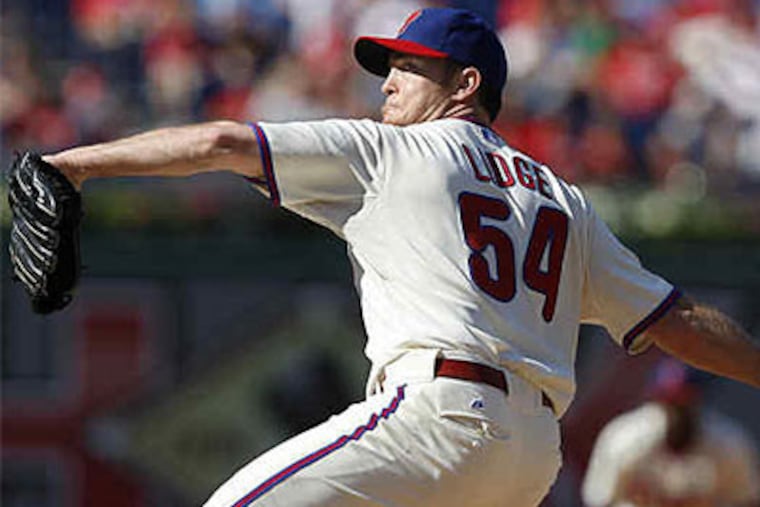
Before the 2001 season, the Phillies signed veteran relief pitcher Rheal Cormier.
The lefthander struggled in his first two seasons with the team. In fact, if his contract hadn't been for three years, he probably would not have been invited back in 2003.
It was a good thing - for the pitcher and the Phillies - that Cormier had another year on his deal after 2002.
Despite being booed during introductions at the home opener in 2003, Cormier had the best season of his career.
After registering a 4.77 ERA in 114 games and allowing more than 1.4 walks and hits per innings (WHIP) in his first two seasons in Philadelphia, Cormier became the Phils' most dependable reliever in 2003, going 8-0 with a 1.70 ERA and a .093 WHIP in 65 games.
Cormier's turnaround was not unusual. Relief pitchers, with the possible exception of Mariano Rivera, the New York Yankees' closer extraordinaire, are the most mercurial group of major-leaguers. By extension, bullpens are often unpredictable from season to season. One year, a reliever is up. (See Brad Lidge, 2008.) The next, he's down. (See Brad Lidge, 2009.) One year, a bullpen is up (See the Cleveland Indians' bullpen, 2005.) Then next, it's down (See the Cleveland Indians' bullpen, 2006.)
The bullpen was a big reason the Phillies won the World Series in 2008. Defining the word consistency, Lidge anchored the unit by going 41 for 41 in save opportunities during the regular season, and the Phils were 79-0 when leading after eight innings. Overall, they had the best bullpen ERA in the National League at 3.22.
This year, Lidge has been maddeningly inconsistent. His 10 blown saves going into Friday were the most in the majors. The rest of the bullpen - its ERA entering Friday was 3.94, ninth in the league - has struggled at times with injuries and at other times with ineffectiveness. (The situation got worse when Chan Ho Park, arguably the team's most consistent reliever this season, went down with a hamstring injury Wednesday night.) The Phils entered Friday with a record of 72-9 when leading after eight innings.
This is why, even with a solid starting rotation and a high-scoring lineup, the Phillies are a team on a tightrope as they prepare to open the playoffs in 21/2 weeks. Their bullpen is a major concern - manager Charlie Manuel confirmed as much when he allowed Pedro Martinez to work the eighth inning en route to 130 pitches last Sunday night - and everyone knows you can't outrun a bad, or even inconsistent, bullpen.
"Not nowadays," said Dennis Eckersley, whose 197 wins and 390 saves earned him enshrinement in the Hall of Fame. "No way. Bullpens are just too important. They can make or break you."
San Francisco Giants pitching coach Dave Righetti, who like Eckersley worked as a starter and closer during his career, concurred during a recent visit to Citizens Bank Park.
"Bullpens are huge," he said. "We're standing in a park where they proved that last year. Lidge had that great season and everything fell into place behind him. That's why they're wearing rings."
If bullpen pitching helped make the 2008 Phillies, it broke the 2008 New York Mets. They finished three games behind the Phillies in the NL East. Think they might have had a better chance of winning if their bullpen didn't blow 29 saves? The 2008 Mets were 78-7 when leading after eight innings.
The bullpen also hurt the Detroit Tigers in 2007. They made the World Series with the help of the fourth-best relief force in the majors in 2006. But bullpen stalwarts Joel Zumaya and Fernando Rodney struggled with injury and ineffectiveness in 2007. The Tigers' bullpen ERA rose from 3.55 to 4.40, 23d highest in the majors, and the team missed the playoffs.
The 2006 Indians are another example of how a team can't hide from a bad bullpen.
The 2005 Indians won 93 games and big things were expected in 2006. However, they won just 78 games that season. The culprit? The bullpen. In 2005, the Indians' bullpen was the only one in the majors to have a sub-3.00 ERA. The next season, with key setup man Bob Howry having moved on to the Cubs, the bullpen ERA swelled to 4.66, ranking 24th out of 30 clubs.
Why do bullpens succeed one year and struggle the next? Why do they make managers pump their fists in triumph one season then pull their hair in frustration the next?
How can Todd Jones have a combined ERA of 5.48 in 137 games in 2003 and 2004, get released by Tampa Bay during that span, then pitch so well for the 2005 Florida Marlins (2.10 ERA and 40 saves in 73 innings) that he goes on to pitch three more years with Detroit and make $17.5 million? How can J.C. Romero have a 6.70 ERA in 65 games in 2006 and a 1.92 ERA in 74 games the next season?
How can Lidge go from perfect to terribly imperfect in one season? How can Phillies fans go from feeling so good about basically the same group of guys that allowed just eight earned runs in 401/3 innings (1.78 ERA) in relief during the postseason last year to so uncertain this year?
Here's a closer look at why relievers in particular and bullpens in general are the most mercurial entities in baseball:
Bad days = losses
"We're human," Cormier said. "We're not robots. We have good days; we have bad days."
The good days can seemingly come out of nowhere. In his first full season as a reliever, Chad Durbin had a career year for the 2008 Phillies, recording a 2.87 ERA in 71 games. Few had ever heard of Cla Meredith before he went 5-1 with a 1.07 ERA in 45 games for the 2006 Padres, or Oakland reliever Brad Ziegler, who went from being released as a Phillies minor-leaguer in 2004 to setting a major-league record with 39 straight scoreless innings to start a career in 2008.
"Every year it seems like there's an established guy who doesn't pitch well," Ecksersley said. "Then there's this nobody who goes on a roll, someone that makes you say, 'Where the hell did this guy come from?' Who knows why? That's why you need an abundance of relievers when you go to camp. It's like, 'Who's hot this year?' "
Unfortunately for relievers, they are a little like umpires, gaining the most notice not for their successes but their failures.
The failures have a way of standing out like a pair of dirty dungarees in a tuxedo store. Mitch Williams had a bad day on Oct. 23, 1993. The image of him giving up the home run to Toronto's Joe Carter that ultimately lost the World Series is forever frozen in the minds of Phillies fans. Other Phillies failed in that series, but Williams is the one that's remembered.
"A starter can pitch himself in and out of trouble," said former Phillies closer Billy Wagner. "The margin for error for a reliever is smaller because the game is on the line. When you struggle, your team loses a game."
Eckersley said: "If a starter gives up a gapper in the third inning, the game ain't over. It's not life or death. With a reliever, especially late in the game, this is it: win or lose the game."
This slim margin for error is the reason, Williams said, that relievers must throw first-pitch strikes. He believes that has been one of Lidge's problems this season, though the pitcher has thrown a first-pitch strike 58.2 percent of the time, as opposed to 55.5 percent of the time last year, according to STATS, Inc.
"You throw strike one and you immediately put the hitter on the defensive," Williams said. "If you don't, the advantage goes to the hitter."
Something lacking
Few pitchers grow up dreaming of being relievers. Pitchers usually end up in the bullpen because they are, in baseball parlance, "short" in an area. Maybe it's depth of pitches. Maybe it's control. It stands to reason that a pitcher who doesn't have all the tools needed to be a starter would be susceptible to stretches of inconsistency.
"Most of the time, relievers are throwers and starters are pitchers," said Jim Kaat, who went 283-237 in 25 big-league seasons. "A reliever might have one great pitch or a specialty pitch. If that pitch is not there on a given night, you'll have an off-night."
"I always thought relievers were guys that never quite learned to pitch," Eckersley said. "Let's face it, the majority of relievers are one-inning pitchers. They don't have three pitches, and if they do, they seldom use all three. How can you learn to pitch if you're going one inning all the time? Years ago, you didn't go straight to the 'pen. Everyone began as a starter. Now, you're a reliever from the get-go. Unless you're going six or seven innings, how are you going to learn to pitch? You've got to get out of jams to learn to pitch. That way, when you lose whatever you have, you have other ways to get outs."
Relievers might not have the depth of pitches that starters do, but they can add pitches and that can help them rebound from a poor season. Cormier said one of the keys to his turnaround in 2003 was the addition of a cutter. Of course, hitters, at least the good ones, are constantly adjusting, too. That's what makes the pitcher-hitter confrontation so fascinating.
Usage
This is one of the biggest factors that can determine the success rate of a bullpen. A manager walks a fine line in getting a reliever the work he needs to build momentum and overusing him. And it's not only game-use that can exhaust a reliever's supply of bullets. Being asked to warm up several times before coming into a game can eventually take a toll on a reliever's effectiveness.
A reliever who carries a heavy load one year sometimes struggles with ineffectiveness or worse, injury, the year after. Romero pitched in 155 games in 2007 (he spent part of that season with Boston) and 2008. This year, he has battled forearm soreness. Durbin, who pitched in a career-high 71 games for the Phils last year, has experienced a drop-off this season.
"In '05, I was coming off back-to-back 80-something-inning seasons and I struggled," Cormier said. "I felt fit. I worked hard on conditioning. I just think it caught up with me. I wasn't tired. My ball was just up in the zone. I had a tendency to make mistakes. Workload can catch up to you over time. That's why a manager has to know each guy. But it's a hard job for a manager. They will ride guys that are hot because their jobs are always on the line."
Chemistry
A good bullpen fits together like a jigsaw puzzle. A bad bullpen always seems to have a piece missing because of injury, ineffectiveness or the inability of team architects to find the right talent.
Late last season and into the postseason, the Phillies' jigsaw puzzle came together snugly with the emergence of eighth-inning man Ryan Madson. Romero-to-Madson-to-Lidge became a recipe for success. This year, the mix was thrown off as Romero served a 50-game suspension to open the season, then came down with a sore forearm. Lidge's early-season knee injury, then his ineffectiveness, further upset the balance of the bullpen as Madson had to occasionally move out of his eighth-inning spot.
"Sometimes the continuity of a bullpen is broken up, and that can lead to the whole unit struggling," Righetti said. "The bridge guy after the starter might not be the same, and that can throw things off."
Eckersley was part of one of the best bullpens ever with the 1990 Oakland A's. He allowed just five earned runs in 731/3 innings en route to 48 saves. Righthanded setup man Gene Nelson had a 1.57 ERA in 742/3 innings. Lefthanded setup man Rick Honeycutt had a 2.70 ERA in 631/3 innings.
"Bullpens definitely feed off each other," Eckersley said. "If one guy messes up, it throws a wrench into it and it becomes a domino effect. If Honeycutt doesn't get a lefty out, I have to do it with someone on base. That changes everything. If there's one kink, if one guy screws up, it changes everything. You don't have that in the starting rotation."
When everything clicks, like it did down the stretch for the Phillies last year, wins follow.
When things kink, problems arise.
"Success is contagious in a bullpen," Wagner said. "So is struggling. Once one guy struggles, the next guy feels like he needs to do more. That's when you get in trouble. It's a vicious cycle."
Confidence
Every pitcher in a bullpen is a major-leaguer. Every one of them earned his way there. Every one of them has talent. Sometimes the difference in showing that talent is an attitude, a belief that "yes, I'm good, and I will get the job done."
"Confidence is huge," Williams said. "It all starts the minute you walk through the gate. If you have a look like 'I hope to get them out,' you'll get nobody out. You want everyone on the other bench to think, 'Oh, God.' This is a game of perception. I wasn't the greatest reliever, but when I walked through that fence I didn't think there was a man alive who could beat me. You better believe you can do the job or no one else will believe it."
Eckersley concurred. A reliever who loses confidence will get ruined.
"Confidence is everything in this game," he said. "The other team gains an edge in confidence if they sense a reliever is vulnerable. It's a double advantage for them. Half the battle in relieving is putting that 'Oh, God, here he comes,' feeling in the other dugout. You lose that, you're dead."
Poor arm health can lead to a reliever losing confidence. Improved health can restore the confidence. Jones said that his big season with the Marlins in 2005 was a matter of health. His elbow had been tender the previous two seasons.
"I wasn't disabled-list hurt," he said. "It just never felt right."
Healthy in 2005, he was able to extend on his pitches and throw his cut fastball, which led to success and opponents thinking, "Oh, God, here he comes." The only way to get that aura is to pitch well. Do it as a group and good things will happen.
"A confident bullpen is a dangerous bullpen," Wagner said.
But confidence is not easily acquired. It can only happen when health and performance come together.
"Confidence is a big thing, but first you have to have the stuff that will enable you to get the job done," Righetti said. "You've got to have the equipment before you have the confidence. These guys are all good athletes, and when they're going good and they get confidence, there's no telling where it will take them. You can't measure it, but you can see it in the way they carry themselves."
Luck
Hall of Famer Lefty Gomez was used in relief in just 48 of his 368 games, but he seemed to be speaking for all relievers when he said, "I'd rather be lucky than good."
Ask any reliever, and he'll tell you he can throw a pitch one year and get lots of outs with it. He can throw the same pitch with the same sharpness the next year and get hammered.
Lidge gave up plenty of hard-hit balls last year. Look at the ground ball that Jimmy Rollins turned into the final double play in the NL East clincher last year. One year, Rollins makes a great play. The next year, the ball might be six inches from his reach. Same pitch. Same hard-hit ball. Different results. How about Lidge's World Series clinching save? With two outs and the potential tying run on second, Tampa Bay's Ben Zobrist scorched a liner at rightfielder Jayson Werth in that inning. What happens if that ball is not hit right at Werth?
"Hell, yeah, there's luck involved in relief pitching," Eckersley said. "I had a lot of balls that were caught in the gap. I look back and there were years I was good. But in the magical years, I was good and lucky.
"I'm not saying every reliever having a tough time is unlucky, but it can be part of it. Once that ball is put in play you never know.
"We had a guy in Boston. Bob Stanley. Great pitcher. He'd come out of the 'pen and go four innings. He'd pitch 150 innings a year, and he made it all happen with his sinker. One night he'd get three ground-ball outs, the next night those same three balls would find the hole on turf. Same guy, same pitches, different result."
That's the life of a relief pitcher. At least many of them.
Up one day, down the next.
And in Philadelphia . . . a source of confidence one year, and concern the next.
Bullpens: A Mercurial Lot
The Phillies led the National League with a bullpen ERA of 3.22 in 2008. Entering Friday, they were ranked ninth in the league with a bullpen ERA of 3.94. This dip is not unusual.
Sean Forman, who runs Baseball-Reference.com, examined NL pitching staffs from 1988 to 2007. In those 20 years, the team leading in bullpen ERA has, on average, finished sixth the following year. In those 20 years, the team leading in starter ERA has, on average, finished third the following year.
During that span, the Atlanta Braves led in starters' ERA 11 straight seasons. Among bullpens, only the 1988-89 Dodgers and 2004-05 Cardinals repeated as bullpen ERA leaders.
Lidge's ups and downs
Brad Lidge has become a classic example of how a reliever can be up one year and down the next.
2008 2009
Games 72 61
Record 2-0 0-7
ERA 1.95 7.21
Saves/Opp 41-41 30-40
WHIP 1.226 1.807
Opponents BA .197 .300
Opponents OBP .297 .398
WHIP – Walks and hits per inning. Statistics entering Friday.EndText