Moving experience for former Phillies' prospect Taylor, now with Oakland
PHOENIX - The Phillies wanted Michael Taylor to play winter ball in Obregon, Mexico. He had never seen anything quite like it.
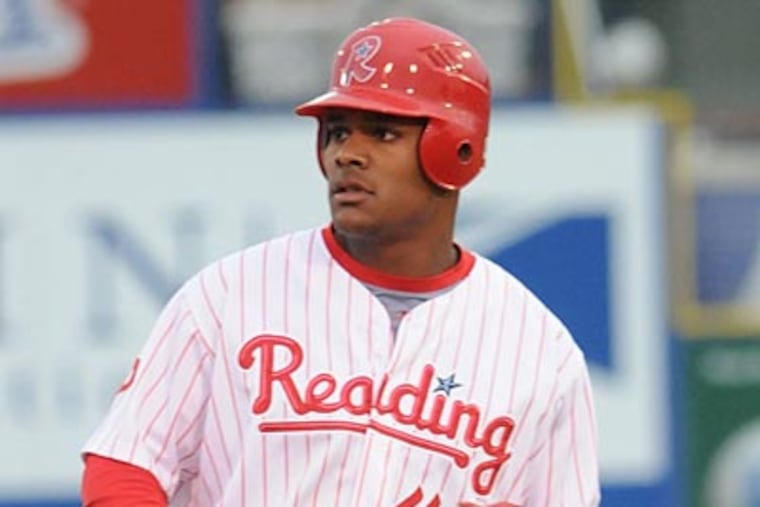
PHOENIX - The Phillies wanted Michael Taylor to play winter ball in Obregon, Mexico. He had never seen anything quite like it.
"Animals on the field. Like chickens and stuff like that. People having barbecues in the stands. Just piling up firewood. The passion. They had bands, a lot of live music," he said yesterday at Phoenix Municipal Stadium.
"It was just a different environment. Baseball fans usually cheer when something happens on the field. These guys were cheering, singing, dancing the entire game. And the mascots are crazy. The mascots would be on the field, too. Dancing and doing shows. It's kind of different to be in rightfield and have a mascot 60 feet from you doing a dance with another mascot. During play. They're involved. It's a show."
He had no way of knowing that the craziness was only starting.
His .320 batting average led all Phillies minor leaguers for the second straight year. He was second in the organization in homers (20) and third in RBI (84). He was named the Double A Eastern League's Rookie of the Year even though he was promoted from Reading after 86 games.
And then the Phillies traded him, including him in the package they sent to the Toronto Blue Jays for Roy Halladay on Dec. 16. But it's one thing to be traded for one of the best pitchers in baseball.
It's another matter entirely to be traded twice. In the same day. But that's what happened to Taylor, who was quickly flipped to Oakland for infield prospect Brett Wallace.
Before the A's worked out yesterday, manager Bob Geren sounded like a guy who had won the lottery. Asked what his reports on Taylor were at the time of the deal, he didn't hesitate.
"That he had the potential to be a real five-tool type guy, which we haven't seen in years," he said. "So when you have a guy with speed and power and plays good defense, it's very rare that anybody has one in the major leagues. So that in itself is exciting. We also knew he's a Stanford guy, so we knew he was highly intelligent, too. Athletic skills and intelligence is a good combo."
Taylor had just returned to his Orlando-area home after playing in Mexico and was still settling in when he began hearing rumors on ESPN
"I had no idea I'd be shipped over here to Oakland," he said. "I was semi-aware that there was the possibility a trade might happen during the offseason. Obviously, I knew Philadelphia might still be interested in adding another arm or switching around their roster. So I knew if they pulled something off I might be a part of it.
"I was obviously very interested and tried to gather as much information as I could. It's difficult because the teams are hush-hush, so you really don't know what's fodder and what's real."
Then he got a call from Phillies assistant general manager Chuck LaMar, telling him he'd been traded to Toronto and alerting him that something else might be going on. Thirty minutes after that, Blue Jays general manager Alex Anthopoulos called to confirm that he was going to Oakland. An hour after that his phone rang again. This time it was A's general manager Billy Beane, welcoming him to the team.
"It was an interesting morning," he said with a laugh.
Taylor had become a high-profile prospect with the Phillies. He was a player many fans were looking forward to seeing in red pinstripes.
"I tend to think the Phillies fans are very savvy. They were good to me. It was fantastic," he said. "Part of it was I tried to espouse that I work very hard and I think that's something they value out of anyone. That's one of the great things about that town. Yes, you need to perform. That's just the nature of the game. But they really do appreciate someone who kind of gives it everything they have.
"A lot of times, as a fan, you see players sort of lost in the business side of it. And it can be difficult as a player because you grow up playing this game as a kid and as you get older it becomes a business. But I tried not to show that to fans, especially kids. I love signing for kids and kind of being available to fans and I think we kind of had a rapport and it grew from there. Doing well helped. They want to win, so if they think you're going to help them win, they're going to support you. So I think the combination of all those different things made it a unique and special situation for a couple years for me."
He's a nonroster invitee to big-league camp, but that doesn't mean much. A year ago, so was Andrew Bailey. He ended up becoming the team's closer and winning the American League Rookie of the Year award.
"The way it works, especially as a minor league player, is you come out and you perform and they'll let you know where you stand," he said. "So I think I'm at least in the picture to compete for a big-league job at some point this year. If it's out of camp, I don't know. I doubt it. But if all the stars align and that happens, that would be fantastic. If not I'll go to Triple A [Sacramento] and try to get better and be ready whenever that opportunity may come."
And he doesn't hold it against fellow Stanford alum Ruben Amaro Jr., the Phillies general manager, for trading him. Asked if Amaro had broken some sort of Cardinal code, he laughed.
"No, he actually upheld the Stanford code, which is to make the best business deal possible," Taylor said.