Change in draft philosophy led to Phillies' success
CLEARWATER, Fla. - Marti Wolever doesn't think much has changed about the Phillies' drafting philosophy during his 18 years in the organization.
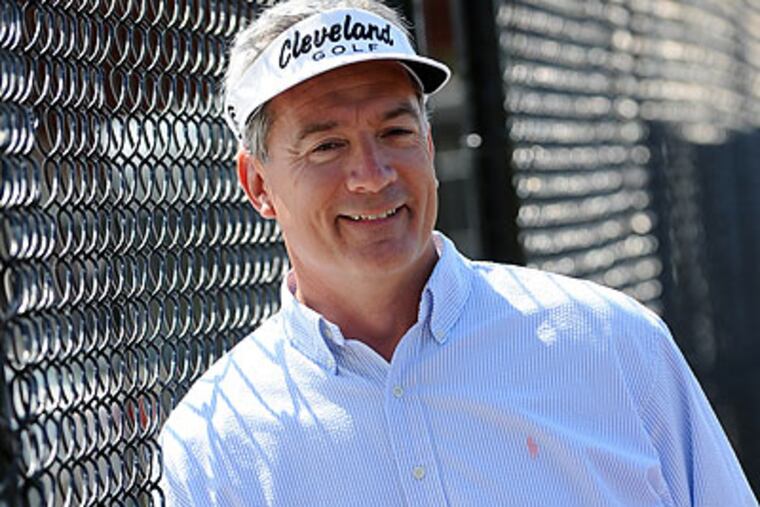
CLEARWATER, Fla. - Marti Wolever doesn't think much has changed about the Phillies' drafting philosophy during his 18 years in the organization.
"I think we're still looking for the same stuff," the scouting director said earlier during spring training from his office inside the recently renovated Carpenter Complex. "We're looking for athletes with good aptitude."
What's changed, he said, is how the Phils go about conducting their draft.
"About eight years ago, we decided when we evaluated players that instead of having two boards with high school and college pitchers together and high school and college position players together, we decided we'd have four boards," Wolever said.
So now the Phillies have separate boards for high school pitchers, college pitchers, high school position players, and college position players.
"By doing that, it has given me more options when we sit there on draft day," Wolever said. "I can look at the board and say, 'The ceiling of this high school kid looks like it has a chance to be more than this college guy that we're picking in a comparable round.' "
A player with a higher ceiling is a kid who may be inexperienced but has a great deal of potential, as opposed to an older player who may be more polished but also may already be as good as he'll ever get.
In recent years, the Phillies have been exceptionally successful at picking high-ceiling high school pitchers in the first round. In addition to Brett Myers in 1999 and Cole Hamels in 2002, they used first-round picks on Gavin Floyd in 2001 and Kyle Drabek in 2006.
Floyd, after a shaky start as a pro, has emerged as a solid big-league starter for the Chicago White Sox and Drabek was a good enough prospect to become the centerpiece in the trade package that the Phillies sent to Toronto to get staff ace Roy Halladay.
Wolever said that because the Phillies have had such low draft position recently, they have been more inclined to go with a high-ceiling high school kid than a polished college player who may be peaking. Another benefit of selecting high school kids is that they are developed in the Phillies' minor-league system rather than by college coaching staffs.
"No doubt," Wolever said. "My belief is . . . our development group is outstanding. Gorman Heimueller has been here a long time and he is one of the best at developing pitchers."
Heimueller is the Phillies' minor-league pitching coordinator.
"I feel like it's good if we can get them here and monitor their innings and don't let them get into habits we have to break if they go to a college program," Wolever said. "We won't have abused arms, because we really monitor what they do. I feel the same way about the way we teach hitting."
Wolever said he has seen college players regress after high school because of the way they are taught.
The Phillies scouting director cited outfield prospect Michael Taylor - who was sent to Toronto as part of the Halladay trade and immediately shipped from the Blue Jays to Oakland - as an example of a career damaged by college baseball. Taylor played on the same Florida high school team as Kansas City star pitcher Zach Greinke and Wolever became familiar with Taylor while scouting Greinke.
"He was a big kid, loose and easy with a great swing who had a chance to be a big power guy," Wolever said of Taylor. "When he went to [Stanford], part of that game was taken away from him. He went to Stanford and he regressed - he got slower, he got stiffer. We all felt like his swing went backward and regressed. It wasn't a fit for him."
The Phillies still took Taylor in the fifth round because Wolever recalled what he looked like in high school.
Wolever said the Phillies have also put greater emphasis of makeup and character in the last few years.
"I think without good makeup and character a guy doesn't really have a chance to achieve what he should be," Wolever said. "We really spend a lot of time on that. I think we're only as good as our area supervisors and I trust them completely. A lot of us have been together a long time and we spend a lot of time in [the players'] homes. We visit the kids and go and ask a lot of questions."
The Phillies, like all teams, administer psychological tests to players they may draft. The tests are conducted by Rick Joneson, a psychiatrist from Carroll, Iowa.
"It takes about 30 minutes and it gives a pretty accurate read on things such as how they will handle failure and those types of things," Wolever said. "We started using his testing about four years ago."
Considering the Phillies have won a World Series, back-to-back National League pennants and three straight N.L. East titles, the team obviously found a way to get better at obtaining the things they were looking for from drafted players.
If you look at the 13 years before Wolever and former Phillies assistant general manager Mike Arbuckle arrived in Philadelphia, the list of draft picks is mostly laughable. The Phillies had four players who became all-stars (Darren Daulton, Mickey Morandini, Mike Lieberthal, and Tyler Green) and zero became superstars.
And when you scan the list of first-round picks from that era - John Russell, Ricky Jordan, Pete Smith, Trey McCall, Brad Brink, Pat Combs, Jeff Jackson, and Chad McConnell are in the group - and it's easy to see why the Phillies fell off the map as a viable entertainment option in Philadelphia.
"When Mike and I got here, I thought we had a lot of nice polished college players that really had no ceiling - and we didn't have any international program," Wolever said. "I'm always a big believer in expanding the pool, whether it's internationally or whatever."
The Phillies' international program, directed by supervisor Sal Agostinelli, has since been built from nothing to a strong force that is responsible for the contributions of catcher Carlos Ruiz, who was signed out of Panama for the paltry sum of $8,000 in 1998.
It's the draft, however, where the Phillies have found superstars and lively young pitching arms that have helped them average 91 wins the last three seasons.
"Starting with the 1993 draft, we wanted to achieve a balance of picks," Arbuckle said by phone from Arizona, where he now works for the Kansas City Royals. "We wanted some high-ceiling high school guys mixed in with some safer college guys."
Since then, the Phillies have watched two college position players, Chase Utley and Ryan Howard, and one high school shortstop, Jimmy Rollins, develop into superstars. At the same time, high-ceiling high school pitchers such as Myers and Hamels became part of a starting rotation that was good enough to win the World Series two years ago.