Bill Conlin: Captain Outrageous outdid The Boss
IT WAS VINTAGE Ted Turner. In February of 1999, the Atlanta Braves owner and founder of the CNN cable network, addressed the National Family Planning and Reproductive Health Association in Washington. In one withering salvo, major league baseball's loosest cannon trashed the Ten Commandments and mocked John Paul II, the Vatican's first Polish pope.
IT WAS VINTAGE Ted Turner. In February of 1999, the Atlanta Braves owner and founder of the CNN cable network, addressed the National Family Planning and Reproductive Health Association in Washington. In one withering salvo, major league baseball's loosest cannon trashed the Ten Commandments and mocked John Paul II, the Vatican's first Polish pope.
"They're a little out of date," Ted said of the Commandments. "If you're only going to have 10 rules, I don't know if prohibiting adultery should be one of them . . . " He was asked to comment on the Polish pope and responded by lifting a leg and showing his foot. "Ever seen a Polish mine detector? . . . He [John Paul II] should get with it. Welcome to the 20th century . . . "
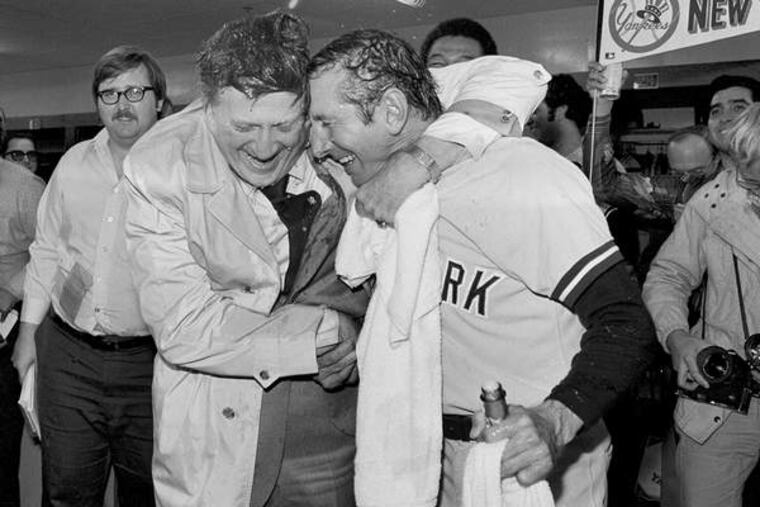
When George Steinbrenner joined Billy Martin for the sixth and final time Tuesday morning at age 80, after an exceptional life of turmoil, triumph and the kind of rule over his New York Yankees once accorded only to monarchs and totalitarian dictators, he was praised as the most influential professional sports owner in history.
Shorthand for that statement is, "George Steinbrenner's stage was New York."
Sure, King George bought seven World Series titles for a franchise that was little more than a low-rated CBS sitcom when he acquired it from the network in 1973 for $8.7 million. Nine current Yankees earn salaries that pay them more than majority partner Steinbrenner and his fellow investors paid for the ballclub.
The Boss is duly credited for the explosion in MLB salaries after the advent of free agency in 1976 forced clubs wishing to be competitive to ante up or fold their hands. Harry Truman had a sign on his desk that read, "The Buck Stops Here." Steinbrenner's sign read, "Lead, Follow or Get Out of the Way." Where the Buck stopped for George went without signage.
Ted Turner knew all about signs. He inherited Turner Outdoor Advertising from his dad at age 24 and purchased a struggling Atlanta TV station that eventually would become Turner Broadcasting System. His Channel 17 programming consisted of old movies and obcure sitcom reruns on this newfangled thing viewers had to pay for called cable TV. The industry thought he was nuts.
In 1976, the first year of free agency, Ted bought the wretched Atlanta Braves for $10 million. Suddenly, the method to his madness became evident. The Braves gave him the staple needed by every TV network: strong prime-time programming. For the offseason, he had purchased the NBA Hawks.
Steinbrenner added immeasurably to his ability to fund a Yankees payroll that has swollen to the current $213 million by purchasing what is now the YES Network. Ted Turner had pioneered that concept a generation earlier. TBS had established the Braves as the MLB version of America's Team.
I was one of two witnesses to an incident during the 1976 World Series that led to Turner's 1-year suspension by commissioner Bowie Kuhn (who had earlier banished Steinbrenner for illegal campaign contributions to Richard Nixon).
San Francisco Chronicle columnist Wells Twombly and I were chatting with Giants owner Bob Lurie at a World Series cocktail reception in a Manhattan hotel ballroom. A visibly inebriated Ted Turner lurched into the room with a supermodel type in tow. (Ted was married to Jane Shirley Smith at the time, a union that ended in 1988.) He made a beeline for Lurie and loudly detailed his intention to sign free agent-to-be Gary Matthews, who was still a Giants outfielder. "Bob, I'm going to pay him more money than you pay your entire outfield . . . I'm gonna bring him to Atlanta and have a parade for him downtown. On the way in from the airport, he'll be welcomed on every billboard on the route . . . " Lurie was outraged. "Ted, you're tampering with my player."
I looked at Twombly. He looked at me. We both dashed to the press room downstairs and filed stories to our newspapers. While Turner was clearly guilty of tampering, he was also guilty of public intoxication. I thought he was just trying to bait the mild-mannered Giants owner, whose team was in deep financial trouble after drawing an NL-worst 626,628 fans to wind-raked Candlestick Park, where cold went for its summer vacation.
Both Twombly, a brilliant columnist who died a year later at age 41, and I were asked to give our versions of the incident by MLB security. We declined. I said Turner was too drunk to remember anything he said.
Kuhn suspended him for a year just the same. Banned from Atlanta-Fulton County Stadium - the Braves had signed Matthews on Nov. 17 to a 5-year, $1.2 million contract - Ted did the only gentlemanly thing. One of the great competition sailors in history, Turner captained underdog Courageous to an America's Cup victory. While his last-place Braves reeled toward 101 losses, "Captain Outrageous" swam nude in Newport Harbor during a wild celebration. His suspension was lifted after 6 months.
In 1995, the Braves finally presented him with a World Series trophy to go with his trophy wife, Jane Fonda. By then, he had assembled a front office management team that enabled manager Bobby Cox to establish record supremacy over the National League. While Steinbrenner's Yankees made it to the postseason most years, the Atlanta Braves made it 11 in a row and 14 out of 15.
Ted Turner turned his attention to the expansion of his global CNN endeavor and backing the financially disastrous Goodwill Games, which helped ease Cold War tensions. While Steinbrenner is fondly remembered for his philanthropies and personal charitable support of many individuals and causes, Turner has donated $1 billion to the United Nations.
Out of baseball since AOL took over Time Warner in 2001, Ted Turner remains America's largest land owner, with 50,000 buffalo roaming his vast Montana acreage. Oh, yes, he predicted the eventual demise of newspapers 30 years ago.
Sorry, Boss, but for once, you were No. 2.