Reds wary of hostile Phillies fans
CINCINNATI - Cincinnati Reds outfielder Jonny Gomes, who was a member of the Tampa Bay Rays when they faced the Phillies in the 2008 World Series, learned one thing about baseball fans in the City of Brotherly Love.
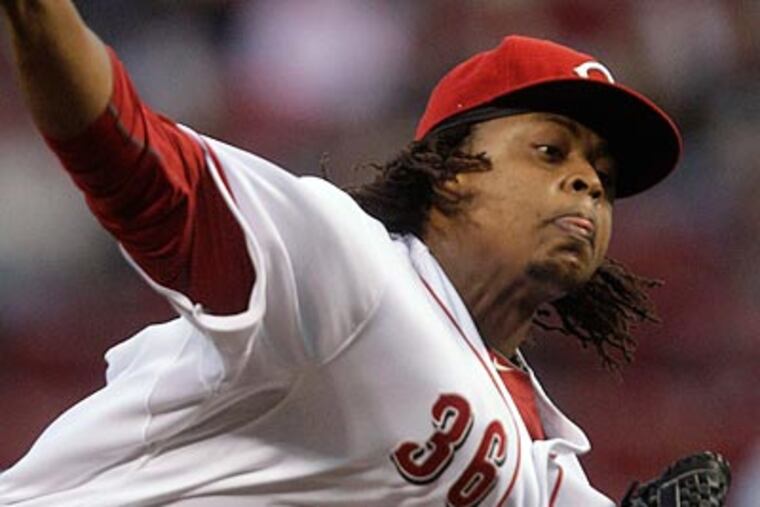
CINCINNATI - Cincinnati Reds outfielder Jonny Gomes, who was a member of the Tampa Bay Rays when they faced the Phillies in the 2008 World Series, learned one thing about baseball fans in the City of Brotherly Love.
"They love the Phillies and they hate you," Gomes said. "It's definitely a hostile environment. You find that out early on."
Now the Reds will enter that environment when the National League division series begins Wednesday at Citizens Bank Park.
With home-field advantage assured for the Phillies, the Reds are anticipating a raucous environment at the Bank. Gomes said it's important to keep the crowd at bay.
"The most important thing is to apply pressure," he said. "When you have the hostile environment and a loud crowd on both sides, you have to apply pressure. If you do, you'll see mistakes being made."
Veteran righthander Bronson Arroyo said Citizens Bank Park and Great American Ball Park provide similar challenges for pitchers.
"Pitching there or here, they're both small places," Arroyo said. "Your back's against the wall no matter what."
Arroyo, who appeared in two division series with the Boston Red Sox, likened the Philadelphia crowds to the ones in New York and Boston.
"They're aggressive and loud," he said. "For years, Philly football fans have been among the worst in the game, as far as how brutal and vicious they are. I haven't experienced that at Citizens Bank Park. But that was the regular season."
The Reds faced the Phillies seven times in the regular season, losing five. The games were closely contested, including four that went extra innings.
In the final series for both teams before the all-star break, the Phillies escaped with a sweep, outscoring the Reds by a combined five runs, including consecutive 1-0 shutouts. The Reds took two of three from Philadelphia in late June at Great American Ball Park.
Cincinnati could use this as a basis for confidence heading into the NL division series, but Gomes was reluctant to place much importance on regular-season contests.
"I mean, if you want to talk about past games, sure," Gomes said. "But once you hit game 162, none of that matters. We're both different teams."
The Reds are making their first postseason appearance since 1995 when, under manager Davey Johnson, they swept the Los Angeles Dodgers in the division series before being swept by Atlanta in the NL Championship Series.
Arroyo, who is among the Reds' most experienced playoff veterans with 10 postseason starts in his career, said the Phillies are a much different team than the club they faced this summer.
"They're just now starting to pick up the pace and be the team they were last year," Arroyo said. "They're head and shoulders better than the team we faced earlier in the year. It doesn't mean we can't win. It's just not as pitchable a lineup as before."
Reds manager Dusty Baker concurred that the Phillies are fully healthy and playing at different level now that they've rallied from seven games back to win the NL East.
"They're a different team now," Baker said. "They didn't have [Chase] Utley, they didn't have [Placido] Polanco. They weren't scoring runs at the time. Plus . . . it's a different atmosphere [in the postseason]. It's a different noise level, different intensity."
Since the last time they played Cincinnati, the Phillies have acquired consummate Reds killer Roy Oswalt. The Phils' Game 2 starter is 23-3 with a 2.81 ERA in 32 career starts against Cincinnati.
The Reds, however, beat Oswalt this season while he was still with the Houston Astros, and they roughed up Halladay, who allowed a career-high 13 hits in a 4-3 loss on June 30.
But the Reds remain leery of the Phillies' 1-2 punch at the top of the rotation.
"Not many people fare well against them," Gomes said. "[Roy] Halladay is more of a 'stuff' guy. He's got a lot of stuff to get you out. It's not velocity or one big breaking pitch that gets you out."