Bill Conlin: Sandberg back where he belongs with Phillies
NEARLY 29 YEARS after one of the biggest heists in major league baseball history, Ryne Sandberg has returned to the scene of the crime.
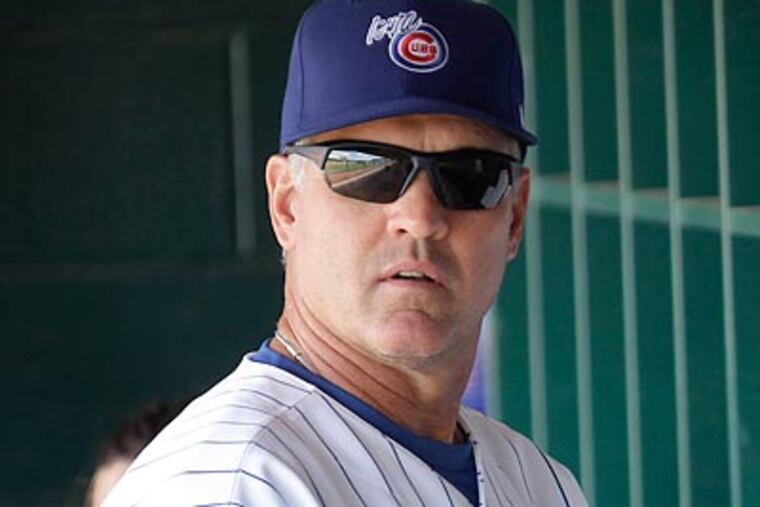
NEARLY 29 YEARS after one of the biggest heists in major league baseball history, Ryne Sandberg has returned to the scene of the crime.
Or at least to the Phillies' payroll . . .
The first-ballot Hall of Famer, who had both 40 home-run and 50 stolen-base seasons, a 10-time National League All-Star with nine Gold Gloves and seven Silver Slugger awards, will manage the Triple A Lehigh Valley IronPigs next season.
That would seem to move the 2010 Pacific Coast League manager of the year into the on-deck circle as Charlie Manuel's eventual replacement.
The man considered by many baseball men to be the greatest second baseman of the modern era appeared to be the logical successor to resigned Cubs manager Lou Piniella. New owner Tom Ricketts - rhymes with tickets - permitted general manager Jim Hendry to give the job to interim skipper Mike Quade. Quade does not rhyme with "cheaper," but you get the idea.
The Phillies are the winners here, big time. The Sandberg hire came a day after Ricketts outraged the population of Illinois by asking for $300 million in state funds to rehab Wrigley Field. Or else, what?
Well, Ricketts has hinted that a bolt to the suburbs could be an option. Schaumburg Cubs? Quade, by the way, never played higher than Double A, which puts him in perfect position to emulate the managing careers of Walter Alston, Earl Weaver and Jim Leyland, to name a few men with more World Series rings than big-league at-bats.
Paul Owens was the Phillies' GM during the turbulence that followed the 1981 sale of the ballclub by the Carpenter family to the Bill Giles group. Manager Dallas Green dropped a bomb the day the Phillies were eliminated by the Expos in a division series created by a 50-day players strike. Green announced he had accepted a job as Cubs' GM.
He had asked Giles for a promotion from field manager to GM, with Owens holding the title of president and Giles atop the masthead as owner and CEO. Giles turned Green down. Bill soon assumed most of the GM responsibilities while chairing a front-office committee I christened the "Gang of Six."
Meanwhile, Giles faced his first offseason at the helm. It didn't take long for a crisis to emerge. Veteran shortstop Larry Bowa became embroiled in a rancorous contract dispute with Giles. Bowa charged publicly that the new owner had reneged on a handshake extension agreement. Giles said he had not agreed to anything. Bowa called his new boss, "a bleeping liar." Giles instructed Owens to trade him.
Minister of Trade Hugh Alexander had remained loyal to the Phillies, but he and Dallas had long had what amounted to a father-son relationship. The old comrades quickly agreed to a swap of Bowa for Cubs shortstop Ivan DeJesus, a slick glove man and bottom-of-the-order contact hitter.
Green told Uncle Hughie he also needed to get another player and asked for a list of four prospects. After the 1981 season, the Phillies' system was still brimming with talent.
There was one intriguing name tossed into the hopper. Ryne Sandberg had been selected in the 20th round of the 1978 draft, a three-sport star who seemed destined to play quarterback at Washington State. Area scout Bill Harper talked Green into taking a flyer on Sandberg, drafting the athlete, rather than the ballplayer. The Phillies later developed this type of high-risk, high-reward tactic as an organizational credo, leading to the drafting of other-sport stars such as Scott Rolen (basketball) and current No. 1 prospect Domonic Brown (football).
It turned out Sandberg was in the wrong place at the right time. He had played shortstop in the minors, but also took occasional turns at third, second and center.
The Phillies had stars at those positions named Bowa, Schmidt, Trillo and Maddox.
Uncle Hughie convinced The Pope that Sandberg would never be much more than a utility player with the Phillies . . .
I can picture Dallas Green putting down the phone after the trade was finalized and bellowing, "Yessssssssssssss!"
But now, Bowa was blocking Sandberg once more. However, Green was intent on changing the Cubs' smug, happy-to-be-selling-out-and-finishing-third culture. He needed to play Sandberg in 1982. So, he released veteran third baseman Ken Reitz. Ryne had an excellent rookie year at third.
In the offseason, Dallas acquired veteran third baseman Ron Cey and Sandberg found his permanent home at second base.
And Dallas Green and unindicted co-conspirator Hugh Alexander took their rightful place alongside Bonnie and Clyde, Butch and Sundance, the James Brothers and other rollicking duos who committed daylight robbery.
Send e-mail to bill1chair@aol.com.
For recent columns, go to
