In college, Gillick developed his baseball savvy
In those Ozzie & Harriet years when he played at Southern Cal, Pat Gillick was that rare mix of athlete and nerd.
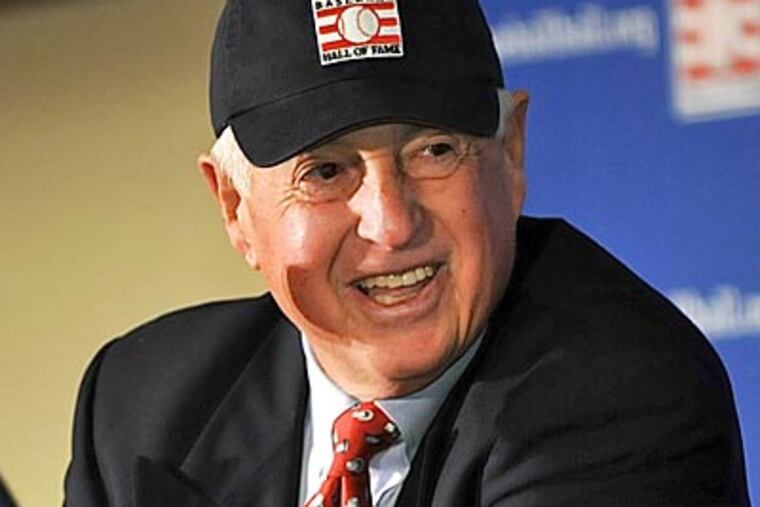
In those Ozzie & Harriet years when he played at Southern Cal, Pat Gillick was that rare mix of athlete and nerd.
A softhearted Eagle Scout, a devoted student, savant-like in his recall of opponents and statistics, Gillick was also a good lefthanded pitcher on the 1958 Trojans team that won the College World Series.
"He never had overpowering stuff," said teammate Rex Johnson, "but, boy, was he smart."
On the journey that has led the 73-year-old Gillick to Cooperstown, where the former Phillies general manager will be inducted into baseball's Hall of Fame on Sunday, those two 1950s seasons at Southern Cal seem insignificant in comparison to the long major-league resumé that followed.
But that apprenticeship under legendary coach Rod Dedeaux marked the transformation of Pat Gillick. Though it wasn't until several years later that an injury moved him from the mound to the front office, it was USC that readied him for the change.
"You could just see Pat soaking up everything Rod said," said Johnson, who played briefly for both the Pittsburgh Pirates and Steelers. "Pat idolized him. I guess, in his own field, he ended up being just as good as Rod, maybe better."
For Dedeaux, who developed such talents as Tom Seaver and Mark McGwire in 45 seasons at Southern Cal, the feeling was mutual.
"Rod loved what he saw in Pat," said John Werhas, another '58 teammate. "Pat was tenacious and fearless. He never gave any excuses, and he always gave it everything he had. I'm certain that if Rod [who died in 2006] were around today, he'd be Pat's biggest cheerleader as he goes into the Hall."
It was at USC that Gillick learned to recognize talent and prize fundamentals, to scour the Sporting News and daily newspapers for useful data, to savor the taste of championship beer.
And it was also there, though the outcome would provide a lesson for life and not baseball, that Gillick witnessed the early chapters in a sports tragedy.
A winning attitude
Gillick's California beginnings read as if they were concocted by a Hollywood screenwriter.
A child of divorce - his mother, Thelma Mineau, was a minor silent-screen actress, and his father, Larry Gillick, an ex-minor-league pitcher turned sheriff - Gillick was raised primarily by his grandparents in the Los Angeles suburb of Van Nuys.
Certain that a boy whose parents were absent needed a firm hand, they sent him to military school. He eventually transferred to Notre Dame High in Sherman Oaks, where he was a baseball star and the center on a football team whose quarterback was future Washington Redskins GM Bobby Beathard.
By the time Gillick arrived at USC, after attending Valley Junior College, Dedeaux had a reputation for finding and developing talent. The '58 title was the coach's second; Dedeaux's Trojans won 10 more in the next 20 years.
"He really implanted a winning attitude," Gillick said recently. "He stressed preparation and a strong foundation. Probably the best fundamental teacher of baseball I was ever around."
Gillick was 0-1 with a team-best 1.80 ERA as USC went 18-4 in his first season, 1957.
"To hone young talent," said Dan Biasotti, an infielder on Gillick's USC teams, "Rod would send us to Western Canada to play in the summers. Pat and I and several others played at Edmonton."
One of those "others" was Bruce Gardner, a lefthanded pitcher who roomed with Gillick and was so talented that the Chicago White Sox offered him $50,000 when he was in high school.
Gillick and Gardner were not only spring and summer teammates and roommates but fraternity brothers at Delta Chi house.
In 1958, Gillick's senior season, USC was loaded. Ron Fairly and Don Buford, both of whom had long big-league careers, played, as did nearly a dozen others who signed professional contracts.
Southern Cal won 29 of 32 games, and, in a memorable 12-inning contest with Missouri in Omaha, Neb., captured the '58 national title.
Though teammates now insist Gillick could have been a No. 1 or 2 on many college teams, he found himself little-used behind Gardner and righthander Bill Thom. In six games, he went 0-1 with a 6.55 ERA.
"Pat threw hard, but he came right over the top, and his ball didn't move as much as those other two's did," said Ken Miller, the first baseman.
But it was the quiet youngster's intangibles that impressed his teammates and coach.
"The kid remembered everything I told him," Dedeaux said in 1996. "And he would practice, practice, practice. . . . The other thing was his toughness. I'll never forget a game against a Marine Corps team in San Diego. The atmosphere in that stadium was total hostility, [and he pitched well]."
Gillick earned a business degree at Southern Cal, and off the field he was reserved.
"He was quiet," recalled Buford, retired and living in Sherman Oaks, Calif., "very, very quiet."
While USC's team, according to Miller, tended to be "wild," Gillick stayed in the background, polite, subdued, serious.
His teammates, though, knew how to draw him out. They'd ask him what he knew about a certain opponent or what kind of statistics some obscure minor-leaguer was compiling. Gillick never let them down.
"No matter how we tried to catch Pat on some baseball issue, or anything at all, we couldn't," recalled Miller, retired in San Juan Capistrano, Calif. "We never found out how he did it. He just had a phenomenal gift."
According to Biasotti, when USC players wanted to know something about an opponent, they'd go to Gillick.
"The rest of us, we just played," said Biasotti, a retired probation officer in Lafayette, Calif. "Not Pat. We'd ask him about this team or that pitcher, and he always had an answer."
Werhas, who played four seasons for the Dodgers and Angels, knew Gillick's secret.
"He was a fervent reader of the Sporting News, and he'd go to libraries and read other newspapers," said Werhas, now a pastor in Yorba Linda, Calif. "He kept on top of things. That tells you why he's been so successful. That was ingrained in him from college."
There at the beginning
Gillick was good enough to sign a contract with the Orioles. In 1960, he went 11-2 with Fox Cities and was invited to spring training with Baltimore the following year. He played five years in the Orioles and Pirates organizations, reaching triple A, before a shoulder problem in 1964 ended his dream.
It was only then that the paths of Gillick and Gardner, two California lefthanders with remarkably similar stories, finally - and tragically - diverged.
While Gillick took a job as a Houston Colt .45s scout and flourished immediately, Gardner foundered post-baseball.
The college player of the year in 1960, Gardner signed with the hometown Dodgers and went directly to triple A. With class-C Reno in 1961, he was 20-4 with a 2.82 ERA. But he was drafted into the Army, suffered an injury, never regained his form, and was released in 1964.
Gardner grew more despondent until, on a sunny June morning, he gathered his USC diploma, his all-American plaque, and his .38 and went to Southern Cal's baseball diamond.
At a spot near the pitcher's mound, on a field named after his college coach, Gardner shot himself in the head and died.
"I just wasn't surprised to hear it," Gillick said.
Gillick's life trajectory, of course, moved in the opposite direction. He became the successful general manager of the Orioles, Blue Jays, Mariners, and Phillies, and is now an adviser to the Phils.
On Sunday, in Cooperstown, Shelly Andrens, the head of the Trojans Baseball Alumni Association, will be there representing the '58 team as Gillick joins Tom Seaver as just the Hall's second USC product.
"When you look back," Biasotti said, "you realize we probably saw Pat developing into what he's become. We were there at the beginning. And we all couldn't be prouder."
Gillick at a Glance
Here is a look at Pat Gillick's life and career:
Born: Aug. 22, 1937.
HoF credentials: He was general manager of four major-league teams, guiding two of them to a total of three World Series championships. He won 1992 and 1993 titles with the Toronto Blue Jays and a 2008 title with the Phillies. He was elected to the Hall of Fame in December by the expansion-era committee.
College and minor leagues: He attended Southern California, graduating in 1958 with a degree in business. A lefthanded pitcher in college, he spent five years in the minor-league systems of the Baltimore Orioles and Pittsburgh Pirates, going as high as triple A. He went 45-32 with a 3.42 ERA in 164 minor-league games.
Front office: He began his front-office career in 1963 as assistant farm director with the Houston Astros and later was director of scouting. He moved to the New York Yankees system in 1974 as coordinator of player development.
Blue Jays: In 1976, he moved to the expansion Blue Jays, becoming vice president of player personnel and later vice president of baseball operations. He became general manager the following year and won five division titles in that role (1985, 1989, 1991, 1992, and 1993).
Orioles and Mariners: In 1995, he was named general manager of the Orioles and guided the team to the playoffs in 1996 and 1997. He left at the conclusion of his three-year contract in 1998 and became GM in Seattle, where he was responsible for trading Ken Griffey Jr. to Cincinnati. He helped guide the Mariners to back-to-back playoff appearances in 2000 and 2001, the latter team finishing with a 116-46 record to tie the 1906 Chicago Cubs for the all-time major-league record for most wins in a season.
Phillies: In November 2005, he was named the Phillies' general manager and retired after the Phillies won the 2008 World Series.
- Associated Press
EndText