Phils' Dubee in most demanding job in sports
THERE ARE dirty jobs and dangerous jobs. The worst are both dirty and dangerous. Diamond miners . . . Oil-well wildcatters . . . Skyscraper window washers . . . Storm chasers . . .
THERE ARE dirty jobs and dangerous jobs. The worst are both dirty and dangerous. Diamond miners . . . Oil-well wildcatters . . . Skyscraper window washers . . . Storm chasers . . .
OK, those guys chasing tornadoes are also nuts. Dirty, dangerous and nuts ranks them just behind the NFL's special-teams gunners. Guys trolling for head-on collisions at 25 mph, usually in a double team.
So what is the most demanding job in sports? You can interpret that to be the job most important to the health, welfare and success of a team.
I nominate the 30 Pitch Count Era major league pitching coaches.
Back when Tommy John was a working lefthander and not the name of the ligament-replacement surgery named for him, you got a sore arm, well, you tried to pitch through it. Surgeries often were career-ending.
When the pain reached the point where combing your hair was a problem, you shut it down. Or, in many cases, simply retired.
Tommy John had reached the last-resort stage when an orthopedic surgeon in Los Angles named Dr. Frank W. Jobe told him he could replace the ruptured ligament in his left elbow with a healthy ligament from his right wrist. The new ligament, Jobe said, should be even stronger than the one being replaced. One last thing: You'll be the first to have it.
Tommy John took a great leap of faith and today he's in the medical journals with Curie, Salk, Parkinson, Gehrig and Hodgkins.
Neither pitching nor pitching coaches have been the same. Frank Jobe should be in the Hall of Fame.
Pre-TJ pitching coaches were part-trainer and part-mechanic. Until Tony La Russa began to regularly use a five-man rotation with greater emphasis on the back end of a game, staffs typically were composed of 10 pitchers. Four starters. A swing pitcher who was used in long relief and as a starter in doubleheaders. There was a relief pitcher who pitched an insane amount of innings, and the cannon fodder.
In 1959, Roy Face made 57 relief appearances covering 93 1/3 innings. The 5-8 forkballer was an astounding 18-1 with 10 saves. In 1960, the Pirates won the World Series. Face's load was upped to 68 appearances, 114 2/3 IP, a 10-8 record and 24 saves.
Much has been made of Gene Mauch's serial use of starters Jim Bunning and Chris Short during the 1964 collapse. But the real issue was the collapse of the back end. Mauch used eight relievers during the 10-game losing streak. Ed Roebuck and Bobby Shantz blew saves. John Boozer chipped in an extra-inning loss. In a 14-8 shootout with Milwaukee, Dallas Green contributed 1 2/3 innings of five-run, seven-hit jet fuel that turned a close game into a rout.
Ray Rippelmeyer was a superb mechanic for the Phillies from 1970-78. The offseason pig farmer convinced Steve Carlton to start throwing his slider again after he scrapped it in 1971. Lefty went to a big-breaking curve and went 20-9 for the Cardinals after a 10-19 1970. He had some arm issues that season and scrapped his devastating, signature pitch. Throwing both the slider and curve, he went 27-10 for the wretched '72 Phillies.
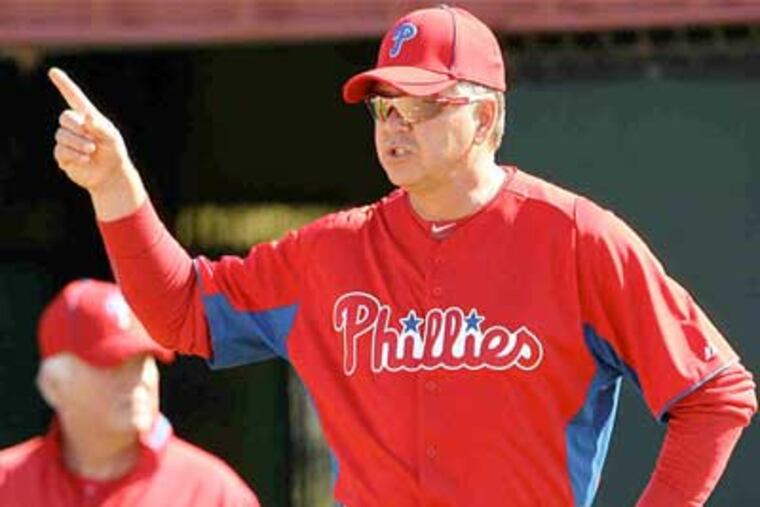
Rich Dubee, a poker-faced man with a background in teaching, holds the keys to one of the most potent staffs ever assembled. It is a Ferrari speeding toward a checkered flag that will leave the Phillies with one of the best records of the modern era. Either Roy Halladay or Cliff Lee could win the Cy Young. Rookie righthander Vance Worley's startling 11-2 season puts him in any rookie of the year conversation. Setup lefty Antonio Bastardo's numbers rank with the best among NL relievers.
And if Roy Oswalt continues to struggle with his command, Dubee and Charlie Manuel could be faced with an agonizing decision. For the Phillies to go deep into October, they are going to have to give the ball to a No. 4. Do they call on Oswalt, Mr. September in the past, and make a commitment to his heart, even if he is less than his best? Or do they call on the intense and so far pressure-proof Worley? A tough call that will be an ongoing discussion.
Dubee is headmaster of the pitching equivalent of the Lee Strasberg Theatre and Film Institute that introduced the term "method acting." Each of the 12 pitchers on his staff has a closely defined role.
Pitchers are like snowflakes. No two deliveries are exactly alike. Line up a dozen pitchers and ask to see their changeup grips, you might get 10 different versions. A Halladay has an aggressive, almost angry, delivery, one you would not ask a young pitcher to copy.
But you would teach Lee's classically simple and effortless-appearing turn, load and throw. Once Cole Hamels is finished with the foreplay that defines his complex setup, he is poetry in motion.
Dubee has a dozen arm slots to monitor for anomalies, 12 release points and follow-throughs. He must ration their pitches - except for Halladay and Lee, of course, who have Cy Young Awards to back their right to self-coach. Dubee has to schedule and supervise their side sessions, their rehabs after injury.
The title of today's 30 major league pitching coaches should be upgraded to pitching coordinator. And they should have "professor" in front of their names. Throwing a baseball has become that specialized.
