Local doctors weigh in on Utley situation
HOW DO we know it's spring in Philadelphia? Chase Utley's knees are hurting.
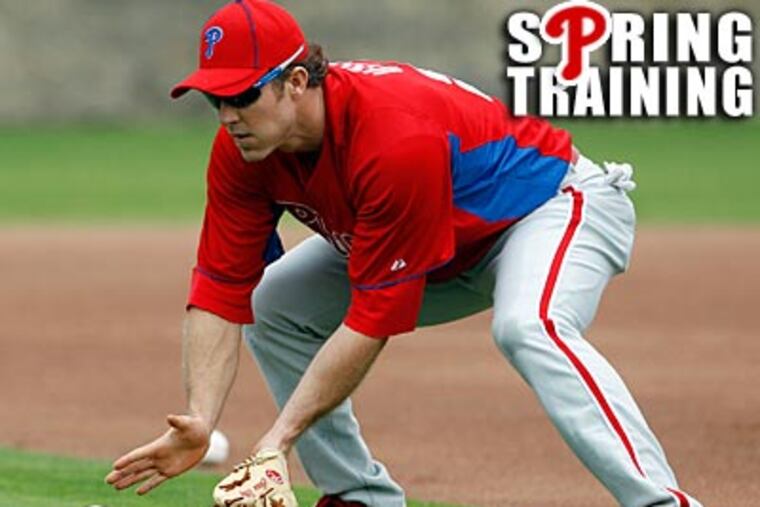
HOW DO we know it's spring in Philadelphia? Chase Utley's knees are hurting.
The Phillies haven't disclosed the name of the specialist Utley, 33, has gone to see, after general manager Ruben Amaro Jr. acknowledged it is likely Utley will begin the season on the disabled list for the second year in a row. A couple of Philadelphia-area orthopedists with sports medicine backgrounds interviewed by the Daily News said they would be very interested in knowing which knee guru Utley has gone to consult, because that would give a strong hint as to what the course of treatment might be - some specialists, you go to if you're contemplating microfracture surgery, others if you, for example, want to try stem-cell injections to help damaged cartilage heal.
Neither Dr. Brian Sennett, the vice chairman for the department of orthopedic surgery and chief of sports medicine for the University of Pennsylvania Health Systems, nor Dr. Art Bartolozzi, former team orthopedist for the Eagles and Flyers, currently serving in that role at Rowan and West Chester, has any role in Utley's treatment. Their comments reflect only what has been reported about Utley's patellar tendinitis (tendon inflammation) and chondromalacia (cartilage damage under the kneecap).
Both doctors agreed that, as Bartolozzi put it, "loss of cartilage is a really bad problem" for a major league second baseman; it portends arthritis. A lot depends on what exactly is causing Utley's pain. The two conditions are different - it would be entirely possible to fix one without fixing the other, which wouldn't really help Utley.
If his pain is mostly from tendinitis, that is treatable with rest and therapy, as we saw last year, when Utley had the same problem, though only in his right knee, instead of in both. Sennett pointed out that Utley "did pretty well with a conservative, nonsurgical approach" in 2011, missing about seven weeks of the regular season, then returning to play at a reasonably solid level for the rest of the year.
You can treat patellar tendinitis surgically, but the time for that was probably right after last season, both doctors said. Sennett said it's possible to remove as much as 10 damaged millimeters of the 30-millimeter-wide patellar tendon, and the tendon will grow back as strong as ever, but that operation requires a 3-to-4-month recovery period.
Sennett noted that there are "not great solutions for cartilage loss."
Bartolozzi and Sennett said microfracture surgery, in which tiny holes are drilled in the kneecap, so the body will fill the holes with a cartilage-like substance, would end Utley's 2012 season. And the substance created, a kind of scar cartilage, isn't as good and durable as real, natural cartilage. Bartolozzi noted that you could also transplant cartilage, but that, too, would need a really long recovery period.
Sennett reflected that a veteran player on a team built to win now probably would not want to have surgery in late March.
"In my mind, there's probably no reason why he won't go the same time course," Sennett said. "Take it easy, get some rehabilitation, slowly get on the field. The only reason it may change is the mental aspect of it. When you've had a problem one year, you've got the same problem the next year, sometimes that pushes us to take a different approach - 'You know what, I'm just not getting better with this thing, I've got to try something different. If I'm going to be out for 3 months [with surgery for tendinitis], I could at least be back by the All-Star break, or in August for the pennant run.' He might opt for a different approach because he was able to get back and play [last year], but it didn't really solve his problem."
If rest and rehab doesn't seem to be working, Sennett said, "then he'll probably have surgery."