Phil Sheridan: Dodgers deal will only push franchise prices higher
Magic Johnson is a savvy businessman, and he leads the group that just spent more than $2 billion to buy the Los Angeles Dodgers.
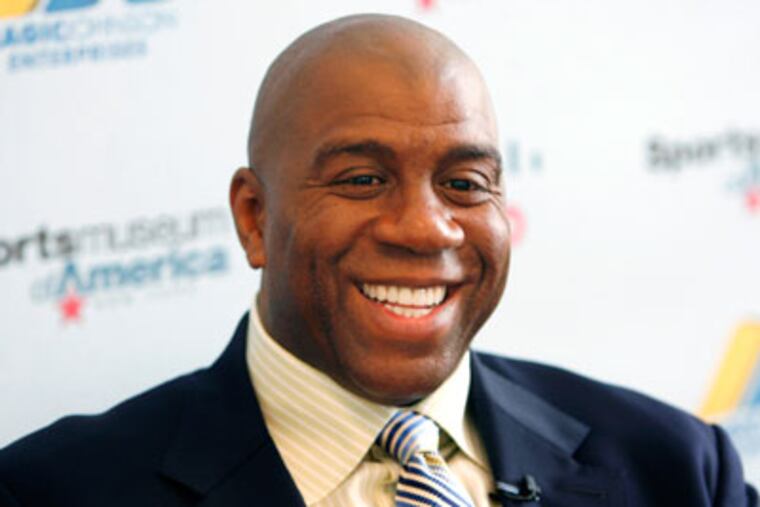
Magic Johnson is a savvy businessman, and he leads the group that just spent more than $2 billion to buy the Los Angeles Dodgers.
So which of these things is true?
The shock waves from that outlandish sale price are going to reach all the way to the Phillies on the East Coast and across sports to the NFL. More immediately, though, the sale underscores that it is almost impossible to fail financially as the owner of a sports franchise - no matter how awful or incompetent you are.
Consider Frank McCourt, a Bostonian who made his personal money by buying cheap South Boston real estate and turning it into commuter parking lots. After failing to buy the Red Sox (forget those two World Series if he had) and the Angels, McCourt bought the storied Dodgers franchise from News Corp. in 2004.
How? By investing "not a penny" of his own money, according to his own attorney. McCourt borrowed the full $430 million sale price, including $165 million he borrowed from News Corp. itself. Sweet deal. McCourt and his wife, Jamie, then proceeded to use Dodgers money to buy adjacent mansions in Brentwood and adjacent beach properties in Malibu.
After a spectacularly acrimonious divorce and a farcical bankruptcy proceeding, McCourt finally agreed late last year to sell the franchise. Speculation was that the price might be just over $1 billion, possibly even setting the record for an American sports franchise.
Then: boom! Magic and his backers plunked down $2 billion, more than a half-billion more than the next highest bid. After putting up zero money and then milking the business for his personal gain for eight years, McCourt walks away with at least $1 billion in profit.
Staggering. And the man is so deeply loathed by Dodgers fans, who began staying away from the ballpark in reaction to his awful stewardship, that his massive windfall is being celebrated in Los Angeles. Anything that makes McCourt go away is worth it.
In Philadelphia, owners have always been viewed with suspicion at best and downright disdain most of the time. But compared to this jackal, Jeff Lurie has been a blessing to Eagles fans, Ed Snider is Santa Claus, and the Phillies owners are practically candidates for sainthood. The new Sixers bunch gets an incomplete for now.
As for those shock waves:
If a baseball team there is worth $2 billion, how much is the inevitable NFL franchise in Los Angeles going to be worth? The league has already used its L.A. vacancy to leverage new stadiums and sweetheart deals from cities all over the country. It will not be long before an existing franchise moves, doubling or tripling its current value, or the city is awarded an expansion team. A franchise fee of, say, $1.6 billion would mean a nice, round $50 million for each of the current owners.
Remember how Norman Braman joked that his new yacht was called the S.S. Jeffrey because Lurie supposedly overpaid for the Eagles in 1994? That $195 million investment is worth over a billion and rising every day.
The only way this Dodgers deal can work out in the long run is through a regional sports network deal. The Dodgers' neighbors in Anaheim, the Angels, have a new TV deal with Fox Sports that pays about $3 billion over 20 years. The Texas Rangers' new deal with Fox Sports Southwest is worth about the same. It is not a coincidence that both of those teams were big spenders in free agency over the winter.
The immediate reaction among Phillies fans was concern that the Dodgers deal was based on the assumption that an even bigger TV deal was inevitable - and that the Dodgers would then be positioned to poach Cole Hamels and anyone else they fancy.
Think a step beyond that. The Phillies' next TV deal, whether it's with Comcast or someone else, is going to be on the same enormous scale. And the Phillies won't have a $2 billion investment to cover. Their owners, who picked up the team in 1981 for about $30 million, have been playing with house money (well, your money) for decades now.
So put aside your concerns that the Phillies are nearing some kind of invisible payroll ceiling. It is going to rise along with their revenues and this Dodgers sale is proof positive that those revenues are going to soar to unimagined heights.
As long as the team continues to be willing to spend to win, the Phillies are going to be just fine. And Phillies fans are going to be better off than Dodgers fans.
Maybe, by 2040, that $2 billion will look as relatively tiny as a $30 million investment does today. If so, maybe Magic's as savvy as everyone says. Until then, all we can be sure of is that the rich get richer even if the stupid don't get any smarter.