Philadelphia's George Taylor was catalyst behind Marvin Miller's leading baseball players' union
Amid the posthumous accolades accorded Marvin Miller this week, the Philadelphian responsible for bringing the labor legend into baseball rated hardly a mention.
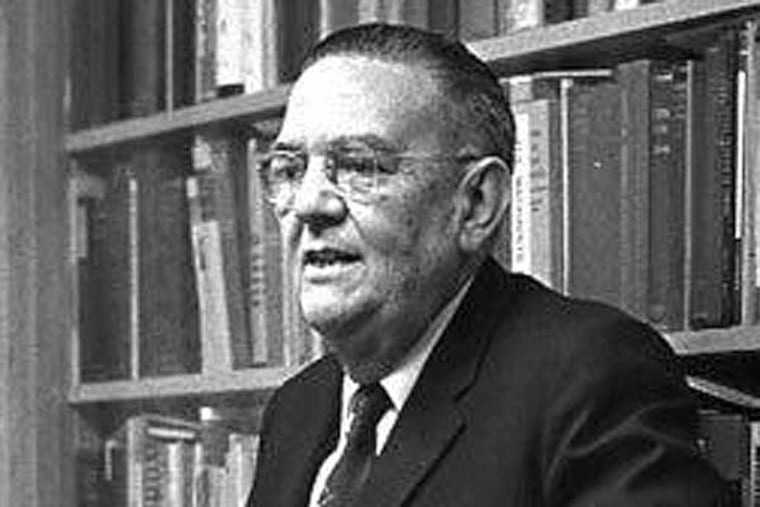
Amid the posthumous accolades accorded Marvin Miller this week, the Philadelphian responsible for bringing the labor legend into baseball rated hardly a mention.
Yet if not for George Taylor, the change Miller forged as head of the Major League Baseball Players Association might never have happened.
It was Taylor, a Kensington native and longtime Wharton School professor, who recommended Miller to Robin Roberts when, in 1965, the toothless union sought a leader.
"I knew he had settled numerous labor disputes and had a reputation for sizing up men . . . experienced in negotiating labor agreements," Roberts said in 1969.
Taylor was a legendary labor umpire. Beginning with a bitter 1932 strike at Philadelphia's Apex Hosiery Mill, he would successfully mediate 2,000 industrial disputes.
A Wharton professor for 40 years - "There's chalk in my veins" - he advised five presidents. His "Taylor Law" still governs public employees' disputes. In 1995, 23 years after his death at 71, he was inducted into the National Labor Hall of Fame.
"[He] created a whole new discipline . . . in labor arbitration, mediation, and other sophisticated forms of alternative dispute resolution," the Monthly Labor Review noted in 1995.
But while the owlish professor was a dead ringer for Dodgers owner Walter O'Malley, Taylor had no history with baseball until, from out of the blue, Roberts telephoned.
Born in 1901, the son of a Kensington factory superintendent, Taylor grew up expecting to work in a mill. But principal George Snook saw a spark in the Frankford High senior and worked to get him a Mayor's Scholarship.
Taylor earned a Wharton School economics degree in 1919, a Ph.D in 1928. In between, he built a reputation.
His thesis on labor relations became the textile industry's guideline.
In 1926, he formulated the now-famous hemline theory - whenever the lengths of skirts shrink, the economy grows.
Taylor soon became the go-to guy in difficult negotiations no matter the industry. Every president from Franklin D. Roosevelt to Lyndon B. Johnson sought his counsel.
"Beneath all his work there lay a strong . . . moral purpose," Joseph Willits, another renowned Wharton professor, once said.
Meanwhile, baseball's labor relations were stuck in the 19th century. In 1953, players formed the MLBPA, a timid organization ignored by owners and without a full-time staff.
A decade later, pension worries led the union to direct Roberts, Phillies pitcher Jim Bunning, and Harvey Kuenn to find a director.
Rejected candidates included Robert C. Cannon, a Midwestern judge who had worked with the MLBPA; former players Bob Feller and Hank Greenberg, and Giants executive Chub Feeney.
Roberts then recalled having read about a Penn professor famous for resolving labor conflicts. Taylor's Rolodex, he thought, might include some interesting names.
An Oriole then, Roberts introduced himself over the telephone. Taylor cut him off.
"I know who you are," he said. "I follow baseball."
Roberts told him the players sought "a strong man of established character" who would represent their best interests and baseball's.
Taylor quickly came up with two names, Miller and Lane Kirkland.
Kirkland, longtime AFL-CIO head, didn't want the job. But a week after Roberts' call, Taylor encountered Miller in a San Francisco hotel.
According to the 1994 book on baseball's labor history, Lords of the Realm, Taylor asked the steelworkers union official whether he knew Roberts.
"Not personally," he said, "but I certainly know who he is."
Taylor explained the MLBPA's need, and Miller, mildly intrigued, agreed to consider it.
Two weeks later, Miller and the three players met in Cleveland. Not long afterward, the MLBPA had a new boss and a new attitude.
In his final years, Taylor retreated deeper into economic theory. Baseball's economics, thanks largely to his wisdom, would never be the same.