Phillies' Steve Susdorf took a circuitous path to the big leagues
DETROIT - The Phillies 42d player this year has as many LinkedIn endorsements for Microsoft Office as he does for baseball. His resume lists his current employer as the Phillies. Before that, he was a program associate at a project-management company. He has a degree in civil engineering.
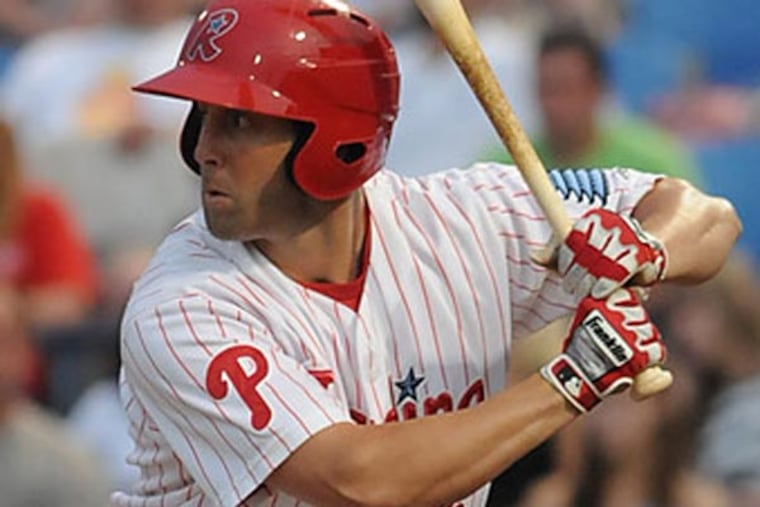
DETROIT - The Phillies 42d player this year has as many LinkedIn endorsements for Microsoft Office as he does for baseball. His resume lists his current employer as the Phillies. Before that, he was a program associate at a project-management company. He has a degree in civil engineering.
Steve Susdorf was called up on Thursday, had his first major-league at bat against the Cardinals the same day - and grounded into double play.
The Phillies had placed Domonic Brown on the seven-day disabled list for concussions before Thursday's game, and needed a replacement, quickly.
The organization had two other likely options: Tyson Gillies and Leandro Castro, both also with triple-A Lehigh Valley. Susdorf was never a lock to make the majors. He was drafted in the 19th round in 2008. He is 27.
At the beginning of the season, the Morning Call reported, Lehigh Valley coaches saw him as a future major-league bench player. So he prepared himself for that role. He pinch hit. He watched a feature on MLB Network about Greg Dobbs, the former Phillies infielder and utility man, now with the Marlins. He observed Dobbs' routine as a bench player.
"When I was in that role, I kind of had a game plan for how to handle it," Susdorf said.
In 70 games at Lehigh Valley this season, he batted .335 with one home run and 13 doubles. On Wednesday night, Susdorf was sleeping in the team hotel in Rochester, N.Y. His triple-A manager and hitting coach entered the room. His roommate woke him. Bed checks, the roommate said.
"And I looked at him like, 'What are you doing in my room?' " Susdorf said.
His roommate told him: You're going to the big leagues. Get ready. The next morning he bought new clothes and went to the airport. He missed a connecting flight and finally made it to St. Louis shortly before the game.
In the offseason, when many minor-league players do other jobs to earn extra money, Susdorf landed internships. For two years, he worked for a firm that designs buildings for protection from bomb blasts. He tapered his work schedule as each season approached.
"If for some reason my baseball career ends, I'm not starting from square one," he said.
For each game with the Phillies, he will make about $2,600.
His wife made it to St. Louis from California. His father, who turned 60 on Thursday, watched at a party with friends.
"This has been awesome," Susdorf said.