New play about the Yankees is a Bronx bomb
Playwright who gave us 'Lombardi' strikes out with play about the New York Yankees.
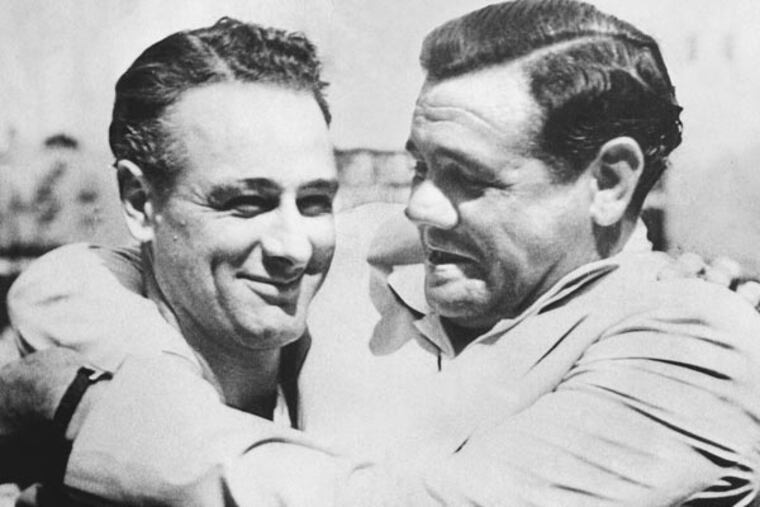
NEW YORK - Babe Ruth never spoke to Lou Gehrig, because Gehrig's mom once criticized the way Claire, Ruth's second wife, dressed Dorothy, Ruth's adopted daughter.
Mickey Mantle hated Joe DiMaggio, because Joe D called him off a fly ball he was tracking and Mantle veered away and stepped in a drainage hole and wrecked his knee.
Thurmon Munson detested Reggie Jackson, because Reggie said he was "the straw that stirred the drink" and because Jackson made more money than he did, which broke a promise they'd made to Munson.
Snide of the Yankees. How did those snarling guys in pinstripes win all those championships? Maybe you'll find the answers in "Bronx Bombers," a new play by Eric Simonson that opened this week at the Duke on 42nd Street. Maybe not.
Simonson wrote a fine play called "Lombardi," focusing on Vince's coaching days in Green Bay. He should have quit while ahead. Followed that one with "Magic/Bird," a drab look at the two guys who saved the NBA.
And now he's done Yankees for Dummies, cramming 86 years of franchise history into 105 minutes of bickering, plus a 15-minute intermission for you to try to comprehend what you've just seen.
First act takes place in Yogi Berra's hotel room the day after the infamous dugout scuffle between manager Billy Martin and slugger Reggie Jackson. Berra's a coach back then, rattling off malaprops, seeking peace, trying to keep the manager from getting fired, the slugger from pouring petrol on the fire, and then roasting s'mores.
Berra has called Martin, Jackson and team leader Munson to his room to negotiate an armistice. "Bury the hatchet, just not in each other," he suggests.
Martin breaks down and cries, not once, but twice. You'd cry, too, if you had to deliver some of the lines handed to Keith Nobbs. Yo, where was Tom Hanks when we needed him, screeching, "There's no crying in baseball."
Berra, played earthily by Richard Topol, has all the funny lines, while Francoise Battiste struts around as Jackson, getting the chance to display his arrogance, his vocabulary, his arrogant vocabulary.
He works feverishly at getting the other three to recognize "the immensity of Reggie Jackson." Funny and true.
For comic relief, there's a running gag about someone dumping 23 tons of potatoes on Berra's front lawn in Montclair, N.J. Turns out Berra needled a guy in North Dakota, telling him the state didn't produce enough potatoes to fill his front lawn.
It gets the requisite laughs, but maybe the audience is entitled to know how the episode ended, with Berra donating most of those spuds to the needy.
"Half the things they say I said, I never said," Berra sighs at one point.
Second act, Carmen Berra, Yogi's loving wife, sees dead people. Invites a posse of dead Yankees - Babe Ruth, Lou Gehrig, Joe DiMaggio, Mickey Mantle - and a couple of live ones - Elston Howard and Derek Jeter - to dinner.
It is "Field of Dreams" without the corn. Oops. The dialogue is cornier than Kansas in August.
Maybe it was a budget crunch, but Wendy Makkena, playing Carmen, is out there without a microphone and can't be heard beyond the first row. Luckily, she doesn't have much to say.
Everybody else steps straight out of a Tom and Jerry cartoon. Pow! Bam! A trim Ruth (don't tell me they couldn't afford a pillow inside his shirt) is rude and crude. His best line is a growling belch.
Gehrig is polite, but he's fall-down frail, which is maudlin. DiMaggio is imperious, aloof. Mantle is gruff, hard-drinking. He bemoans the curse, all the Mantle men dying young, but never delivers his famous line, "If I'd known I'd live this long, I'd have taken better care of myself."
The press is meddling, the owner is meddling, and that takes care of the villain quota. There is one moment in the play that seemed new and significant. Berra screws up his courage to confront DiMaggio, tells him how scared he was of the Yankee Clipper sitting glumly at his locker smoking his cigarettes, drinking his coffee.
Then came a one-run game against the Washington Senators. Uh-huh, Washington, first in war, first in peace, and last in the American League. The runner steals and Berra flings the ball into centerfield.
Afterward, Berra shuffles sadly into the clubhouse. DiMaggio is sitting there, smoking his cigarette, drinking his coffee. Without looking up, he barks at Berra.
"Get better!"