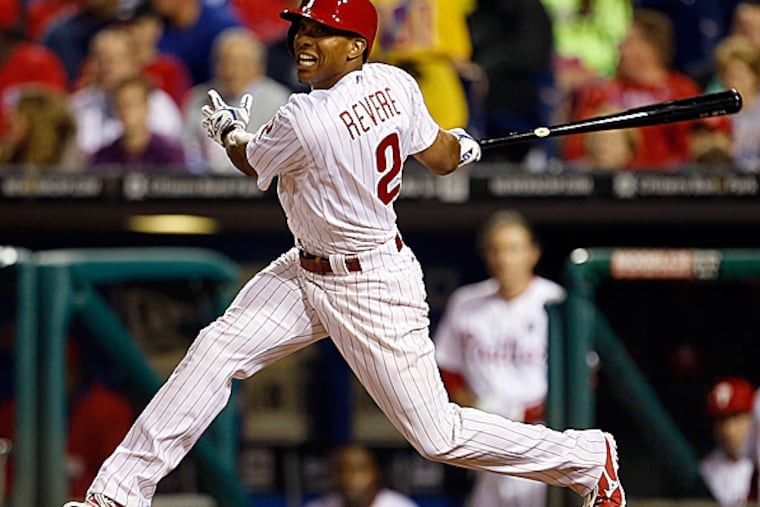
AND THE award for the top pitcher in the Phillies' minor league system goes to . . .
. . . A 27-year-old reliever with 30 career big-league appearances under his belt who was pitching in the independent leagues two years ago.
That's not an indictment of Luis Garcia, who had an excellent season as the closer at Triple A Lehigh Valley, where he saved 22 games and allowed just five earned runs while striking out 52 and walking 16 in 46 2/3innings (that's a 0.96 ERA). The Phillies don't take major league ceiling into consideration when handing out the Paul Owens Award, given annually to the team's top minor league hitter and pitcher. And they do seem inclined to reward players who have overcome adversity, as they did in 2010 when they gave it to 26-year-old reliever Scott Mathieson, who was one year away from heading to Japan to pitch.
But Garcia is the reality of the Phillies' minor league pitching talent right now. We've said it plenty of times over the last couple of months, but in the wake of yesterday's announcement, it is worth repeating: The biggest obstacle standing in the way of a return to respectability is the remarkable lack of options for filling a rotation that currently has one healthy starter under contract for next season. While the organization has some intriguing arms in its lower levels, the list of pitchers who used 2014 to establish themselves as bona fide candidates to help the big-league club over the next couple of seasons is exactly zero players long.
Anyway, enough about that. Let's play a guessing game, using 2014 stats prior to yesterday.
Player A: 26 MLB starts, 157 innings, 3.78 ERA, 5.6 K/9, 3.4 BB/9, 0.5 HR/9, 1.21 GB/FB;
Player B: 14 MLB starts, 91 1/3 innings, 3.05 ERA, 6.5 K/9, 2.0 BB/9, 0.9 HR/9, 0.99 GB/FB.
Player C: 17 MLB starts, 99 1/3 innings, 3.90 ERA, 5.7 K/9, 2.6 BB/9, 1.0 HR/9, 1.09 GB/FB.
Player A is former top pitching prospect Jarred Cosart, who began the year in the Astros' rotation and then was traded to the Marlins.
Player C is David Buchanan, who initially wasn't on the list of players the Phillies were inviting to big-league spring training. More than anything, that's a testament to Buchanan, who made impressive strides with his cutter and displayed a not-gonna-take-no-for-an-answer attitude when presented with his opportunity. While Buchanan does not have the kind of repertoire that projects as anything more than a back-of-the-rotation starter, he gave us no reason to doubt that he can fill that role the same way soon-to-be free agent Kyle Kendrick has since 2007.
Oh, Player B is Vance Worley, who has reclaimed his career as a 26-year-old in Pittsburgh after flaming out with the Twins, who acquired him from the Phillies along with Trevor May for centerfielder Ben Revere after the 2012 season. Worley's strikeout rate has dropped from the 7.7 K/9 he posted in two-plus seasons in Philadelphia, but he has also lowered his walk rate from 3.1 in 2010-12 to 2.0 in 2014.
Player A: 1,271 plate appearances, .289 BA, .339 OBP, .396 SLG, 8 HRs, 49 SBs, 13 CS, 89 BB.
Player B: 884 plate appearances, .308 BA, .333 OBP, .364 SLG, 2 HR, 65 SB, 15 CS, 28 BB.
Player A is Denard Span in his first two seasons since the Nationals acquired him from the Twins. Player B is Ben Revere in his first two seasons since the Phillies acquired him from the Twins in the same offseason.
Keep in mind, the Nationals have paid Span $11.25 million over the last two seasons and have a $9 million option on him for 2015, after which his contract expires. The Phillies have paid Revere $2.465 million in 2013-14 and have him under team control for 2015-17. Plus, the Nationals parted with pitcher Alex Meyer, who prior to this season was ranked as a Top 50 prospect by Baseball America and Baseball Prospectus.
Revere has earned himself a stay in centerfield, but don't let his pursuit of the NL batting title fool you. Despite the .308 batting average, he still has an on-base percentage that is right around league average for a centerfielder, and his OPS is below average.
The one encouraging sign is an increase in power. In 2012, Revere produced an extra-base hit in 3.4 percent of his plate appearances. In 2013, he did so in 3.6 percent. This year, that number is 3.8 percent. And in his last 399 plate appearances, his extra-base hit percentage is 4.8. In other words, there is some reason to think that Revere is maturing as a hitter.
The flip side is that his walk rate is still a paltry 2 percent during that stretch, and that's the figure that makes it hard to believe he will ever be more than a league-average hitter. It isn't a matter of selectivity. It's a matter of pitchers being unafraid to feed him fastballs in the strike zone. No hitter in the major leagues has seen a higher percentage of fastballs than Revere. Of the pitches he has seen, 68.4 percent are fastballs, a figure that is 2 points higher than the next person on the list (Dee Gordon, who has seen them in 66.3 percent of plate appearances). Revere's walk rate on the season is 2.2 percent, the lowest in the National League. Gordon's 5.2 percent rate is 12th-lowest. Billy Hamilton, who has seen the fourth-most fastballs, has the 11th-lowest walk rate. These guys aren't getting pounded with fastballs because they are putting themselves in hitter's counts, they are doing so because their power does not compel pitchers to throw them anything else. And keep in mind that Revere's career-high extra-base hit rate is still the lowest among 68 qualified National League hitters. If Revere continued to improve that rate by 0.2 percent every year, he'd reach league average in the year 2030.
Player A: .255/.303/.379, .682 OPS, 5 HRs, 264 PAs.
Player B: .249/.323/.357, .680 OPS, 7 HRs, 371 PAs.
Player A is Domonic Brown from June 1 through Tuesday. Player B is Chase Utley since June 1 through Tuesday. That's more of a concern for the latter than it is a testament to the former. So it doesn't really fit with our theme. But it is a reminder that as the Phillies look to plug the leaks they sprung this year, they could end up dealing with even more next year.