Utley's declining production begs questions
Chase Utley's offensive numbers by month suggest he wears down playing second base.
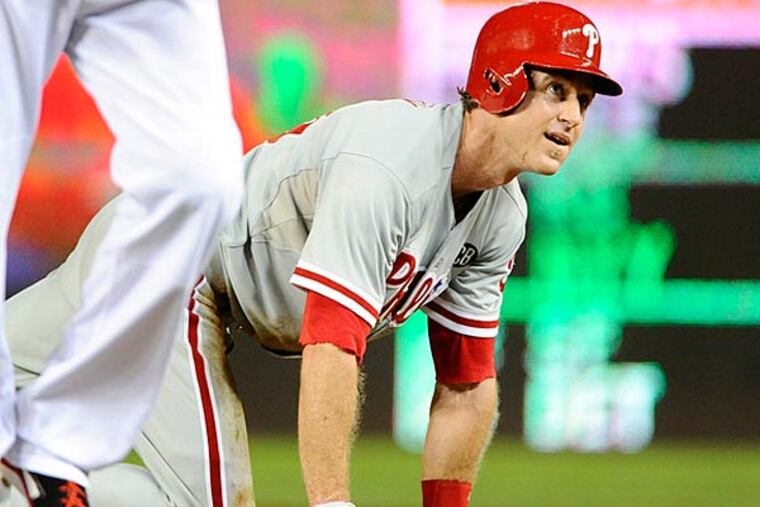
CHASE UTLEY'S name was missing from the lineup yesterday, the fourth time in 15 games that had been the case. At 35, the six-time All-Star and four-time Silver Slugger award winner is still among the most productive players at his position. On the list of issues that the Phillies must address this offseason, Utley's name is near the bottom. Yet there are plenty of reasons to think that the club should take a hard look at second base this offseason as it searches for ways to maximize its roster for 2015.
At this point, there are no indications that the Phillies would consider trading Utley to an American League team that could occasionally use him at designated hitter. They signed him to a 2-year, $25 million contract with three vesting options last year because they want him to finish his career where he started it. Whether he can finish it as an everyday second baseman is the question. Heading into last night's game against the Pirates, Utley had an on-base percentage of .343 and a slugging percentage of .415, both of which would represent career lows for a full season. He had hit home runs in 1.8 percent of his plate appearances and extra-base hits in 7.8 percent. His numbers in those categories from 2011-13 were 3.0 percent and 8.5 percent.
Since May 1, Utley was hitting just .257/.329/.383 with eight home runs in 498 plate appearances. After an April in which he hit .355/.408/.570 with three home runs, he has been a slightly-above-league-average hitter. Since the All-Star break, he has hit just .237/.330/.356.
As evidenced by his on-base numbers, even when Utley struggles, he still does things at the plate that contribute to the offense. Rarely do you find yourself grimacing after one of his at-bats. But for the Phillies to improve on their current 76-win pace, they need their big-money players to provide production commensurate with their salaries. For Utley, that means hitting for the kind of power that enables runs to be scored in bunches.
"I don't know," Ryne Sandberg said when asked where that power has gone, "because over that period of time he's stung some balls that might have been hard singles rather than hit in the gap. But as far as elevating some balls and hitting the ball out of the ballpark, sometimes that comes and goes with the swing. But like you said, he can give you a quality at-bat and drive in a key run with a base hit. He's done that through this stretch. They talk about him keeping his legs underneath him, whether he wears down a little bit with the leg power. I don't know. I still see good batting practices with him, so it's hard to tell."
Wearing down is a theme that has followed Utley throughout much of his career. His career .769 OPS in the month of August and .810 OPS in the month of September are well below the numbers he has posted in the first 4 months of the season (April .977, May .871, June .867, July .912), but this year, the decline has been even more pronounced.
It is worth noting that the 601 plate appearances that he carried into last night were 70 more than he had logged in any season since 2009. Sandberg's recent tapering down of his second baseman's workload is a conscious decision. Whether it represents a glimpse at the future remains to be seen. The Phillies are clearly a better team when Utley is in the lineup. His post All-Star break numbers are still better than the ones that Cesar Hernandez, who started at second last night, or Freddy Galvis, who has played there in the past, have shown themselves capable of producing. Third baseman Cody Asche spent his first year in the minors as a second baseman, and while Sandberg essentially ruled out the possibility of playing the 25-year-old there this season, he left open the possibility of experimenting with it in the future.
Utley, whose 11 errors are tied for second most in the NL, still brings big offensive value to the position. His .758 OPS ranks fourth among 13 NL second basemen with at least 300 plate appearances. Asche's .699 OPS would rank sixth among those second basemen. On the flip side, Utley's OPS would rank just ninth among 13 first basemen with at least 300 plate appearances. Of course, it is much better than the .687 OPS that Ryan Howard carried into last night's game.
Sandberg has been asked on a few occasions this season about the potential of Utley moving to first base, a position that he has played in 27 games in his career. The question isn't just whether a combination of Utley at first base and Asche or another player at second base would offer more production than Howard and Utley; it's whether a move to first base would increase Utley's production by saving his body some of the physical stress that comes with playing second.
"I think playing first base would eliminate a little wear and tear at that position," Sandberg said. "Whether that's a consideration or not has yet to be seen."
Such a move would be contingent not only on the Phillies moving on from Howard, but on Maikel Franco establishing himself as a viable big-league bat at third base. The reality is that the Phillies' best option might be their current one.
Blog: ph.ly/HighCheese