Howard's struggles linked to more than injuries
It wasn't merely professional pressure to perform as Ryan Howard battled with his family over finances.
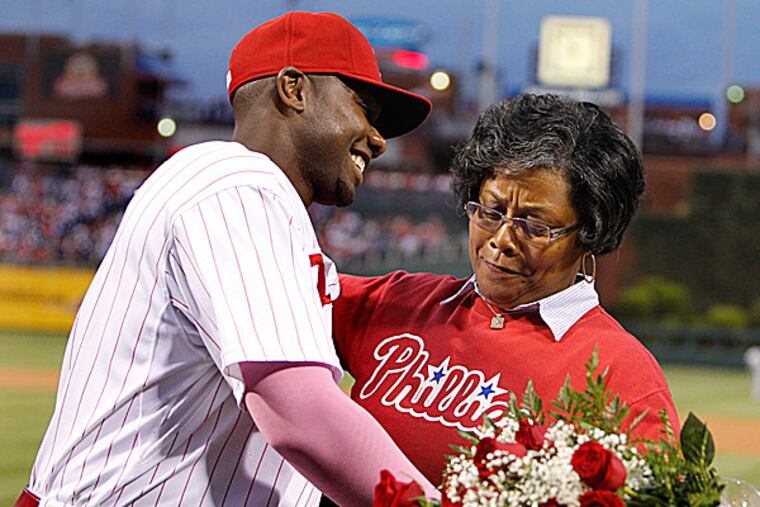
RYAN HOWARD turned 35 yesterday.
These should be the best years of his life.
In 2010, Howard was almost as big as Jared, his Subway co-star. With Donovan McNabb out of Philadelphia, Howard was the biggest show in town; the Big Piece, as manager Charlie Manuel called him; the linchpin in a Phillies machine that had potential Hall of Fame players all over its well-heeled roster.
No one's heels were as golden as Howard's.
In late April 2010, Howard signed a 5-year, $125 million extension that would keep him in Philadelphia through 2017. Its average annual value then made him the second-highest paid player in the sport, after Alex Rodriguez - a sadly convenient link.
Since April 2010, few players besides Rodriguez have undergone more stress than Howard.
That's when his offensive numbers began their journey toward ordinary, when he posted career lows in every category and began a battle with foot and ankle injuries that still might be hindering him today. The Phillies had traded Cliff Lee but acquired Roy Halladay and remained the class of the NL East . . . before they lost in the NLCS and witnessed the start of the Giants' dynasty.
The next season, 2011, offered more promise, since the team reacquired Lee, but Howard's spiral continued downward. Jayson Werth left for big money in D.C., and Howard, unprotected and still hurting, again failed to reach the Ruthian levels that warranted the contract in the first place.
That season ended, of course, with Howard grounding out to end the Division Series; blowing out his Achilles' tendon on that swing; with the Phillies saying farewell to their string of five division titles.
And now, this.
His dirty laundry has been aired for all to see. His now is a career in early decline with a backdrop of bickering among a family once painted as close and trusting.
Howard recently ended a legal battle that had lasted at least 3 years with a portion of his family over money, according to court documents acquired by the Daily News. It was settled out of court; and, hopefully, was settled with some semblance of civility and forgiveness.
But this was no small legal battle.
In an effort to keep his finances private by using those he trusted, Howard, as he ascended to stardom 8 years ago, made the classic mistake many newly rich young people make: He let his family mess with his money. His twin brother, Corey, was on his payroll as a "consultant" charged with acquiring marketing deals, an arrangement that paid Corey almost $100 an hour and gave him a 5 percent cut of any deal made.
Good "work," if you can get it.
The NFL and NBA each run annual rookie symposiums. At each, rookies are told to keep their families away from their finances.
Major League Baseball offers no such structured advisory events. Howard could have used one.
All along, Howard allowed his mother, Cheryl, to make important financial decisions and to act as paymaster - to Howard himself, in fact. He bragged about his thrift as he drove a well-used SUV and admitted that Cheryl gave him an "allowance."
Well, everybody grows up.
The court documents say that, in early 2012, Howard wanted them out of his business affairs.
They weren't eager to cut loose their golden goose.
Howard's mother, Cheryl, and father, Ron, wanted $5 million apiece to sever ties with RJH Enterprises LLC, an abstract entity Howard foolishly created to . . . well, to give his kinfolk a cut, mainly. Cheryl was "chief financial officer" and Ron "business manager," respectively, in his corporate vehicle designed to, essentially, pay his family to hang around.
Corey, Howard's "personal assistant" and "consultant," sued Ryan for almost $3 million in late 2013 for breach of contract.
Howard responded with a countersuit in January that charged fraud and conspiracy and said Corey never did more than a speck or two of work as a consultant. He said his family stole money from him for years and would not let him see the books that recorded the financial outlays of his own company.
Thanksgiving is next week.
Those Howard family holidays must have been lots of fun the past few years:
"Please pass the turkey."
"Gimme my money, you turkey."
Often, fans and the press forget that the men tasked with throwing touchdown passes and hitting home runs are human; that real-world problems affect everyday output, no matter how rich or talented or famous.
No one is mechanized.
Families have disputes all the time. Most often the disputes center around money.
Always, everyone's life and work are affected by the disputes.
There are a few largely unappreciated differences between most professional athletes and most of the rest of the world.
For one, pro athletes usually are sheltered from life's most annoying and bothersome problems. Usually, sports agents, personal assistants and caretakers from the team assist with chores such as finding an apartment, locating a mechanic, setting up bank and investment accounts and the like.
For another, pro athletes exist in a fantasy world of entitlement and hyper-sensitivity. They are treated like princes. So, often, they react to criticisms as if they are above reproach; as if they have royal, or at least noble, blood. They are taught, and so they often believe, that they are not subject to the same rules and niceties by which others in society are bound.
It should be noted that, in these areas, Howard is a cut above most athletes. He is principled and honest; a responsible father; a good and generous teammate. Ron and Cheryl did a fine job.
Still, Howard is a privileged star playing Amercia's most privileged sport. He is not normal.
Imagine, then, at age 30, the sense of betrayal upon discovering that the people closest to you, to whom you have been unfailingly generous, insist that you give them almost $13 million . . . for nothing.
Imagine, as a hyper-sensitive multimillionaire who just signed a promise to carry a $1 billion franchise on his shoulders for the next 7 years, trying to excel as an entire league stacks its pitching staffs to limit your effectiveness.
Imagine trying to carry that weight on a bad knee and a bad foot and a bad ankle, which cause you grief for most of 2010 then collapse at the end of a rough 2011, then aggravate you at least through 2013.
Imagine enduring all of this for the bulk of 3 years . . . while fighting with your family about your money.
Howard averaged more than 49 home runs from 2006-09.
He has hit a total of 48 home runs since 2012, as he tried to fire his family.
Clearly, on any level, these are not the best years of his life.
Blog: ph.ly/DNL
Email: hayesm@phillynews.com