Like it or not, Phillies' Jonathan Papelbon's been worth the price
Phillies closer has not been a fan favorite, but all he's done since he arrive is do his job.
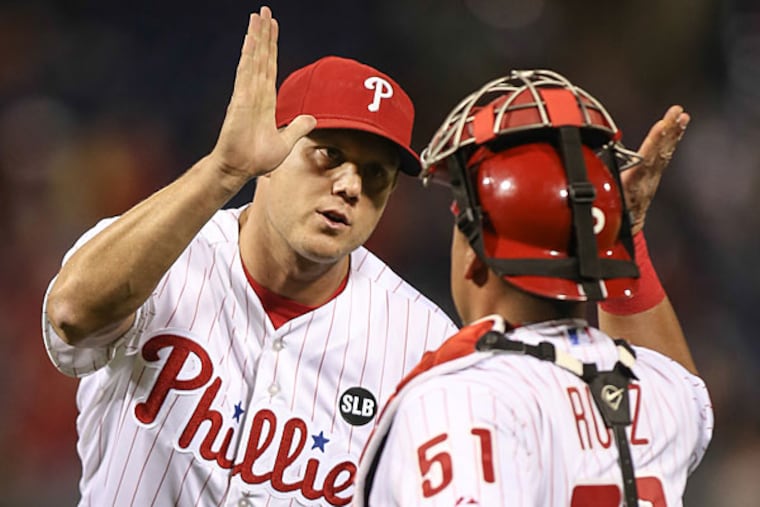
THE LEGACY of Ruben Amaro Jr. will center not on the three playoff trips or on the Phillies' seventh World Series appearance.
Instead, Amaro will be remembered for the crippling contracts given to veterans who failed to produce because of injury, ineptness or age. Some of those contracts went to future Hall of Famers in their twilights - Roy Halladay, Chase Utley, maybe Jimmy Rollins. Others went to unquestioned stars: Ryan Howard, Cliff Lee, streaky Cole Hamels, who has yet to earn a Cy Young Award or even win 20 games.
Only one big-time player Amaro sought and signed has played to the value of his contract. By the end of this week, barring a trade or an injury, that player will own a significant Phillies record.
The problem is, Jonathan Papelbon is a quadrophonic Blaupunkt installed in a '94 Hyundai.
He is in the fourth season of 4-year, $50 million contract that could vest an additional $13 million season for 2016, the largest total package for a closer in history. "Pap," as his teammates affectionately call him, will catch Jose Mesa and own the Phillies' career saves record, which stands at 112.
It just so happens that practically no one else in Philadelphia calls Papelbon anything affectionately - proof positive that the town cares as much about personality as performance. Since he signed in November 2011, Papelbon has been, without question, the best Phillie: healthy, effective and accountable.
None of that could compensate for his crude mannerisms, his candor and his allegiance to Boston.
His antics and his honesty make him the best athlete the City of Brotherly Love has ever hated.
Papelbon can hardly believe how little his historic performance has been appreciated.
"Considering all the other guys that we've signed, yeah, I think that kind of does go unnoticed," he said. "You're the first person who's ever talked about my production and what I signed here for. Ever. Doing what I was supposed to be doing, as far as my contract, my deal. Everybody else talks about what I say, or how I act in certain situations. That stuff doesn't have anything to do with losing or winning. To me, it's all about performance on the field."
Off the field, Papelbon is as diplomatic as a drone.
"I don't seek out controversy. It's not me," said Papelbon - who has grabbed his crotch, asked for a trade and said he'd go into the Hall of Fame wearing Red Sox. "You ask me a question, I'll tell you honestly. If not, why ask me the question?"
Surely, his views, allegiances and actions must rankle his teammates, right?
"Pap? Believe it or not, he's one of the best guys in the clubhouse," said catcher Carlos Ruiz, the most popular guy in the clubhouse. "He keeps everybody loose. He helps the young guys, and the young guys love him. They love him because of how he is in the clubhouse. He's funny. At the same time, when the games start, he's locked in. The guys in the bullpen are always looking at the way he prepares for the game."
The guys in his bullpen are always ready to defend him, too.
"He gets a bad rap. Really bad," snarled Jake Diekman, a shocking tone for someone who usually is as ornery as a duckling. "The bullpen is a family down there. He's the leader. If you have any questions, he has the answer, because he's been through literally everything. He's a really good teacher.
"In a game, there's nobody who knows what's going on more than Pap."
Like a Pentagon strategist, Papelbon (Papelbon?) spends the fourth and fifth innings of every game loosening up in the clubhouse, where he watches the game on television. By the time he strolls out to the bullpen in the sixth, he has a full report ready for the other relievers: where the umpire's strike zone sits, which hitters are pulling off, which are lunging, whether the opposition seems overly aggressive.
"He'll be, like, 'He's giving you 3 inches on the outside of the plate,' " setup man Ken Giles said Sunday. "Or, 'Nobody's swinging at the inside pitches.' Or, like today: 'They're ambushing today. They're swinging away. Attack 'em early and put 'em away early.' "
One pitch from a reliever can undo 3 hours of good work by the rest of the team, so bullpen life can be stressful. Like a sensitive father, Papelbon (Papelbon?) knows when to teach and when to watch. For instance, he has yet to say anything to Diekman, whose struggles this year have cost the team dearly.
"I know my guys," Papelbon said. "I know how to get to them. I know how to push them in certain ways. And when to leave them alone."
Jonathan Papelbon: pitching coach, life coach, lights-out closer . . . all for only $50 million.
In a galaxy of mistakes and misfortune, Papelbon is Amaro's brightest star.
"He's done exactly what we've asked him to do," Amaro said as his last-place team prepared to hit the road after Sunday's game. "Unfortunately, the rest of the team hasn't."
Papelbon had just saved No. 110, which made him 4-for-4 this season. He logged a fifth Monday night in St. Louis. He has allowed one meaningless run.
This march toward history was predictable. Papelbon averaged 36 saves in his six full seasons as the Red Sox' closer. Mathematically, he's right on track.
Papelbon hates the math of baseball.
Analytically, these days it is fashionable to diminish a closer's value; to argue that closing by committee or riding a hot young arm makes better fiscal sense.
"Yeah, that thinking's fine - until postseason comes," Papelbon said with a sneer. Papelbon gave up zero runs in his first 16 postseason games, which spanned six series.
Asked whether the calculus that minimizes his worth angers him, he replied:
"It kind of does. Nobody understands until you get put in that situation. All these sabermetrics, this and that . . . it's the most asinine stuff. To me, [a sabermatrician] has no clue what he's talking about. He doesn't get it."
Amaro doesn't worship at the altar of Bill James, either; but then, Amaro enjoys an extra-large budget.
"I believe in having a strong bullpen, and having a strong closer to close out games you're supposed to win, particularly if you're a contending team," Amaro said.
Of course, when Amaro signed Papelbon, he expected to be installing a quadrophonic Blaupunkt into a powerful Porsche, not a '94 Hyundai.
"We haven't played up to our expectations since we signed him, but he's done everything we've asked him to do," Amaro said. "It was a big contract, because we thought he was the best person available to do that job. As it turns out, he was."
Joe Nathan shined for the Rangers in 2012 and 2013 for half of Papelbon's price, but struggled with the Tigers in 2014 and now needs Tommy John surgery. That same procedure derailed the career of Ryan Madson, the home-grown reliever the Phillies spurned when they signed Papelbon.
"Our feeling at the time was, if we wanted the best guy, let's go get him," Amaro said.
They paid the highest price. How high is too high?
"To me, there's no set value," Papelbon said. "To me, the question is, does he help your ballclub, and what are you willing to pay for it?"
The Phillies paid plenty.
Like him or loathe him, he's been worth every dime.
On Twitter: @inkstainedretch