Cole Hamels is a Philly institution, but for how long?
Lefthander has been a Phillies mainstay for nearly a decade, but rebuilding team is likely to ship him elsewhere this season.
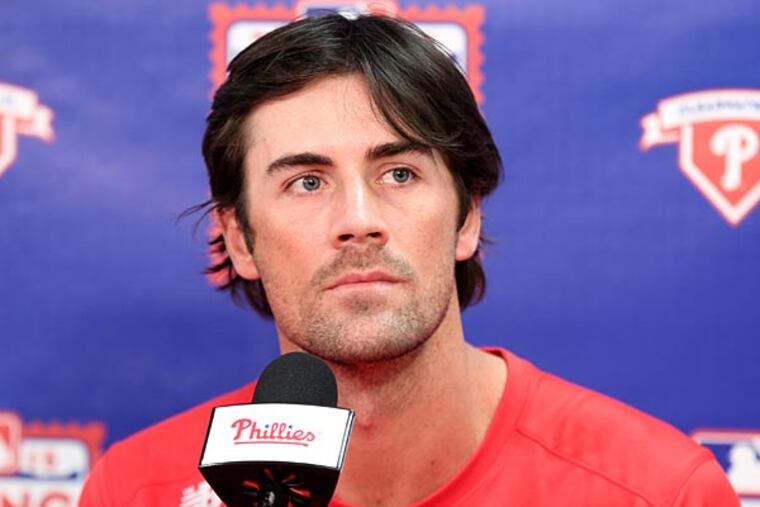
COLE HAMELS navigated the small hallway leading up to the main event with his closest teammate by his side.
There were cheers. And chants. They sang the national anthem, and later, "Take Me Out to the Ball Game."
There wasn't an empty seat in the house. Tom McCarthy stood behind the microphone and introduced Hamels.
But Cole Hamels wasn't wearing Phillies red. No, it wasn't a Red Sox uniform, either. He wasn't outfitted in a Cardinals, Cubs or Padres hat.
Hamels was wearing a a blue tie and a khaki suit as he stood next to his wife, Heidi, inside the cafeteria at John H. Webster Elementary School. The Hamels Foundation was awarding more than $50,000 in grants to eight Philadelphia-area schools.
One school was getting a new math curriculum, another a new sound system. Thomas Holme Elementary was receiving a check for $3,700 to fund a new second-grade reading library.
The Hamels Foundation, founded by the couple in 2008, has awarded more than $1 million in supporting Philadelphia schools in the last seven years. In the back of the cafeteria, the man who once put his signature on a document that would hand Hamels the richest contract in Philadelphia sports history was beaming with pride.
"It's amazing they picked education," David Montgomery said. "Because we have no greater need in Philadelphia than public school education."
Hamels, now 31, has been a member of the Phillies organization since he was a teenager. He's in his 10th season in a major league uniform.
"When you think back, the incident at Razzels when he broke his hand, it was, 'What do we have here?' " Montgomery said, considering Hamels' legacy and the long-forgotten bar fight at a Clearwater, Fla., establishment in 2005.
"It makes you so proud," continued the Phillies' longtime team president and current chairman. "In our business, you try to draft both ability and character. And we've often said character, for success in the game, it's often more important than ability. And when you couple that with someone who's willing to be such a part of the community for so long . . . Look right here."
Montgomery motioned behind him.
The room that was filled with a few hundred people about five minutes earlier was nearly empty. Among the half dozen remaining were Montgomery, a media member, and a few elementary school students, who were in conversation with a very engaged Cole Hamels.
Again, Montgomery smiled. He didn't want to consider the almost foregone conclusion that, within the next 2 1/2 months, Hamels could be taking his formidable talents, which were raised as an amateur in San Diego but reared in the sometimes-harsh sports climate of South Philly, to a new major league team.
The Phillies still owe Hamels upward of $80 million from the record, six-year, $144 million contract extension signed three summers ago. But while the pitcher remains in his prime, the organization is on a collision course with a fourth straight season without a winning record. The Phillies are rebuilding; trading away the team's top asset is widely viewed as the most prudent way to restock the club with young talent.
"I'm not going there," Montgomery said, before rattling off the names of a half-dozen pitchers developing in the team's minor leagues. "After all that he's done for us, my hope is he's still here to provide that leadership."
Hamels, one of the four players who remain from the 2008 world championship team, and the only one of them who hasn't celebrated his 35th birthday yet, had his say last winter.
"I just want to win," Hamels was quoted in USA Today in February. "That's all. That's all any competitor wants. And I know it's not going to happen here."
About 72 hours after those words went viral, Hamels sat in front of several cameras and microphones inside Bright House Field, the Phillies' spring training home in Clearwater, Fla., and tried to delicately and diplomatically dance around the trade topic for close to a half-hour.
Just this week, Hamels spoke glowingly about Citizens Bank Park: "This is the best place to play when you have 45,000 fans supporting you." But the glory days of the Charlie Manuel era are gone and Hamels, like any other living, breathing professional athlete, would prefer to play for a contender given the choice.
"I wish I could give Cole advice, but I don't know how to do it, especially in Philly," former Phillies ace Roy Halladay said this spring.
Six summers ago, Halladay was in the same spot Hamels sits today: He was the darling of the trade market. Wherever he went in St. Louis, where he started for the American League in the All-Star Game, Halladay couldn't escape it.
"It is a grind," Halladay said. "It's an absolute grind. You're pitching for your team. You're pitching for yourself. You're pitching for the rest of your career but you're not pitching for anything. It's tough. And for me, the hardest thing was answering the questions about do you really want to leave, do you want to go somewhere else, what's it going to be like to leave? That was hard to answer those questions after every start. That was difficult."
Hamels has veered away from any queries regarding rumors and hypothetical scenarios within the last three months. Although he has a limited no-trade clause - one that's not expected to hold up in any potential deal - Hamels has little control.
Wherever Hamels does go - and where he might spend the third act of his big-league career - he still subscribes to the Jonathan Papelbon school of thinking, in terms of his identity. Just as Papelbon said last month his baseball blood is more Red Sox red than Phillies, Hamels might not be wearing a "P'' on his ballcap in three months, but it won't be far from his heart.
"This is where I was 18 years old, signing a contract and moving across the country, fully committing to a grownup lifestyle," Hamels said. "They took me in, taught me how to play the game right, players taught me how to play. I grew up as a person, the good and bad, the failures and successes. And that will always be the memory: I'm a Phillie. And who knows what else happens in my career, where I'll go or what I'll do in the future, but that's what you hold on to. That's what created you, what set you on that path."
Tuesday marked the nine-year anniversary of Hamels' debut in Cincinnati, where he recorded 14 outs, six via strikeout, before allowing his first major league hit. Hamels struck out Ken Griffey Jr. twice that night.
Hamels began living his big-league dreams nearly a decade ago and wasn't shy on sharing his goals of throwing no-hitters and racking up Cy Young Awards on a path to Cooperstown upon his arrival. Self-confidence has rarely been an issue for the seemingly carefree Southern California native.
"When I was young, I thought I was better than [everyone]," Hamels said. "I actually thought I was better than Tom Glavine, John Smoltz and [Greg] Maddux, the guys I grew up watching. I was, like, 'No, I'm going to be better than them.' Now it's getting reversed. I was in their role, and the young kid is, like, I'm better than him . . . You have to keep staying in that lane of, confidence is great, but you have to have respect, too. People are going to come [at you]."
Three days later, Hamels showed off his maturation in defeating the new hotshot pitcher in the National League East, righthander Matt Harvey, of the New York Mets. Thanks in part to a Ryan Howard home run, Hamels walked away with his second win in his first seven starts this season.
The Phillies have won four of the eight games Hamels has pitched in this season. Since the beginning of 2013, the team has a 32-39 record in his starts.
But don't let that win-loss total fool you: Hamels has a 3.10 ERA in those 71 games. Hamels is the only major league pitcher who has been getting less than 3.5 runs of support per start in each of the last three seasons.
Entering this week, Hamels had a major league-low 1.9 runs per start in 2015. In the last 20 years, no pitcher with at least 25 starts has ever received less than 2.5 runs per start.
The Phillies have scored three runs or fewer in 59 percent of his starts - and two runs or fewer in 39.4 percent of his starts - since the beginning of 2013.
"That is uncannily terrible," general manager Ruben Amaro Jr. said. "Uncannily bad. It's unbelievable. Had he had some - even if it was just another run [per start] - the guy would probably have a chance to win 20 games."
Despite dreams of Cy Young Awards, Hamels has finished in the top five of the voting only once. He's never won 20 games and has finished with more than 14 wins only twice - and one of those two seasons was eight years ago.
"He's never had that big winning season, and that's not always his fault," former pitching coach Rich Dubee said. "He goes out there, goes deep into a game and pitches well enough to win. What more do you want the guy to do? He's put up a lot of good starts where he hasn't been rewarded for it."
Current bench coach and longtime Phillies shortstop Larry Bowa recalled the forgettable 1972 season, when the Phillies lost 97 games, but Steve Carlton somehow recorded an MLB-best 27 wins.
"We were terrible," Bowa said. "But in our minds, we knew if we scored two runs, we had a chance to win. We were a young team. We knew coming in, if we could get two runs we had a chance of winning. And we didn't get a lot of runs for him."
Carlton received 3.8 runs per start in '72 - an average of nearly two more runs per game than Hamels is getting in 2015.
"He knows he has to match zeros with zeros," Bowa said. "And that's like telling an infielder, 'Don't make any errors, because if you do, we're going to give up five runs.' A pitcher, 'Don't make a mistake, because if you do, it could be a 2-1 or a 1-0 game.' It's hard to play like that, it's hard to pitch like that."
Cole Hamels has the World Series ring that fueled Halladay and Cliff Lee into their 30s. But he remains just as driven.
"You know when you ask someone, 'When did you realize you made it?' " Heidi Hamels said. "I bet if you asked Cole, he'd say, 'I haven't made it yet.' "
Since the beginning of the 2010 season, Cole Hamels has a 3.03 ERA in 167 games.
Among his peers who have also pitched at least 1,000 innings over that time, only Clayton Kershaw (2.34) and Felix Hernandez (2.74) have better ERAs. Among the same group, only five have thrown more innings or have a lower opponents' OPS.
The deeper you dig into the numbers, the better Hamels looks. ERA-plus, for example, measures ERA against the league average and adjusts for ballpark factors. Since 2010, Hamels has a 128 ERA-plus - again, only Kershaw (157) and Hernandez (138) are ahead of him.
"You want to be at the top," Hamels said when asked whether that's good enough for a self-proclaimed perfectionist. "And the top is 1-2. It's always 1-2. 1 and 1A."
Since his time in a Phillies uniform may very well be winding down, it's interesting to consider his legacy in Philadelphia. Hamels' playoff prowess alone would vault him onto a franchise all-time rotation.
Consider Curt Schilling, who spent a similar amount of time (nine seasons) with the Phillies. Their numbers are fairly close - Schilling has a better strikeout-to-walk ratio, 3.74 vs. 3.71, and a slightly better WHIP, 1.12 vs. 1.144 - but Hamels has a better ERA, 3.28 vs. 3.35, in a Phillies uniform.
Steve Carlton pitched for 15 seasons in a Phillies uniform and made 217 more starts than Hamels has, so the current lefty comes up well short in building a back of a baseball card.
But from ages 25 through 31, which coincidentally begins with each pitchers' fourth year in a big-league rotation, they're not dissimilar. Hamels, beginning with 2009, has a 3.22 ERA in 199 games, with a 3.76 K/BB rate, 1.147 WHIP and 122 ERA-plus; Carlton, from '70-76, has a 3.25 ERA in 263 games with St. Louis and Philadelphia, with a 1.258 WHIP, 2.12 K/BB rate and 115 ERA-plus.
Hamels, however, is a little more than a third of the way through matching the durability of Carlton, who pitched in the big leagues for 24 seasons, with a 3.22 ERA.
Carlton's teammate and fellow Cooperstown honoree Mike Schmidt laughed out loud when asked whether he sees a future Hall of Famer in the Phillies' current ace.
"Well, I would think Cole is on the right track," Schmidt said. "I think he's got to cover a lot of ground in the next seven or eight years to be talked about like some of the pitchers that are in the Hall of Fame, the 300-game winners and 3,000-strikeout guys. Not taking anything away from him. Cole has definitely had a remarkable career at this point. But it's way too early to start commenting on H-O-F, related to him."
Hamels' numbers do compare favorably with Hall of Famer Tom Glavine's first 10 years in the big leagues, aside from the 30 more wins Glavine racked up in his first decade.
"When you talk about the Hall of Fame today, there's going to have to be some adjustments in the whole mindset of numbers," said Glavine's longtime teammate, John Smoltz, an MLB Network analyst who will be inducted into Cooperstown this summer. "There will not be the ability for guys to reach certain numbers unless they push past the [old] philosophy today . . . I'm not a [sabermetrics] guy, and I think the win has value, but you are limited to what you can control. You ask four to five Hall of Famers and you might get four to five answers about what's the most important. I personally think innings is the most important."
Hamels, one of only five pitchers in baseball who entered this season with a chance to rack up his sixth straight 200-inning season, has proved durable in that regard. But he must pitch deep into his 30s to emulate Carlton and Glavine, and not break down like Halladay and Lee.
Hamels' legacy could gain legs, of course, with a change in venue.
If he's traded to a better team, he has an opportunity at bolstering his already impressive postseason credentials. If he's dealt to a superior team, he could see run support, and then, more wins, too.
"He wants to be on a winner," said Papelbon, who's voiced a similar opinion more than once in the last two years. "You can't blame him for that. I feel he deserves that."
But if (when?) the Phillies do decide to put Hamels into that position, they'll take on as much risk in the unknown bounty of prospects as they are in hoping to one day find another pitcher of his caliber to front their rotation when they hope to contend again.
Within the last five years, the Kansas City Royals traded away their own ace, whom they selected in the same 2002 draft as Hamels (Zack Greinke), only to change courses and subtract from a rich farm system to trade for another (James Shields) two years later.
"Anytime you move players that have great value . . . those are troublesome things to do," Amaro said. "Because on the back end of it, you're always looking for those players to top off your team. Or to get your team going. For years and years and years, all I heard when I was an assistant GM is, 'We've got to get pitching, we've got to get pitching.' Well, [bleep], there aren't a whole lot of No. 1s floating on the trees.
"So the value - a lot of people don't understand the value of what a No. 1 pitcher brings - and how that affects a team and the rest of an organization. One, they're not really very replaceable. Two, it helps you put other players that are in your rotation into proper spots. It helps cover your bullpen . . . There are different values you can associate with a guy who's going to go out there and throw seven innings. And do it effectively. That person is tough to replace."