Frank's Place: Bad baseball, a Philadelphia tradition
Before the pair of renaissances that yielded the Phillies their only two World Series titles and salvaged some pride for a franchise paralyzed by humiliation, Bucks County-born author James Michener was asked how he endured the ups and downs of being a baseball fan.
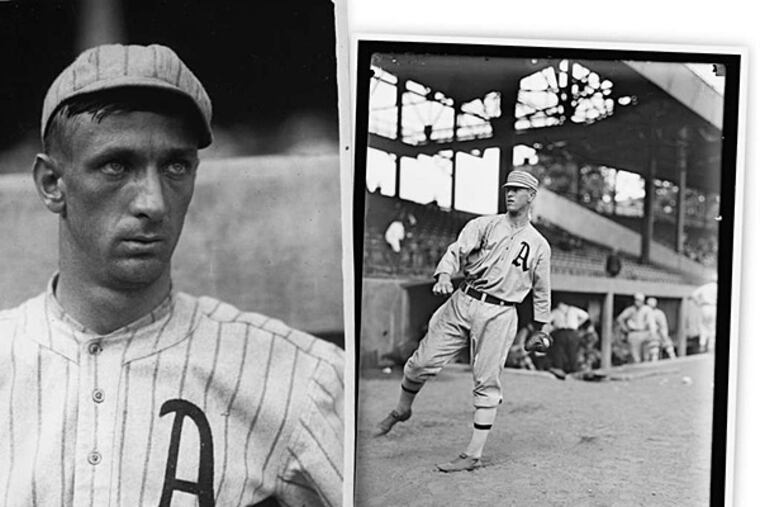
Before the pair of renaissances that yielded the Phillies their only two World Series titles and salvaged some pride for a franchise paralyzed by humiliation, Bucks County-born author James Michener was asked how he endured the ups and downs of being a baseball fan.
"Ups?" Michener replied. "What ups? I'm from Philadelphia."
The Philadelphia Michener knew as a boy was a robust industrial hub, a city frequently referred to as "The Nation's Workshop." But by the time the prolific writer died in 1997, most of the factories that had cranked out everything from locomotives to hats were shuttered.
Were he alive this summer, however, there is one surviving Philadelphia product Michener would recognize. This city continues to produce some of the worst and deeply dreary seasons in baseball history.
By now you've probably surmised that 2015 could be another. While this is just June, the only possibility it will conclude with a Phillies Broad Street parade is if the marchers are bearing torches and pitchforks.
With 47 losses - most of them unwatchable - in their first 70 games, a scoring average that barely tops three runs a game, and the likelihood that their few productive players will soon be traded, these Phillies seem destined for more inglorious history.
If so, it won't be easy. Just as New York is the epitome of World Series dominance, Philadelphia is the unchallenged capital of bad baseball seasons.
In fact, when it comes to them, we may have more in common with Punxsutawney than any rival National or American League city.
Like that Western Pennsylvania town's famed groundhog, championship-caliber baseball surfaces here only rarely. When it does, the sightings are welcome and met with big crowds and great enthusiasm. But mostly, our teams hibernate deep underground, occupying holes they've dug for themselves.
While it's true that every year someone has to finish last, no one does it with quite the flair of Philadelphia.
Consider that of the 21 worst seasons in the game's modern era, post-1900, nine belong to either the Phillies (six) or the Philadelphia Athletics (three).
Nowhere else is even close, Boston being next with four historically terrible seasons. New York, despite having had three teams for more than a half-century and two since 1962, has only one representative on the list, the '62 Mets.
The A's, who departed in 1954, apparently weren't interested in mediocrity. Connie Mack's team played 54 seasons here, winning five World Series. But they also finished at the bottom of the American League standings in a third of those Philadelphia seasons, 18 times in all, including a seven-year cellar streak from 1915 to 1921.
Most notable, the A's managed the single worst season of baseball's modern era.
It came in 1916, two years after a third World Series appearance in four seasons. Mack's club finished 36-117, for a record-low winning percentage of .235.
Those A's were so bad, their statistics seem almost comical.
Pitcher Tom Sheehan, for example, went 1-16, yet didn't have the rotation's worst record. That distinction belonged to 1-20 Jack Nabors.
Two Athletics pitchers, Elmer Myers (14-23) and Bullet Joe Bush (15-24), combined for 29 of the team's 36 wins. That means the rest of the staff, 18 pitchers over the course of the season, won seven games.
Even the Phillies, who finished in the basement in 31 of their 115 seasons since 1900 and have more losses than any other franchise, haven't had a modern-era season quite as bad as that.
They came close often, putting five seasons on that all-time-worst list between 1938 and '45. And if it's any consolation, they did have the worst dead-ball era record.
In their initial NL season of 1883, our Phils were 17-81. No team since has won so few games.
The Phils' post-1900 low-water mark came in 1942. They ended 42-109 (.278), 621/2 games out of first place. Not coincidentally, they also drew only 230,183 fans to Shibe Park, a total that even in the midst of World War II was almost 314,000 below the NL average.
So why have Philadelphia teams descended so often to such defeat-laden depths?
The reasons are more plentiful than Ryne Sandberg's lineups: Personnel mistakes. Front-office incompetence. Questionable managerial choices. Feet-dragging on the signing of African American players.
And, while it can't be blamed for the Phils' 2015 failures, the real culprit has been underfunded ownership.
Connie Mack's resources were always thinner than his torso. And, until the Carpenter family's 1943 purchase, the Phillies were run like a second-rate shoe store, fittingly, since one owner, Gerry Nugent, was a shoe salesman.
Another, sportswriter Horace Fogel, was believed to be a front for the family of President William Taft and in 1912 was banned from the game for drunkenly implying that the 1912 season had been fixed.
In 1917, his successor, William Baker, whose finances were nearly as bad as the rickety stadium he renamed for himself, traded Hall of Fame pitcher Grover Cleveland Alexander for two nobodies and $60,000.
Nugent's tenure was particularly atrocious, producing a won-loss mark of 598-1,076. According to the Phillies Encyclopedia, whenever revenue fell short of expenses - an annual occurrence - he sold two players and sometimes even the office furniture.
Not long after he unloaded future Hall of Famer Chuck Klein, the NL stripped Nugent of ownership. He was succeeded by William Cox, who, in less than year, was ousted for gambling.
That history was nearly forgotten in the last decade as the Phils won five straight NL East titles. But amid this season's hopelessness it has resurfaced. They may or may not, in the long stretch of baseball that remains, challenge their forebearers' failures.
But at this point that possibility may be the only reason to watch. Or to care.
Frank's Place: Worst of the Worst
Philadelphia teams have recorded nine of the 21 worst regular-season records, since 1900, in Major League Baseball history.
Team Year W L Pct.
Philadelphia Athletics 1916 36 117 .235
Boston Braves 1935 38 115 .248
New York Mets 1962 40 120 .250
Washington Senators 1904 38 113 .252
Philadelphia Athletics 1919 36 104 .257
Detroit Tigers 2003 43 119 .265
Pittsburgh Pirates 1952 42 112 .273
Washington Senators 1909 42 110 .276
Phillies 1942 42 109 .278
Phillies 1941 43 111 .279
St. Louis Browns 1939 43 111 .279
Boston Red Sox 1932 43 111 .279
Phillies 1928 43 109 .283
Philadelphia Athletics 1915 43 109 .283
Boston Braves 1911 44 107 .291
Boston Braves 1909 45 108 .294
St. Louis Browns 1911 45 107 .296
Phillies 1939 45 106 .298
Phillies 1945 46 108 .299
St. Louis Browns 1937 46 108 .299
Phillies 1938 45 105 .300
Source: baseball-reference.comEndText