Remembering the play that defined Utley
Around here, the hours that have passed since the Phillies traded Chase Utley to the Dodgers late Wednesday night have pretty much been a collective memory loop - people sharing their most treasured Utley moments, getting sentimental over someone who didn't have to reveal much of himself as a person to have a city's baseball fans appreciate him, even adore him, as a player.
Around here, the hours that have passed since the Phillies traded Chase Utley to the Dodgers late Wednesday night have pretty much been a collective memory loop - people sharing their most treasured Utley moments, getting sentimental over someone who didn't have to reveal much of himself as a person to have a city's baseball fans appreciate him, even adore him, as a player.
That's an important distinction, Utley the person vs. Utley the player, because the white lines of a field or court are always the best boundaries and limits to establish when praising a professional athlete. Go beyond them, and you run the risk of having your idyllic perception of who the athlete is, what he's really like, shattered to shards and bits. Utley himself seemed to recognize and understand this truth, based on something he said during a lengthy interview in March:
"For me, the ultimate compliment is for a dad to say, 'I want my son to play like you.' I think that's the best compliment you can get because it shows that fans recognize the way you go about your business on the playing field. Obviously, they don't see what goes on behind the scenes. They only see what happens on the field."
Let's stay within those boundaries, then. It is not often that a great athlete's career can be distilled to one play. It can be with Utley. So forget the expletive that he dropped during his post-World Series parade speech and his fury rising on the pitcher's mound during that embarrassing loss in Baltimore earlier this year. Instead, let's examine the single play that defined Utley's time with the Phillies better that any other.
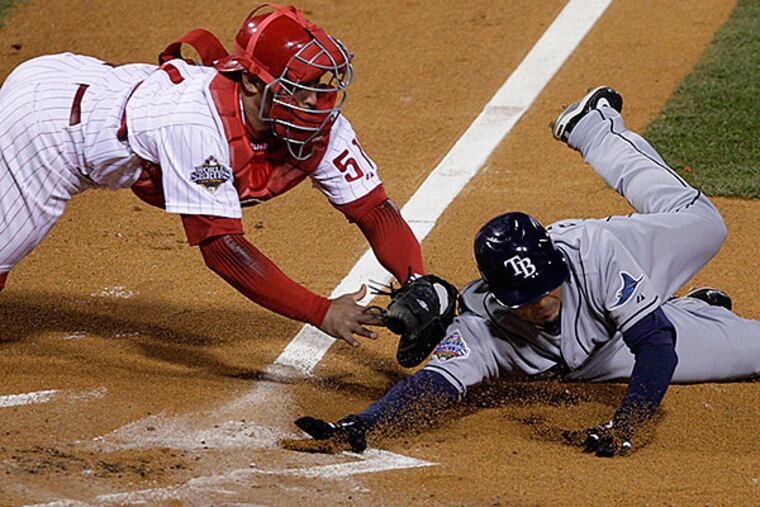
Let's go back to the top of the seventh inning of Game 5 of the 2008 World Series. Game tied at 3. Two outs. Jason Bartlett on second and Akinori Iwamura at bat for the Tampa Bay Rays. J.C. Romero pitching for the Phillies. If you saw it, you remember it: Utley fields a ground ball up the middle by Iwamura, fakes a throw to first base, and heaves the ball to home plate to nail Bartlett for the final out, preserving the tie and setting the stage for the Phillies victory. The play is a baseball instructional video in and of itself, a perfect melding of athleticism, instinct, and timeliness. Watch it now. No worries. I'll wait. It's worth it. OK, got it? Good. Let's begin.
Notice, first, how far Utley has to range to his right just to get to Iwamura's grounder, and that he fields it cleanly despite sprinting to reach it and having to backhand it. Everything that follows springs from Utley's ability not merely to keep the ball in the infield but to pick it up and transfer it to his throwing hand without hesitation. If he bobbles the ball for even a millisecond, if the ball spurts out of his glove and he has to chase it down, Bartlett probably scores the go-ahead run.
Now comes the play's moment of true brilliance: Utley's faking the throw to first base. He does it immediately, and he sells it so well - leaping in the air to gain leverage, letting his arm follow through fully - that it's almost impossible to believe that his decision to feign the throw was spontaneous. That is, before Romero threw that particular pitch to Iwamura, Utley had to have at least considered the possibility that, if the circumstances aligned correctly, he could deke Bartlett. It calls to mind a cliche that every kid who has ever played Little League baseball or softball has heard from a coach: Think about what you're going to do with the ball before the batter hits it to you. It's just that kids tend to think about baseball strategy in the same way they think about their algebra homework, first-level stuff. By comparison, Utley is Euclid.
In pulling off the fake, Utley traps Bartlett. More important, he traps Tom Foley, Tampa Bay's third-base coach. Bartlett, after all, can't see what Utley has done. As he approaches third, he has to look at and listen to Foley, who has the play in front of him and presumes that Utley has flipped the ball half-blindly toward first. Foley waves him home.
Utley sees Bartlett round third, and here's what he doesn't do: He doesn't stop, plant his feet, and try to make a strong throw that will reach catcher Carlos Ruiz on the fly. He doesn't waste time or force Ruiz to make a more difficult play than he has to. Suppose the throw short-hops and handcuffs Ruiz? Here's what Utley does: With his momentum still carrying him to his right, he floats the ball to Ruiz on one big, soft hop, allowing Ruiz time to catch the ball up the third-base line and lunge back toward home plate to tag Bartlett.
From beginning to end, for its aesthetics and intelligence, that sequence captured Chase Utley, baseball player. Me, I don't need to know more about him as a person to appreciate it, and I don't particularly want to. What happened on the field, in that instant, is enough.
@MikeSielski