Philly Sports Hall of Fame umpire Shag Crawford broke up baseball's craziest brawl
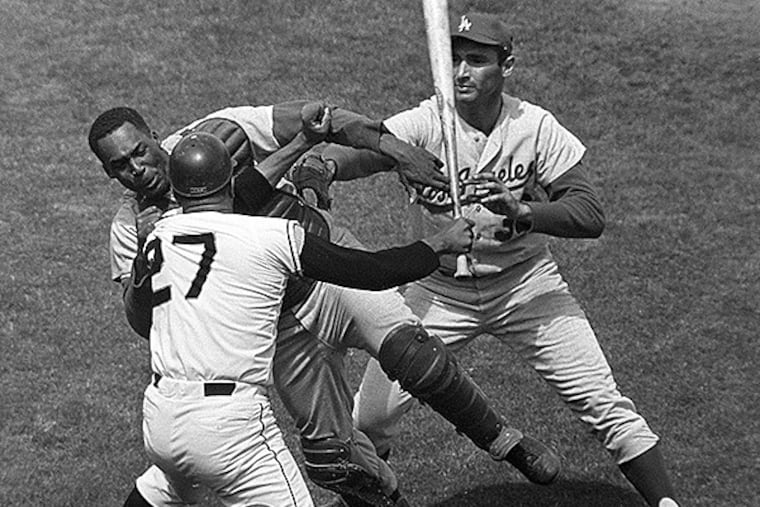
It was late August at Candlestick Park, and John Roseboro was looking for a reason to snap.
The Dodgers' catcher knew his pitcher, Sandy Koufax, wasn't going to throw at the batter, Giants pitcher Juan Marichal, despite Marichal throwing at a few Dodgers' heads in their last meeting. So Roseboro took it on himself to throw the ball back to Koufax a little close to Marichal's face in hopes that his intended offense would be noticed.
Marichal noticed.
He noticed so clearly that he brained Roseboro with the bat before heading out to the mound to deal with Koufax. And right behind him was umpire Henry Charles "Shag" Crawford, who didn't like where Marichal was going with this. Candlestick Park erupted into less of a brawl and more of an active crime scene.
Crawford put himself in the middle of one of the more notorious free-for-alls in baseball history, and it was one of the moments of pressurized officiating that got him in the Philadelphia Sports Hall of Fame Thursday night at the Society Hill Sheraton hotel. Having passed away in 2007, Crawford's son Joe was there in his place.
"Y'know, my father was one of those guys that… he didn't say much about his profession," says Joe, an NBA referee since 1977. "His whole thing was to hustle on the field. He was a skinny guy. Most umpires, y'know, are fat. And my father was skinny. And he hustled."
"He thought that that was a big part of umpiring. When I started doing basketball, he said 'I don't know anything about what you're doing. But I do know one thing: if you work hard, a lot of those players or coaches will overlook it if you're a hustling official.' And for the most part, he's right."
Watching baseball today, namely this year, viewers get an earful of the "unwritten rules," a bible of mythic baseball laws that revolve around "respecting the game" – seemingly, the Brian McCann and/or the St. Louis Cardinals parts of it. But Crawford wasn't tangled up in phantom stipulations; he was there to run a ball game.
"Big common sense guy, on the field," Joe continues. "He wasn't wrapped up in the rules and all that crap. He was just a common sense guy. He came back from the war, that was his ticket out; baseball, umpiring was his ticket. He was living in downtown Philly with four kids."
That common sense eventually included running into an infield melee in which Juan Marichal was brandishing a bat and Giants catcher John Roseboro was nursing a two-inch gash in his head.
But there Crawford was, ripping his mask off and trying to use common sense in a situation of which chaos had taken hold. Things eventually settled down, we can assume, since there isn't still a fight going on at the Stick, and there may not have been a cooler head to talk down a furious gaggle of ballplayers than Crawford; he'd survived the USS Walke as it was kamikaze'd by a Japanese pilot and would go on to send Earl Weaver to the showers in the first World Series ejection in history. One of the most vicious fights in pro baseball history was probably child's play.
Crawford came from Philadelphia's streets, and had his demeanor chiseled by his experiences in the second World War and the variety of jobs he took following it.
"He was an ice man, a milkman, he was doing all that stuff," Joe says. "He was doing baseball on the side. And a guy saw him and he called a Major League umpire and he said, 'Hey, I got this guy working my high school games…'"
But Crawford's instantly noticeable abilities were chiefly built from his base, established in Philadelphia.
"My father's passion was broadened by being a Philadelphian," Joe says. "By being brought up on these streets, he was passionate about baseball, because that was their thing back then. Back in those days, it was baseball and boxing, when he was growing up. And that transformed into his officiating, and that's what he was."
In 1950, without so much as an academy diploma or scouting report, the New York/Penn League had a contract in the mail addressed to the Crawfords' two bedroom house. Five years later, he was a National League umpire. And ten years after that, he was trying to keep Juan Marichal from bashing anybody else's head in, during a career in which he would see three World Series, two NLCS, two All-Star Games, and the first ever game at a place called Veterans Stadium.
"We didn't see him much," Joe recalls. "When he left for spring training, the only time we saw him after October was when he had the Phillies."
The system is different now, with umpires getting time off during the season, and MLB's current umpire roster features a couple of suspected divas; guys who want the game to be as much about their decisions as it is about the players' abilities. But it's still a job that, when done well, requires something that Crawford had in spades, and a word that's been used to describe Philadelphians for generations.
"He was a very, very passionate man," Joe remembers. "Very passionate."