Rich Hofmann: Eagles hopefully paying for the old DeSean
THE QUESTION was obvious, and it felt a little funny not knowing the answer after four seasons, but here it was: What is DeSean Jackson especially good at, other than being fast?
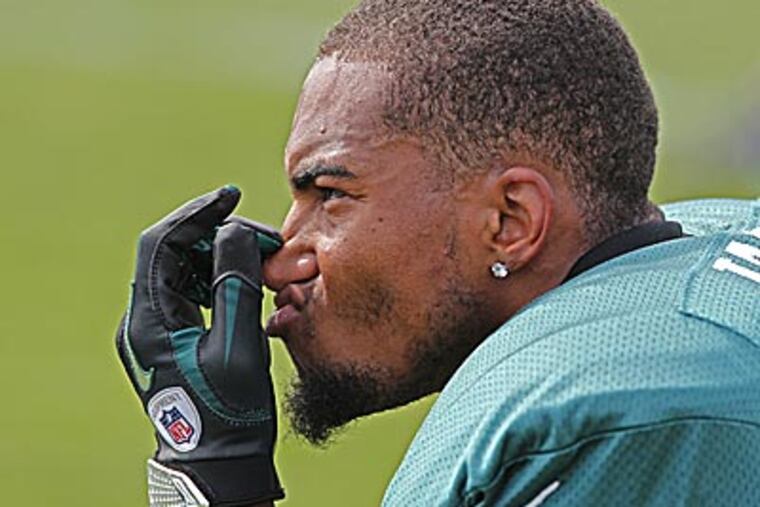
THE QUESTION was obvious, and it felt a little funny not knowing the answer after four seasons, but here it was: What is DeSean Jackson especially good at, other than being fast?
Here is what Marty Mornhinweg came up with:
"He'll go track the ball," the Eagles' offensive coordinator said. "As you know, he's great down the field, across the field, inside, breaking route. He's very, very good at those types of things. He also can get in and out of breaks very, very quickly . . .
"He's really sharp, he's got natural playing ability and that's what enabled him to play at such a high level so early in his rookie season. He was dynamite. The guys that are pretty sharp, they certainly have to have talent first - you have to have a certain amount of talent. But [he is] real sharp with the natural instincts, and if they stay healthy, they tend to help you early and then DeSean's been progressing ever since. He sure is a dynamic player for us."
But the progress hit a wall last season, when the Eagles did not accede to his contract demands. Jackson's production was down a bit, but that was just the beginning. He was benched for a November game against Arizona because he had missed most of a meeting the previous day. He was benched again, a couple of weeks later, in the fourth quarter of a loss to New England. But after that, he would apologize for his behavior and win back his head coach, Andy Reid. In the offseason, a team-friendly, long-term contract was signed (5 years for $51 million, with $15 million guaranteed). People around the team say that settling the contract situation has seemingly fixed everything.
"You definitely can" see a difference in Jackson, teammate Jason Avant said, "as far as his preparedness and his focus and his concentration. Also, he's just back to being a kid again, as far as his excitement and his love for the game. Sometimes in this game, because there's a business aspect of this game, sometimes you get your view tainted, when it comes to just playing this game like you're a child again."
Reid says he sees the same thing.
"He's put together a good training camp," the coach said. "I think he is in the right frame of mind, number one. What that will do is - this game, a lot of it is upstairs. I think his approach, all that stuff, everything that goes into it, working hard out on the practice field, timing with the quarterback, all those things are better than what they were last year."
Now comes the rebuilding, they hope. Over the last three seasons, according to profootballfocus.com, Jackson has the fourth-highest number of dropped passes (25) in the NFL. His drop rate - he failed to come up with 12.95 percent of catchable balls in that time period - also is fourth highest in the NFL.
Back in July, wide-receivers coach David Culley told reporters that the contract affected Jackson, in his preparation sometimes and on the field sometimes. He said, "I saw a couple of times last year where I saw him maybe trying to maybe save himself because, 'I'm not under contract and I don't want to get hurt.' I don't think there was a fear factor involved. I think it was more, 'I don't want to get hurt because I don't have a contract.' The first 2 1/2 years he was here, that wasn't an issue. A couple of times last year, that came up. And I believe it came up simply because of that."
This is the central issue. Was it the contract or was it a fear of getting hurt again after suffering two concussions in two seasons? The truth is that Jackson began to shy away from balls in the second half of the 2010 season, after he returned from the October concussion inflicted by Atlanta's Dunta Robinson. It was understandable enough. The Robinson hit was brutal; Jackson was laid out and knocked cold by that one, you will remember.
When it seemed to continue in 2011, and when he suffered another concussion, the situation was murkier. The Eagles, in signing Jackson to a new contract, are counting on the notion that it was the business uncertainty and not fear of another injury that left him less interested in making certain plays.
On Sunday, we begin to find out if they are right. And if they are, this offense will explode (in a good way) - because Jackson is just so fast.
Teams that attempt to press him at the line of scrimmage tend to regret it. Most teams play the corners soft and the safeties deep and live with whatever happens - and why the Eagles sometimes seem unwilling to force-feed Jackson the ball underneath is a mystery. Of course, a willingness to catch the ball over the middle is part of that.
Their best plays often involve getting Jackson in the slot, or in a bunch, and watching him find himself freed up in space as a result of the confused traffic. But it is the fear of the long ball that predominates; there were several notable plays last season where the safety cheated so far Jackson's way that somebody else was wide open.
Still, his deep numbers were down in 2011. He had only two catches where the pass was in the air for more than 40 yards (compared to four in each of the previous two seasons). He had only nine catches where the ball was in the air for more than 20 yards (compared to 12 in 2010).
Everything was down, really - catches (a little), touchdowns, red zone, punt-return average, yards per catch, all of it. The benchings created their own uproar, but the drop in the numbers was somewhere between subtle and significant.
Now, though, he has the money. We will see if it bought the Eagles offensive happiness.
Contact Rich Hofmann at hofmanr@phillynew.com. Follow him on Twitter @theidlerich. Read his blog at philly.com/TheIdleRich, or for recent columns go to philly.com/RichHofmann.