Dominique Wilkins offers perspective on road back from injury for Sixers' Brand
DOMINIQUE KNOWS. Dominique Wilkins, the "Human Highlight Film," knows where Elton Brand is, where the 76ers' forward wants to be and how to get there.
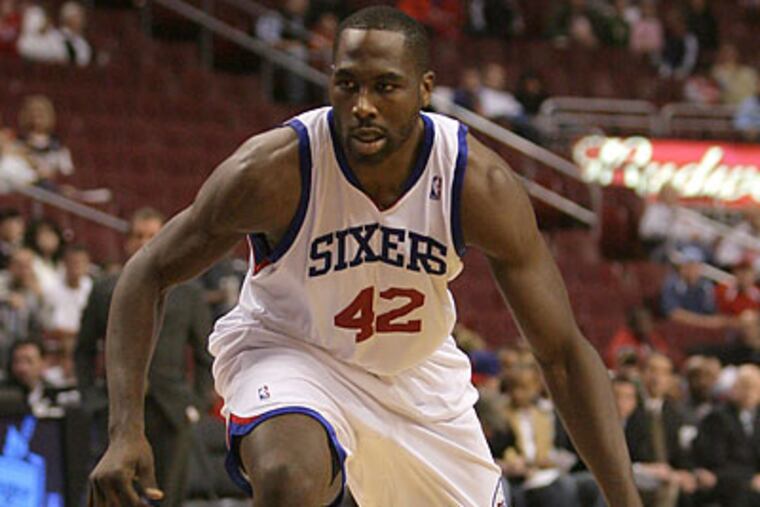
DOMINIQUE KNOWS.
Dominique Wilkins, the "Human Highlight Film," knows where Elton Brand is, where the 76ers' forward wants to be and how to get there.
Wilkins is one of the few - only - NBA stars to suffer a ruptured Achilles' tendon and come back to play at his previous level.
Wilkins, now 49 and a special assistant to the executive vice president of the Atlanta Hawks, was a nine-time All-Star. But he found his way onto two All-Star teams after his injury. And just to add a touch of irony to the story, he was hurt in a game against the Sixers on Jan. 28, 1992.
Brand was hurt during a workout in the summer of 2007, came back to play the last eight games of '07-08 with the Los Angeles Clippers, then left in free agency to sign a 5-year contract with the Sixers worth $79.8 million.
He appeared in 29 games last season, making 23 starts, limited by a dislocated right shoulder. He averaged 13.8 points and 8.8 rebounds, but he hardly resembled the guy who arrived with career averages of 20 points and 10 rebounds. His left calf was perhaps two-thirds the size of his right and veteran observers privately said he hadn't regained the explosiveness in his legs that had made him a two-time All-Star.
"I didn't feel too much pain [when it happened]," Brand said after completing this eight-game preseason averaging 9.5 points and 6.0 rebounds, "but it felt like a drum banging in my head. I can still hear it sometimes - pop. It's like, dang. The foot just went limp. There's a test that they do where they pull on a calf muscle, and if it doesn't snap back they know it's torn. You lay on your stomach and they pull that muscle . . . mine didn't snap back."
Dominique knows the script only too well.
"I was 31 when I got hurt," he recalled. "The doubters said I'd never come back. But I had a great doctor. He basically guaranteed me that I'd be as good, if not better. I knew I had to prove people wrong. I knew I had to work as hard as I could."
Others had tried, but with limited success.
Courtney Alexander's career ended on a ruptured Achilles' in a preseason game in 2003; Dan Dickau and Dominique's brother Gerald (he tore both Achilles' tendons) resumed their careers. Luke Jackson, the Sixers' rugged power forward, went down during the 1968-69 season; he played parts of three additional seasons but was never the same. When the Detroit Pistons' Isiah Thomas, a 12-time All-Star, went down April 19, 1994, at 33, he already had decided to retire at the conclusion of the season, and made no attempt at a comeback.
"I rehabbed twice a day for 7 1/2 months," Dominique Wilkins recalled. "I did water therapy, flexibility stuff, upper-body stuff. The most important part of that was, I had to focus. I had to make a commitment to what I was doing. I couldn't just rehab and work out, I had to be productive in what I was doing if I wanted to stay at the same level as a player."
He came back to average 29.9 points in '92-93, finishing as the league's No. 2 scorer behind Michael Jordan, and 26.0 points in '93-94. He developed his three-point shot. He understood that, while he could still do some things above the rim, he had to learn to "play on the ground."
"Dominique had depended on raw athleticism," said Thomas, preparing for his first season as the coach at Florida International. "But age erodes things like your ability to jump. With Elton, just judging from afar, he didn't have 'Nique's type of athleticism but he has an incredible work ethic. Maybe he'll come back the way Bernard King once came back from a knee injury."
Brand seems fully committed.
"[The leg] was 50, 60, maybe 70 percent healthy," he said, remembering his limitations at the start of last season. "It was good enough, though. I couldn't do a lot of the one-leg stuff, so I jumped off of two legs. I could do a lot of things on the court that weren't too detrimental to the game or the team. It didn't bring the level of my play down too much, I didn't think. I had to make adjustments. It's going to hurt your game a little bit, not being able to drive off two legs, and you lose some explosiveness, and that's what it's all about in the NBA."
Ed Stefanski, the Sixers president/general manager, said, "I see Elton moving better than he did last October, and that's something all the doctors told me we'd see. He's an integral part of our plan. We feel real good about our young guys, and it's important how he progresses with them. I've heard all the questions about whether he and Andre Iguodala can be on the floor together, but we have no issues with that. When we played Phoenix [in a preseason game] in Monterrey, Mexico, we had 16 fastbreak points in the first quarter. Elton was out there all 12 minutes."
"He has to get the rust off," Stefanski said, "but we expect him to be Elton Brand. We have to be patient, let him get acclimated. You can do all the rehab, go through all the practices and drills, but games are a different story."
Dominique's memory tells him, "I tried to do a little more each day, to build my level of confidence. That was the biggest problem, regaining my confidence. When I first went out on the court, I was very tentative. The first few times I fell, I cringed. I had to get the fear out of my head. I had to fall three or four times in the first couple of games to understand."
But Wilkins didn't merely want to resume his career: "I wanted to be an All-Star again."
"I think 40 percent of it is mental, 60 percent is physical," he said. "My plan was to focus on it mentally, and that would drive the physical side. There were days I didn't want to go to rehab. My wife pushed me. I went.
"I tore the right Achilles'. Now, it's stronger than the left. The calf isn't as big, but it's three times as strong."
Brand has spoken with Dickau, a point guard, "but not anybody who is a power player. For him, it's the same thing; the calf is still smaller. I don't know if the size of the calf will ever come back, that's just a matter of how your body responds. It's still muscle; you just have to see."
Wilkins said he knows Brand as a competitor. If he could speak with him, "I would say I worked on stuff I didn't want to work on. For me, I had to learn to play on the ground as much as in the air. I understood that athletic ability by itself doesn't take you through a 12-, 13-year career."
"I'd tell him to stay the course," Wilkins said. "It's a hard injury. But you can't let it defeat you."
As Brand rehabbed, he said, "You start thinking, 'Will this thing ever get better?' Especially during the first month or 2, you can't stand on your tippy toes on one leg and stuff like that. It's very disheartening. You have no idea when you're going to be able to run again and dunk again."
And now?
"It's still coming," he said. "I think I'm definitely right there. I think I'm getting very close to that [previous] level."