Bob Ford: Sixers' arrow pointing up, but it's still very early
Slackers that they are, the 76ers were off on Thursday. No practice, no game. Just the blissful freedom to leave the ankles untaped and the sneakers untied. Who says there's no rest for the weary?
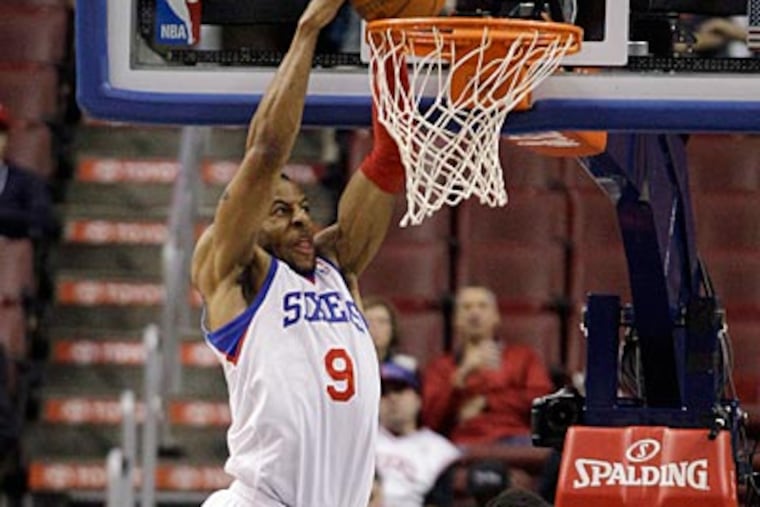
Slackers that they are, the 76ers were off on Thursday. No practice, no game. Just the blissful freedom to leave the ankles untaped and the sneakers untied. Who says there's no rest for the weary?
In racing through the first 10 games of the compressed NBA schedule - five of which were played in the previous six nights - the Sixers have certainly been overworked, but they have also overachieved. Their 7-3 record represents their best start in a decade and has fueled understandable optimism about just how much they have improved.
All of which leads to questions that can't be answered in the space of 10 games. How much, in fact, have they improved? Are they really overachieving or is this a team that can sustain its early pace and win somewhere around 45 games in a 66-game season? Is this a team capable, as former coach Jim Lynam insists, of winning the Eastern Division just two seasons since finishing 28 games under .500?
If the last of those questions is eventually answered with a "yes," then the turnaround will be more than remarkable, and not one that could have been predicted even after coach Doug Collins got them moving in the right direction last season. Without a true star on the roster, the Sixers have to rely on energy and collective talent. That's a dicey formula in the NBA, but so far the needle is still pointing up.
"This franchise, for 10 years it was star-driven with Allen Iverson," Collins said. "People came in to watch this little guy play incredible basketball. Now, we're trying to develop stars. That's who we are."
The problem is that stars, real stars, aren't developed in the NBA. They come into the league more than halfway there already. If you look at the Sixers roster, with the possible exception of rookie center Nikola Vucevic, there isn't a single player whose future place in the firmament isn't already pretty predictable. Vucevic has great footwork for a big man and he has the potential to become something special, and it's about time the Sixers got lucky in that regard.
As for the rest, there are some really nice players, including some young ones who will improve. But there isn't anyone on the roster who makes an opposing coach say, "Oh, God. We have to play Jrue Holiday tonight," or, "How am I ever going to stop Thaddeus Young tonight?"
The positive side of not having a caste system of royalty and footmen is that the Sixers are standing on the same step as they work together. Collins has them buying into the one-for-all mentality and it shows, sometimes to a fault. They often start games sluggishly on offense because it takes a little while to figure out the hot hand that evening. That was never really a problem with Iverson.
"Guys respect that if they're playing well, they'll be on the floor," Collins said. "If they're not in the game, they're either not doing what they're supposed to be doing or somebody is doing a better job."
It's a low-maintenance team, according to Collins, but there's nothing wrong with hanging a villager now and then to keep everyone's attention. Former first round draft pick Marreese Speights, whose dedication to defense was less than legendary, didn't even last until the home opener. Anybody else want to buck the program?
Defense is what has driven the bus so far, and that will have to continue if the Sixers are to have success, because they can't be counted on to outscore the other guy on a given night. Of their top six scorers this season - bunched between 15 points per game (Lou Williams) and 10.6 per game (Evan Turner) - three are starters and three are bench players. Try to find another NBA team with a similar distribution, which is, at once, a compliment to the Sixers' depth and an indictment of their starting firepower.
The offense sagged without the presence of Spencer Hawes on Wednesday night against the Knicks. (That's an amazing sentence, isn't it?) Hawes is a very good passer out of the post and suddenly the looks weren't as good. The Sixers shot 3-of-15 on three-point attempts and Knicks were able to survive a night in which they didn't shoot all that well, either, and tossed in 21 turnovers for good measure.
Maybe the Sixers, playing for the third straight night, just didn't have the legs and that would be understandable. They got outmuscled some, which was also a problem in previous games against Portland, Utah, and New Orleans.
What will be really interesting is a stretch in early February when the Sixers have to play a group of good teams in a quick burst, getting Chicago, Miami, Atlanta, the Lakers, San Antonio, and the Clippers between Feb. 1 and Feb. 10. So far this season the schedule, although compact, has been kind, and that will be a switch.
Taking the records of teams entering last night's games, the Sixers have played just four teams with a winning record and are 1-3 in those games. Their only win over a .500 or better team came against the Indiana Pacers on a night when leading scorer Danny Granger was out with food poisoning.
What does it mean? Right now, it doesn't mean much either way. It means they have played an energetic and successful 10 games and played consistently good defense. It also means there is a lot of basketball left.
That's a good thing. It wasn't that long ago that January marked the annual end of professional basketball in Philly. Now, it's just the beginning.