The second coming of shoe mogul Seth Berger
These days, Seth Berger's office is a cramped locker room that smells of overworn sneakers. There's a whiteboard with objectives for the next game ("Respect the opponent"), John Wooden's "Pyramid of Success" is pinned to one wall, and a muffled thud, thud, thud of dribbling basketballs in an adjacent gym provides a constant soundtrack.
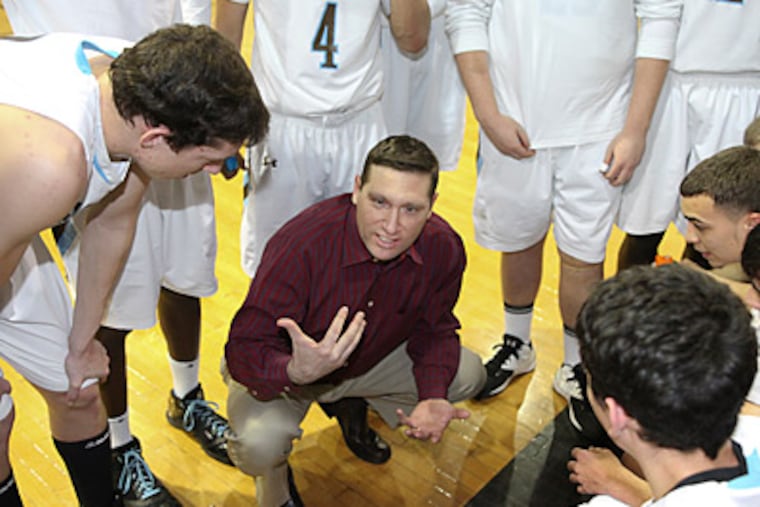
These days, Seth Berger's office is a cramped locker room that smells of overworn sneakers. There's a whiteboard with objectives for the next game ("Respect the opponent"), John Wooden's "Pyramid of Success" is pinned to one wall, and a muffled thud, thud, thud of dribbling basketballs in an adjacent gym provides a constant soundtrack.
In other words, it could be just about any coach's office at just about any high school in the country, which is exactly how Berger wants it.
Berger, 44, is head basketball coach at Westtown, a bucolic boarding school nestled on 600 acres in West Chester. At first glance, Westtown seems like an unlikely basketball power. The campus looks more like that of a small liberal-arts college, with an arboretum, a lake, and an organic teaching farm. The upper school costs $46,000 per year to attend. Yet since becoming coach, Berger has made Westtown's program one of the best in the region, drawing prospects from as far as Africa and Europe, and spectators such as Villanova coach Jay Wright and Temple's Fran Dunphy.
But the setting isn't the most remarkable thing about Westtown's ascent in the hoops world. It's Berger. Before becoming a volunteer assistant in 2005, after all, he had never coached a single game. For the previous 12 years, his energy had been focused on his high-profile - and highly profitable - business, AND 1, the basketball shoe and apparel company he cofounded and helped turn into a $280 million enterprise.
Today, though, when you bring up money or business, Berger winces. He would just as soon talk about scoring margins than profit margins. He even kicks his coaching salary back to the school.
"To me, I'm just a coach. Being in business, that was a prior life," Berger says.
Even so, 7 years removed from selling AND 1, Berger is doing on the court what he once did in the sneaker business: taking an upstart and turning it into a major player. The difference is that even when he was living the life of a business mogul - a life others often dream about - this is the life he always wanted.
"I can't think of a more fun way to make a difference in a kid's life than coaching high school basketball," he says. "It's been more intense, it's been a bigger intellectual challenge, and quite frankly, it's been more rewarding."
Or as Jay Coen Gilbert, an AND 1 co-founder and Berger's best friend since seventh grade, puts it: "It's a mistake to say that because Seth made a bunch of money at AND 1 that all of a sudden he had the freedom to become a high-school basketball coach . . . I think Seth would have become a basketball coach whether he was a UPS man, or whether a successful entrepreneur or whether he was running for political office."
Berger first played organized basketball in middle school. Born in Brooklyn, raised in Manhattan, he went to a prep school in the Bronx, where he played hoops and met Gilbert.
"The only two dream jobs for Seth were either point guard for the Knicks or high-school basketball coach," Gilbert says, joking that Berger, who played junior varsity as a freshman at Penn, still has visions of playing point guard for the Knicks.
After graduating from Penn, Berger dabbled in politics, spending 2 years on Capitol Hill before deciding to go to grad school. Although he originally wanted to get a master's degree in public policy, he figured he would be left with too much debt. Instead, he decided to get his MBA at Wharton, where he considered entering investment banking before acknowledging that the numbers weren't for him. In his second semester at the business school, he settled on going into the basketball business, working up an advanced study project for a business plan called "The Hoop," a basketball retail store. The project eventually led him and his partners to the shoe industry, whose major players at the time all focused on multiple sports. Berger thought he could tap the market of basketball devotees by focusing solely on hoops.
"If you give everything you got and you fail, in 2 years you'll be 27 with a Wharton degree, you'll go a get a job," Gilbert told him. "No wife, no kids, broke. Who cares?"
They named the company AND 1, a common bit of basketball jargon. When people came to him and told him they didn't understand what "AND 1" meant, Berger thought: Good. It's not meant for you.
"We viewed AND 1 as a company that was for and by basketball players," Berger says. "We never tried to be a renegade company. Make products, make marketing that spoke with and spoke for basketball players."
Yet, they fit the image of the renegade company. One of their most notable endorsers was Latrell Sprewell, who signed with the company after the NBA suspended him in 1997 for 68 games when he was with Golden State and choked coach P.J. Carlesimo. When Sprewell was traded to New York and led the Knicks to the NBA Finals the next year, AND 1 embraced his reputation not by offering apologies but by offering a story. It was a 30-second spot of Sprewell getting his hair braided into cornrows. Jimi Hendrix's famous Woodstock rendition of the national anthem played in the background. Sprewell looked into the camera and said: "I've made mistakes, but I don't let them keep me down. People say I'm what's wrong with sports. I say I'm a three-time NBA All-Star. People say I'm America's worst nightmare. I say I'm the American dream."
The brand would come to have a devoted following. So much so that some players, including former Sixers guard Larry Hughes, sported tattoos of the company's logo.
"When they were at their peak, they took market share from Nike," says Matt Powell, a shoe-industry analyst from SportsOneSource. "They were an extremely formidable competitor to Nike in the basketball sense . . . I think people were looking for an alternative to [Michael] Jordan, partly because of price, partly because of style. They came out with some looks that were unique and marketed them in a unique way. The time was right for an upstart company like that."
At its peak, the company had 23 percent of the NBA wearing its sneakers. Yet AND 1's most noticeable influence came away from the NBA. They thrived with mix tapes, going on tours with street-ball players who did ball tricks, and sold trash-talking T-shirts with slogans such as "My game is like rice, one minute and you're done" and "Here's $5, go buy a game." At one point, they trailed only Nike in the basketball market. But as tastes changed and basketball sneakers became less fashionable off the court, the company's revenues started to decline. Plus, there was the realization that no matter how big the company got, the company could never overtake the behemoth from Beaverton, Ore.
"I knew we couldn't beat Nike," Berger says. "I had been in business for 12 years; it was time to go make a difference."
When Seth Berger was working on Capitol Hill, he had a conversation with a friend. If you could somehow earn enough money to feel comfortable - comfortable enough to turn your back on the life you've created and pursue the life you really wanted - what would you do?
It's the sort of conversation you have when you're 21, when idealism and the ability to pay the rent haven't yet gone their separate ways. Even then, though, Berger knew he eventually wanted to work with teenagers. Even then he knew he wanted to be a high-school basketball coach.
On his way to start his new life, however, Berger had to deal with the obstacle of never having coached basketball. So at age 37, he started as a volunteer assistant at Westtown, learning how to do the job. He studied the game and developed a relationship with the players, gaining enough experience that he considered looking elsewhere for head-coaching jobs before Westtown hired him to replace its retiring coach in 2007.
"He presented a growth plan, if you will, for the program," says athletic director Jeannette Cooper. "One was a commitment to a long-term association with the school and the basketball program. He understood where we were at that point, sort of in the middle of the pack. He wanted to move that forward, certainly with support from the school and myself. He was articulate about some of the training things he wanted to do, and we were able to support that. He was particular about connections he had . . . He felt strongly we had to find some other kids to have interest in school who have basketball talent."
After being named head coach, Berger became the school's chief recruiter, scouring summer basketball camps to find players. Westtown does not offer athletic scholarships; players must fit within the school's academic profile, and the players who've gone on from Westtown to play in college usually attend schools such as Brown or Skidmore - not exactly hoops factories.
"From my point of view, Seth has been much more vigilant about the kids he talks to and where they stand academically," Cooper says. "We might have taken some risk on some students before his coming. They might have been a little more challenging. But it's been much improved. His eyes are more vigilant. And, quite frankly, he won't win a battle with the admissions office if we don't think the kid will thrive."
Berger's efforts are helped by the fact that the school is not restricted by geography. Because Westtown is a boarding school, it has the ability the attract players from pretty much anywhere, and the team mirrors the school's geographic diversity, with 14.4 percent of its K-12 students from 17 states outside Pennsylvania. The upper school is even more diverse, with students from 18 countries. On Berger's team, six of the 12 players are from Pennsylvania and one is from New Jersey. Two are from Nigeria, one is from Lithuania, one is from Virginia. Daniel Ochefu, meanwhile, grew up in Nigeria and Maryland.
Berger was turned on to Ochefu by a friend who attended a Sixers camp where Ochefu was playing. At the time, he was a 6-7 14-year-old. Berger saw Ochefu miss a layup and hustle back on defense without complaining. Berger thought that was his kind of player. Ochefu, who lived in Nigeria at the time, visited Westtown with his parents while in the states for the summer and was impressed with the campus. He enrolled as a freshman, bypassing basketball hotbeds such as Oak Hill Academy in Virginia and Georgetown Prep in Maryland. In his time at Westtown, Ochefu has become the face of Berger's program.
"I really liked Seth when I first met him, and my parents liked him, too," Ochefu says. "He definitely had great connections because of AND 1. And I really liked the focus on academics and athletics."
Berger soon discovered what the successful college coaches who visit Westtown learn.
"Once we got three players in, other players want to come," Berger says. "I think now when kids are good ballplayers and good students, Westtown is one of the schools they consider - instate, out-of-state and out of the country."
That was the case for senior Jeremy Schulkin, who transferred to Westtown from the Solebury School, in Bucks County, for his final season in hopes of becoming more appealing to Ivy and Patriot League schools. It can only help playing with Ochefu, who has committed to Villanova after also drawing interest from Georgetown and Temple, and with Nigerian junior Yilret Yiljep, who has scholarship offers from La Salle, Temple and Lafayette, among others.
"He's really built that program up tremendously," says Lafayette coach Fran O'Hanlon, a former Penn assistant who knew Berger at Penn. "On our radar and everyone's radar. Before Seth got there, it certainly wasn't a basketball school. He's carried that thing and made it special."
During a Wednesday practice, Berger had a minute-by-minute plan for the session. The first 30 minutes were devoted to reviewing the previous day's work, with the team split into two groups. Then they worked on the three-man weave, beginning with chest passes and finishing with a layup. Then it was on to rebounding and outlet passes, leading to layups and jump shots. For each drill, there was a tangible goal, whether it was making 24 layups or 18 jumpers.
Berger emphasizes fundamentals. Many players are, like him, still learning the game. When he stops a drill, he explains why and provides real-life examples of why it should be done a certain way. While explaining passing accuracy, he cites North Carolina's Kendall Marshall. When discussing conditioning, he mentions Michael Jordan. The reason for the lengthy explanations, he says, is that his players are intelligent and want to know why as much as what.
" 'Because I said so' is not an acceptable answer here, because the kids are so smart," Berger says. "My learning curve is still so steep. I'm still really, really young as a coach."
Berger is constantly tapping into his network of basketball connections, including college coaches, to make himself a better coach. He calls some college coaches at least once a week, and attends college practices at least twice per season. Three times per week starting in the fall, Berger bounces ideas and seeks input from Villanova associate head coach Billy Lange, formerly Navy's coach, and Church Farm School coach Marc Turner, a former Villanova assistant.
At home, Berger has more than 100 basketball DVDs from various coaches. He's watched some more than three times. He bases his offense off of O'Hanlon's system at Lafayette. He gets his defense and game management from observing Dunphy at Temple. His pressure defense and personnel management comes from Turner, and he models his individual instruction off what he's learned from Wright.
Like other coaches, losses irk him more than wins satisfy him. He can provide blow-by-blow accounts of what happened in games - whether it was against nationally acclaimed Oak Hill or league-rival Friends Central - and admits that he needs to become less frustrated by a player's mistake.
Berger doesn't talk with his players much about his former life. He cares more about what the players will do in the future than what he has done in the past.
In the locker room before a game against Moorestown Friends, Berger asks former Villanova standout Harold Jensen to explain how the lessons of teamwork transcend basketball. The teenagers' eyes sometimes wander - they had school that day and a game in a few minutes. But Berger sits at attention, nodding to the points that resonated.
After the speech, Berger explains to the players why Jensen should matter to them. That's when it becomes clear that this is more a vocation for Berger and not an overreaction to a midlife crisis. Instead, spending a Friday evening diagramming defenses in a middle-of-the-century gymnasium appeared every bit his idea of paradise.
"This is what I'm supposed to be doing with my life," Berger says. "It's where I'm meant to be."