Stan Hochman: Schayes recalls Syracuse Nationals' move to Philly
DOLPH SCHAYES was nearing the creaky-knee end of a Hall of Fame career when his team, the Syracuse Nationals, moved to Philadelphia 50 years ago. Surprised?
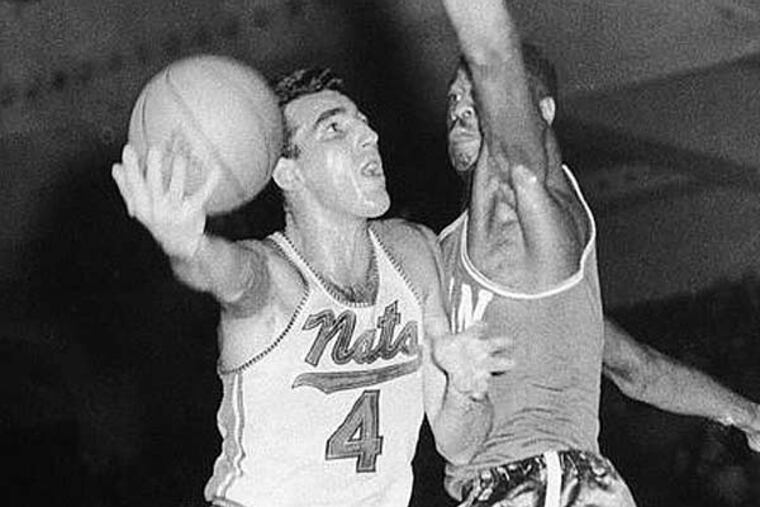
DOLPH SCHAYES was nearing the creaky-knee end of a Hall of Fame career when his team, the Syracuse Nationals, moved to Philadelphia 50 years ago. Surprised?
"I read about it in the papers," Schayes recalled the other day. "Larry Costello was on his honeymoon. He heard about it in Bermuda."
Schayes is 84, living in Syracuse, his wit dry, his memory sharp. (I'm 84, so maybe someone can consult the Guinness folks, and see if we set a record for combined age, writer-subject, sports story.)
To Schayes, the move made cents, as in dollars and cents. "We had a relatively new arena," he said, "but it only held about 6,000. Salaries were going up, although the most I ever made was $20,000.
"With two teams in California, travel expenses were going up. Danny Biasone, the owner, was not a wealthy man. He had a little restaurant that he mortgaged to support the team.
"I've been told that when Bob Short was moving the Lakers from Minnesota to California, he talked to Danny. The league wanted two teams out west, to justify travel expenses. Short offered Danny LA or San Francisco. Danny wanted to stay put in Syracuse.
"That's when Eddie Gottlieb sold the Warriors to Franklin Mieuli and they moved to Frisco. So that left a gap in Philly, although they had the Tuck Tapers [of the American Basketball League]. They had a guy named Sym-o-lewski on the team and every time he made a basket, Dave Zinkoff would holler, 'Deuceski by Sym-o-lewski.' "
Those were the bad old days. And then here came the transplanted Nationals with Hal Greer and Lee Shafer and Red Kerr.
"They were loaded at forward and my knees were bad, so [co-owners Irv Kosloff and Ike Richman] asked me if I wanted to coach. Alex Hannum had gone west to [coach the Warriors].
"I had mixed feelings. I was closing in on 20,000 points and I wanted to play, so we worked out a player-coach deal. Looking back I wished I had eased into coaching, learning the trade."
Schayes and the Sixers staggered right into the middle of a bitter feud, ignoring the adage that you don't pick a fight with a guy who buys ink by the barrel.
"We were getting set to start the [1963-64] season and there were no stories in the papers," Schayes said. "Not a word. Paul Arizin had not gone west with the Warriors and he was playing for Spike's Trophies, and they got stories and we got nothing.
"Somewhere along the line, I was told that the Sixers were looking for a general manager and that they wanted to hire the sports anchor guy away from Mr. [Walter] Annenberg's television station. Les Keiter.
"Mr. Annenberg got really hissed off and set the policy of no publicity for the team."
(The way I remember it, it was one paragraph for a win, two paragraphs for a loss.)
The 76ers got a lukewarm reception at Convention Hall.
"We also played some games in high school gyms," Schayes remembered sadly. "Played in Wilkes-Barre, played in Scranton. We had a good team, won 34 games, finished third in the East, still made the playoffs, but lost to Cincinnati in the first round."
The next year they were 40-40 and played a memorable seventh game against Boston in the division finals. The one that ended with John Havlicek stealing Hal Greer's inbounds pass, preserving a one-point lead.
"We'd won three games at home, they'd won three games at home," Schayes said. "Seventh game up there, one of the greatest games ever played. Havlicek stole the ball. I could give you 30 minutes on that play alone."
Midway through that second season, the phone rang at 4 a.m.
"Who calls at 4 in the morning?" Schayes wondered. "It has to be bad news, an accident, a death in the family.
"It was Larry Merchant from the Daily News. He says, 'How does it feel to be the coach of the greatest player in the game, Wilt Chamberlain?' I said, 'It feels great, now let me get back to sleep.' "
There were some wounds to heal.
"Wilt was an awful foul shooter," Schayes explained. "Under 50 percent. I told a writer, how could Wilt be considered the greatest player in the game when he only hits 40 percent of his free throws? Wilt was angry about me saying that.
"Years later, after he passed away, his sister told me that Wilt was excited about coming, that he could work with me, improve his free-throw shooting. We worked at it, day after day after day.
"Back then, we got the feeling Wilt was not happy about coming back to Philadelphia. He had an apartment in New York. He was a night person. So we scheduled practices in the afternoon, giving him time to get down to Philly. Not everybody liked that. But he was a good person, a good guy.
"I looked around, saw the talent we had: Wilt, Chet Walker, Hal Greer, Luke Jackson, Billy Cunningham, so towards the end I played only seven guys and we won 55 games. But we lost to Boston in the division finals [in 1966]."
The next year, Hannum replaced Schayes as coach and the Sixers finished a dominating 68-13.
"One conversation changed everything," Schayes said. "Hannum took Wilt aside, told him they had all the scoring in the world. Told him he wanted him to rebound, to pass, to block shots. Told him he wouldn't be scoring 40 a game. That conversation made the difference."
Wilt only averaged 24 points a game, but he finished first in the league in rebounding and third in the league in assists and the Sixers won the NBA title and a place in the history books as the greatest NBA team ever assembled.