Beloved ex-Sixer Caldwell Jones dies at 64
Caldwell Jones played in three NBA Finals with the colorful Sixers teams from 1976-82.
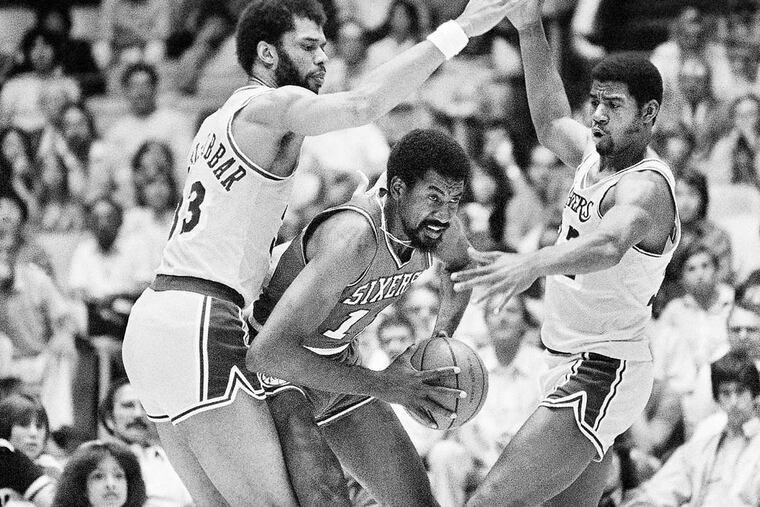
IT WAS THE SUMMER of 1982 and the 76ers, who had been to three of the last six NBA Finals and lost each of them, were on the verge of a blockbuster deal that would give them the league's most dominant center.
Moses Malone had averaged 31.1 points and 14.7 rebounds for the Houston Rockets in 1981-82 and won the league's MVP award. He became a restricted free agent after the season and the Sixers and Rockets had worked out a deal that would bring Malone east and send 6-11 center Caldwell Jones and a 1983 first-round pick to Houston.
The deal was just about to be completed when a major problem arose. Malone balked at the trade because Jones was going to be shipped out.
"Houston was adamant that in order for the trade to happen they wanted Caldwell Jones and that first-round pick," said Orlando Magic senior vice president Pat Williams, who was the Sixers' general manager then.
"Although we loved C.J., it was really a move we had to make. But Moses almost blew it up because he wanted to be teammates with Caldwell. He had known him from mostly playing against him in the ABA and respected him that much. I had to call Harold [Katz, the Sixers' owner] in a panic. He came flying down to the offices and convinced Moses to agree to the trade. That's how much Caldwell Jones meant to people. He was a terrific man."
Jones, an Arkansas native who spent six of his 14 NBA seasons with the Sixers (1976-82), including those three empty Finals appearances, died Sunday at 64 of a massive heart attack in Georgia after spending the day with his wife and three daughters in church and then hitting some golf balls at the local course.
On Sixers teams that included stars (and big personalities) such as Julius Erving, George McGinnis, Doug Collins, Lloyd Free and Darryl Dawkins, Jones was that quiet guy who didn't need points to speak for his game, rather relying on playing strong defense, corralling rebounds and blocking shots. He was the steady, silent, reliable player who coach Billy Cunningham could rely on nearly every night, as Jones missed just 10 games during his time in Philadelphia.
"I loved him," Cunningham said. "He was the type of guy who would play with a broken nose, a broken hand, and never say a word. He was from the same mold as Bobby Jones, just two guys who care nothing about themselves and everything about the team.
"When we made the trade for Moses, I knew that Caldwell had to go and it was very difficult for me because I loved him so much as a person. I couldn't allow myself to be emotional about it because I knew it was the right thing for the team, but it wasn't easy. I had to convince myself that it was the right business move, but it wasn't easy."
The Sixers, of course, breezed through the 1982-83 season, going 65-17 during the regular season and 12-1 in the playoffs to capture the elusive NBA title. Malone averaged 24.5 points and 15.3 rebounds during the regular season and 26 points and 15.8 boards during the playoffs. He was MVP of the league and of the Finals.
Jones was taken by the Sixers in the second round of the 1973 draft (No. 32), but played three seasons in the ABA before playing for the Sixers and then four other NBA teams. Three of his brothers, Charles, Major and Wil, also played in the NBA. Caldwell averaged 6.2 points, 7.2 rebounds and 1.4 blocks in the NBA.
When the Sixers played in Houston the season after winning the championship with Malone, Cunningham hunted down his former center.
"I told Caldwell that even though he wasn't on that championship team, he was a huge part of it," Cunningham said. "I pulled out my championship ring and I told him I wanted him to have it. I already had a ring [as a player for the Sixers in 1966-67] and I really wanted him to have it. He just laughed me off and didn't take it.
"He was such a father figure to so many players, a great guy who had a wonderful sense of humor, especially after two beers. He was low-key and had no ego. He just put his head down, did what he was asked. I can still see him and Maurice [Cheeks], two of the quietest guys, sitting next to each other in the locker room and laughing so hard. He will be missed."