Sixers seem better at one long-range strategy over another
Sixers might have a good, long-range plan to improve, but in the short run, their long-range defense isn't much.
I SUPPOSE I could start this and all columns about the Sixers for the foreseeable future with this disclaimer: "Don't worry; it'll all be worth it in two, three or four more seasons when the plan comes together."
After all, I've been told that the Sixers deserve credit for being transparent about their decision to sacrifice the present in an effort to build long-term success.
None of this bad basketball should be a surprise. If you can't stomach the growing pains of "building together" then come back in 2016-17, when hopefully things will begin to kick into gear.
But I can't look at it like that.
I get what the Sixers are doing, long-range. Still, to me, each team is an individual entity that should be measured based on what it currently is - not what it might be three or four seasons down the road.
I'll be ready to discuss Joel Embiid, Dario Saric and the first-round draft pick the Sixers got by trading away savvy veteran Thaddeus Young when they are actually on the court contributing to the cause.
In the meantime, the 2014-15 version of the Sixers is playing a season because the NBA isn't going to stop while the Sixers try to play catch-up.
I'm going to look at this team in that context, because that is the reality of NBA basketball in Philadelphia for the next 6 months.
Still, you want to be fair. You don't want to take the simple approach every night and say this team just doesn't have enough talent to win in the NBA - although you could.
But how do you measure the 2014-15 Philadelphia 76ers? If it's not going to show up that often in the win column, what are the indications that things are moving forward?
"I think I would answer that in two ways," Sixers coach Brett Brown said. "I would first go to the individuals . . . [Improvement from] the pieces are a fair judgment.
"What I hope, from a team standpoint, is that people say, 'They're getting better defensively,' because we were poor last year. I think the numbers will bear out that we are trying to build and grow a defensive program.
"I hope that the numbers bear out, after the 82 games, that say what I just said we spend a lot of time doing. I think those measurements are things the fans and writers can accurately assess."
Well, right now at this particular moment, that would be an issue.
Last night at the Wells Fargo Center, the Sixers suffered their fourth straight loss to start the season by dropping a 104-93 decision to the Houston Rockets.
It was the third time in those four games that they surrendered at least 100 points and the fourth time in those four games that they lost by double digits.
I don't recall too many good defensive teams that allow stuff like that.
For a team that freely acknowledges it has no reliable scoring options, in part because it has been focused on establishing a defensive foundation, the Sixers are a confusing unit.
In some ways, such as forcing turnovers and protecting the rim, they look as if they are on to something, but in other ways, particularly at big moments, their lack of NBA concepts, experience and ability becomes glaringly bad.
Just as in last season, the Sixers couldn't stop a three-point shot if the shooter held the ball in front of them before letting it fly.
The Sixers yielded 16 made three-pointers to Houston and have progressively allowed more treys to be scored in each successive game.
And they always seem to come at the wrong time.
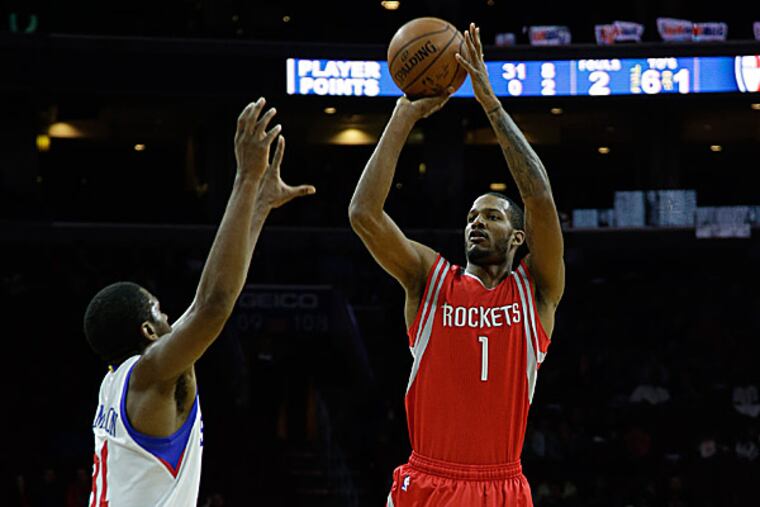
Against the Rockets, for instance, the Sixers were hanging close at 90-84 with 5 1/2 minutes remaining when Rockets guard Isaiah Canaan made consecutive threes.
Trevor Ariza made a trey, followed by one from James Harden, and just like that, the Rockets had put together a 12-2 run that made the score 102-86 and put the game to rest.
"I know this is a question that comes up all the time about us guarding the three-point line," Brown said. "My gut feeling is a lot of them were borne out of an abundance of turnovers.
"I am sure there will be some where you just scratch your head and say, 'We've got to do better,' and better we will try."
How do you measure "will try"? And will "trying" be enough to satisfy a fan base that already knows there will not be a lot of wins coming its way?
Houston is considered one of the marquee teams in the Western Conference and features Harden and fellow All-Star Dwight Howard.
Still, the attendance dropped from the season opener against Miami by more than 6,600, to 12,896.
If everything goes according to design, in 3 or 4 years, it might all be worth it, but until then, there is the here and now - which isn't looking all that good.
Columns: ph.ly/Smallwood