76ers’ great Moses Malone has died at age 60
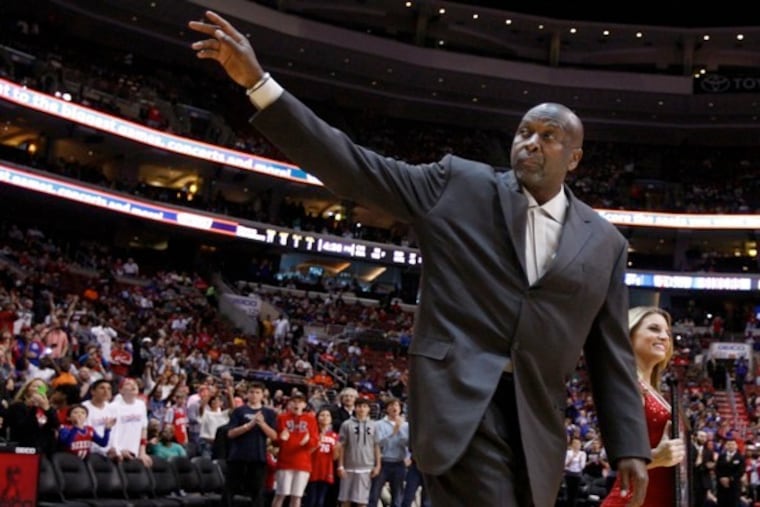
AFTER THE 76ERS had acquired Julius Erving before the 1976-77 season, the team went on a run of being eliminated in the NBA Finals three times and the Eastern Conference Finals twice in a six-year span.
While those teams were composed of other star-level players such as Doug Collins, George McGinnis, Bobby Jones, Darryl Dawkins and Lloyd Free, to name a few, there was an ingredient missing.
Billy Cunningham, who took over as head coach before the 1977-78 season, knew exactly what it was.
"What we needed was that physical presence," Cunningham said yesterday. "As good as Darryl and Caldwell Jones were, they weren't able to take us to the next level. With Doc [Erving] and Bobby Jones and the others, we had great athletes. We needed exactly what we got."
What the Sixers got in the summer of 1982 was Moses Malone, the player everyone thought could take the organization to the promised land. He delivered, carrying the team to its only title since the 1967 season. Though he promised to deliver the title in "Fo', fo', fo' " fashion, the team actually needed 13 games to garner the championship after a sweep of the Los Angeles Lakers in the championship series.
Malone passed away yesterday morning in his sleep in Norfolk, Va., at the age of 60. Sadly, the two players from whom Malone took over the center position - Dawkins and Caldwell Jones - also died in the past year, from heart attacks.
In his first season with the Sixers, Malone won MVP honors by averaging 24.5 points and 15.3 rebounds during the regular season in which the team compiled a 65-17 record. In those 13 playoff games, in which the Sixers stomped their way to the championship in three series, Malone averaged 26 points and 15.8 rebounds, garnering Finals MVP.
"I was just with him and Darryl at the ceremony at the Wells Fargo Center when the team unveiled their new uniforms [in mid-June] and then had lunch with Moses and Bobby Jones a couple of weeks after that," Cunningham said. "As always, he was so much fun to be around."
When the name of Moses Malone comes up, it is usually followed by laughs and a story. John Nash, who was assistant general manager for the Sixers when Malone was acquired from the Houston Rockets, shared one yesterday.
"I could write a play about us acquiring Moses," said Nash. "[Owner] Harold Katz called me on a Sunday and said he wanted to get it done. But he was in Las Vegas, [general manager] Pat Williams was in China with Julius on a goodwill tour for the NBA, Billy was in North Carolina on a golf trip and Moses was in Houston. Somehow, we got everyone together, except for Billy, at 7 o'clock that Tuesday night in the Grand Hyatt in New York. We waited for Billy for about 30-to-45 awkward minutes before he came into the room, with his golf clubs over his shoulder. When we asked what took him so long, he said the cab ride was too expensive from Newark Airport, so he took the train in.
"It took until 2:30 in the morning to iron things out, and about two weeks later the deal was finally officially done - though Moses decided to go on a radio station in Virginia the morning after we talked and announced he had signed with the Sixers. It was crazy."
At the time, the deal was the largest for a player in team sports. Malone's contract was for six years at $2.2 million a season. After he averaged 23.9 points and 13.4 rebounds in four seasons, the Sixers traded him and forward Terry Catledge to the Washington Bullets for Jeff Ruland in one of the most-hated deals in Philly sports history. He would return in 1993-94 and average 17.1 points and 13.2 rebounds at age 38 in his next-to-last season.
But few players in this city's sports history, maybe none, connected with the fans with their style of play the way Malone did. There was that ever-present scowl when he was on the court, soaked with sweat, and that jovial smile and large laugh when he was off it that drew so many to embrace him.
"When we got him, we knew all about him," said Maurice Cheeks, the starting point guard on that 1983 team. "He was an MVP. He had great numbers. But we didn't know who he was. Well, it didn't take long for us to mesh with him on the court, and it certainly didn't take long to love him off of it, too.
"When I think of Moses, besides the numbers and the great player, he was a great person. I just think of that laugh. I can still hear it. He would still tease me about pancakes. We had a noon game one time in Milwaukee and Moses was a little late coming down from his room. He saw me eating pancakes and asked me for some. I said no and he couldn't believe it. He teased me for years about those pancakes. It breaks me down to think this has happened."
In that initial meeting in New York, Cunningham pulled Malone aside and let him know his expectations of the player who had won MVP honors in Houston the previous season by averaging 31.1 points and 14.7 rebounds.
"Before we signed, we went into a room and I asked if he could deal with what we want to do," Cunningham said. "I said that we expected him to rebound defensively and get it out and let us run as much as we could, then we'd look for you inside. He said he was 100 percent on board.
"A lot of players were unsettled by the trades we made, popular guys like Darryl and Caldwell. But after two days in training camp with Moses, they understood. Moses' favorite player was Julius. He would just like to play, leave and not talk to anybody. His hero was Doc and he wanted to win it for him. Moses was the smartest player I've been around in my life. Moses knew every player, their strengths and weaknesses, everybody on the court. He was just a basketball junkie."
Malone grew up in Petersburg, Va., and signed a contract with the ABA's Utah Stars following high school. He played two seasons in the ABA before bursting onto the scene in the NBA, where he played 19 seasons. He was a 12-time NBA All-Star, won three MVPs and led the league in rebounding six times. He averaged at least 20 points for 11 straight seasons, was named to the league's 50th anniversary all-time team in 1995 and was inducted into the Naismith Memorial Hall of Fame in 2001.
Said Sixers CEO Scott O'Neil in a statement: "It is with a deep sense of sadness that the Sixers family mourns the sudden loss of Moses Malone. It is difficult to express what his contributions to this organization - both as a friend and player - have meant to us, the city of Philadelphia and his faithful fans. Moses holds a special place in our hearts and will forever be remembered as a genuine icon and pillar of the most storied era in the history of Philadelphia 76ers basketball. No one person has ever conveyed more with so few words - including three of the most iconic in this city's history. His generosity, towering personality and incomparable sense of humor will truly be missed."
Blog: ph.ly/Sixerville