A few thoughts on how Jimmy Butler would fit with the Sixers | David Murphy
Timberwolves star Jimmy Butler is available, but is he the kind of star the Sixers need?
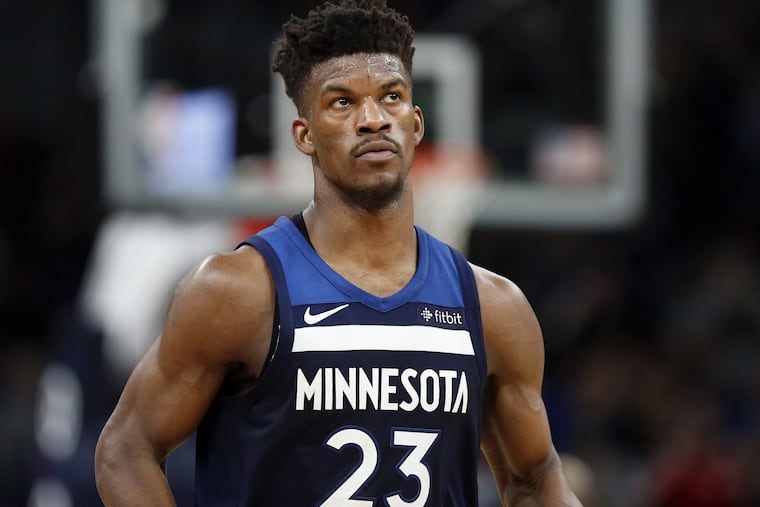
There might come a point in time when it makes sense for the Sixers to cash in their considerable trade and financial capital on a player who is something less than a transcendental superstar. But now is not that time, and Jimmy Butler is not that player.
When news broke a week ago that the two-time all-NBA wing was on his way out of Minnesota, it was fair to wonder whether opportunity was finally smiling on the Sixers. Their much publicized flirtations with LeBron James and Kawhi Leonard may have been dead ends from the start, but the market is now a lot different than it had been at the start of the summer, when teams were still in the early stages of constructing their rosters for the upcoming season. Here was a four-time NBA all-defensive player who'd averaged at least 20 points per game in each of the previous four seasons, available to be had from a team that had all but resigned itself to trading him away. Surely, this was a bidding war the Sixers could win.
Could? Perhaps.
Should? No.
There's no doubt that the Sixers would be better with Butler, just as they would be better with any number of players throughout the league. But the pertinent question is whether they would be as good as they possibly could be when considering the other options that will arise between now and the end of next summer, when they'll need to have settled on a definitive blueprint for the next four to five seasons.
Three reasons:
1. Butler is the wrong kind of ball-dominant player to slot alongside Ben Simmons. This is particularly true in the Sixers' offense, which prioritizes ball movement and spacing, the latter of which is generated by a willingness and ability to shoot the three. Butler isn't a poor shooter, but his percentages put him at the lower end of what the Sixers could conceivably get away with in a rotation that features Simmons running point. Last season, he knocked down threes at a .350 clip, a mark that ranked 105th out of 136 players who averaged at least three attempts per game (min.: 50 games). That's 70 points lower than what J.J. Redick shot, 35 points lower than what Marco Belinelli shot, and 19 points lower than what Robert Covington shot. In other words, a lineup with Butler at the two or the three would likely be a worse-shooting lineup than the most effective ones that the Sixers fielded in 2017-18.
There's an argument that Butler would be a better shooter within the confines of the Sixers offense, and that his ability to defend the perimeter and create off the dribble would more than make up for any drop off in pure shooting ability.
But the question of fit goes far beyond the three-point line. Much of Butler's production throughout his career has come with the ball in his hand. Last year, 60 percent of his field goals were unassisted. For comparison's sake, Paul George checked in at roughly 45 percent. Creating off the dribble is not a bad thing in and of itself. But the Sixers are a ball movement team. Last year, 66 percent of their field goals were assisted, second only to the Warriors.
2. Butler has already failed to fit in with two young teams, and his tenure in Minnesota raises serious questions about how he would fit into an offense that draws its identity from Simmons and Embiid. Like the Sixers, the Timberwolves had a couple of young ball-dominant scorers in Karl Anthony-Towns and Andrew Wiggins. Like the Sixers, they had a veteran coach in Tom Thibodeau. The most recent reports say that Butler has identified the Heat as his preferred landing spot. It might not be a coincidence that Butler would be the undisputed primary scoring option in Miami.
Unlike Leonard, who thrived in a star-laden environment in San Antonio, and George, who managed to coexist while playing alongside Russell Westbrook, or LeBron, who is LeBron, Butler has yet to show that he can mesh with other strong on-court personalities. He is an alpha, plain and simple. Any trade would come with the risk that he is too alpha for the dynamic that exists with the Sixers.
3. Butler is 29 years old. By no means is he over the hill. But by no means is he on the upside of his prime. Forget about whether he would be willing to re-sign with the Sixers next summer. While it's an important part of any equation that has the Sixers parting with assets to acquire him, a more pressing question is whether the Sixers should even want to give a max contract to a player who would be 33 years old in the fourth year of such a deal.
As was recently noted by the website 538, Butler has played 45+ minutes in 26 games since the 2013-14 season, by far the most in the NBA. The indefatigable LeBron James, by comparison, is second with 15 such games.
The Sixers have a finite window to spend their salary cap dollars. At some point, that might mean settling for a player who is less than a perfect fit. Yet they are still very much in the midst of finding out what, exactly, the perfect fit looks like. How will Simmons' game mature in his second season? What is Markelle Fultz's destiny? What impact, if any, will rookies Zhaire Smith and Landry Shamet have?
The Sixers can benefit plenty from remaining in a holding pattern for as long as possible. Unless the Timberwolves return for Butler is much less than assumed, there's a strong argument to be made that Elton Brand and his front office would be wise to keep their options open.