After Hillsborough, the Premier League and seven World Cups, Alan Green writes a new chapter of his story in Atlanta
If you've ever listened to a soccer broadcast on a BBC radio outlet, even online from the United States, you've almost surely heard Alan Green's voice. Now he's the play-by-play voice of Atlanta United's local broadcasts.
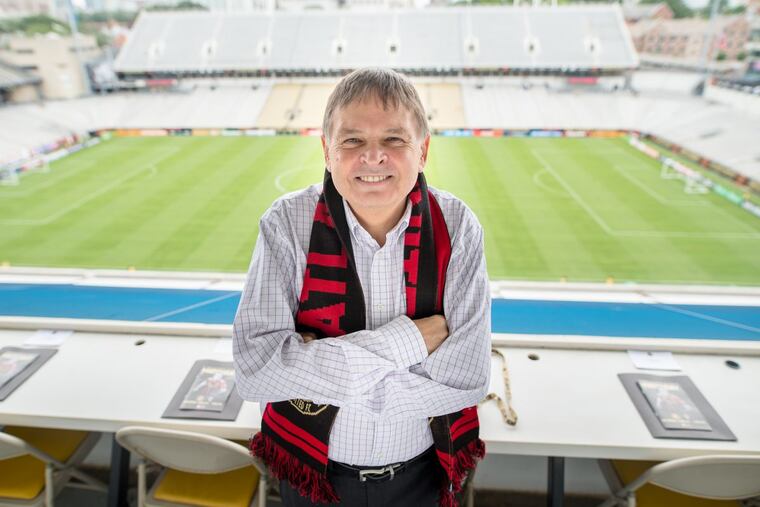
If you've ever listened to a soccer broadcast on a BBC radio outlet, even online from the United States, you've almost surely heard Alan Green's voice.
The Northern Irishman covered every World Cup from 1982 to 2014 for the renowned British network, plus countless games from the English Premier League and other European competitions.
Green was one of the BBC's primary voices at the infamous Hillsborough stadium disaster, when 96 Liverpool fans were killed while attending their team's 1989 FA Cup semifinal against Nottingham Forest in Sheffield.
On top of all that, he is the longtime host of a weekly global soccer program on the BBC World Service.
Now Green has come to America to serve as the primary television play-by-play voice for Atlanta United. Or perhaps more accurately, he has come back to America. As I found out when I met him earlier this week, he owns a vacation home in San Diego, and has relatives there.
Green's brother-in-law is Brian Quinn, who won 48 U.S. national team caps in a career that took him to Everton, the NASL's Montreal Manic and Los Angeles Aztex, and the indoor San Diego Sockers. Quinn is now the associate head coach at the University of San Diego; he will become the head coach next year.
(If you think that makes the world feel small, this will really blow your mind: Quinn's son Aodhan was a Union third-round draft pick in 2014. He now plays for FC Cincinnati and was part of the team's epic run to this year's U.S. Open Cup semifinals.)
It was a pleasure to sit down with Green and listen to his perspectives on Atlanta, MLS as a whole, and the many places the world's game has taken him in his broadcasting career.
This is a long piece, but I think you'll enjoy it. I've edited the transcript only slightly for clarity.
Were you here in 1994 for the World Cup?
Yes, I was. I had been to the States before that. Obviously, I was here for the duration of the World Cup. I spent most of my time on the west coast, because such is the distance involved, it didn't make sense to try this zig-zagging. So after a couple of games in the east – I think Detroit, and Chicago for the opening game – I flew west and spent the remainder mostly in California.
Which is actually why I have such an affiliation with California. I fell in love with the state, and got my wife and kids to fly out after the World Cup, and we did a tour. My wife has a sister in San Diego, so we gravitated to San Diego and fell in love with the place, and ended up buying an apartment there. It's our second home.
What drew you to Atlanta this year?
The strangest invitation. Apart from working for BBC Five Live [the network's sports radio channel], I present a program on the World Service called World Football. I think it was back in October, my producer said, "Oh, I want you to talk to somebody at one of the new expansion clubs in MLS." I said "Okay, who is he?" And he said, "His name is Darren Eales, and he's with Atlanta."
Shamefully, since I deal with managers and players in England rather than executives, I'd never heard of him.* We were hooked up – I think he was over in London at the time – and I heard his voice. And I said, "I apologize, Darren – in the nicest possible way, who are you?" I knew he was president of Atlanta, but he gave me a rough résumé of his background.
I was as interested in what he was doing in Atlanta as I was about the topic of the interview. We did the interview, and we got on well, and he said "Let's keep in touch." And I said, "I'd love that. I'm interested in what you say about Atlanta. I'm changing my views on MLS, because I was a bit disparaging in years back."
I'm ashamed to admit that, but it was the truth.
[* – Eales was an executive at Tottenham Hotspur before Atlanta United hired him to be its team president. He was born in England and came to America to attend Brown University, then briefly played professionally with American indoor teams including the Hershey Wildcats]
It's been the truth for plenty of people over the years. Nothing wrong with admitting it.
Well, you know, I thought I was being realistic about the standard of soccer that was being played here. So, anyway, Darren did keep in touch. And my wife and I went out for our normal winter break to San Diego, in February.
Just before we left, a guy called Matt Moore from Atlanta United [the team's director of digital and broadcast operations] sent me an email saying, "We'd love to talk to you." And I'm thinking, what about? I said, "I'll be in San Diego on Monday, here's my cell phone number. Would it not make more sense to talk when I'm in the States?"
We spoke on the phone, and they said they were interested in employing me. I thought, "How can this work? MLS starts in about a month's time. What can they do?" But they made me an offer, and we talked about it. I was really keen, having spoken to Matt and subsequently to Darren, to do the work for them. But I had to get permission from the BBC, as a long-term employee of over 40 years.
So I went back to England and spoke to my ultimate boss, who thought it was as exciting a prospect as I thought it was exciting. And we agreed that we'd make it work. It was strange in many ways, because obviously I had to complete the season in England. My last game was the UEFA Champions League final, Real Madrid and Juventus. Then my next game was Atlanta [vs. Columbus on June 17].
I turned up not really knowing what to expect, and I was overwhelmed. By the size of the crowd, averaging 46,000. Fantastic. The noise in Bobby Dodd Stadium.
And then when they started to play, not everything was perfect – I didn't expect it to be – but I love the attacking approach of Tata Martino. It does mean that it's going to put your defense into vulnerable areas if you're so committed to attacking play. But I just find the whole experience exhilarating, and it hasn't stopped. It really hasn't stopped for me.
I did a run of five games quickly, and then there was a gap for various reasons, and my wife came out. We had our normal vacation in San Diego, and she went back this past Sunday to England for a little while.
I have these two games – Wednesday night [at D.C. United] and Philly on Saturday. Then on Sunday I'll go to England for 10 days. I need to sort out a few things. Then I'm back out in September and I'll see it through.
It's wonderful. And that's not just unnatural enthusiasm. I promise you it's deep down. This is what I feel about it.
You are following in the footsteps of some former BBC colleagues who have come over here to call games, from Arlo White to Richard Fleming to Ross Fletcher. You probably also know Jon Champion, a Premier League broadcasting veteran who has called games over here for ESPN. Did you talk to any of them about their time in America?
Not really. I know the names. I know Arlo. I know John very well. I knew of Arlo's experiences. I heard that he was going to Seattle, and he was going to give it a go, and I thought, "Well, what a great opportunity for him." And now everything has gone well for Arlo.
I see him frequently at games in England, and we talk, and he knew about the Atlanta thing, and he was as excited as I was. But I honestly didn't sit down with him and chat with him about it. I just know how well he's done here. He's had a couple of good breaks, and he's been picked up.
He's a great guy too.
[I am quite fortunate to know this from experience. I've interviewed Arlo a number of times over the years.]
Absolutely. Ironically, of course, now he's back living in England, because he's commentating in England for games shown in the States. Whereas my wife back home, she sat up last night, she had a link to the game and she's watching me on her iPad as I commentate in the States.
I just saw this as something that's fresh and different. I've been very lucky. I've done a lot. In fact, in mainstream football, there isn't anything I haven't done. Seven World Cup finals, et cetera. But I've never had the opportunity to work in the States. Despite my affiliation to the States, I've never worked here. And here was a chance.
I was given the opportunity. I couldn't think of any reason why I shouldn't take it. And I'm delighted that I took it.
To be part of a league that is growing in the way MLS is, in contrast to – obviously the Premier League has grown in a lot of ways over the years, especially financially, but MLS is growing in a certain way that the established leagues in Europe are not. For you to be part of that over here, what does it mean to you?
Well, it's allowing me to experience something very new. Because they are largely sensible about the expenditure of money here, there's an emphasis on youth. Particularly at Atlanta. And I love this.
I'll give you an example. Chelsea have vast Russian money through [owner] Roman Abramovich, and they buy up lots of young players. Overwhelmingly, you never see those players play for Chelsea. They just bag up talent to store it, to keep it away from other clubs.
When Atlanta brings in young players like Miguel Almirón, he gets to play, and show that he's very good, and I love that. The next step for me would be just changing the emphasis a little bit to make sure that more young Americans come through.
Atlanta has got a truckload of them coming, including Andrew Carleton and Lagos Kunga and Chris Goslin.
I am sure the players are there, because I see the talent at youth level. The emphasis in the States on young players, including young girl players, in soccer, and the size of this population and the popularity of the game, it must produce talent. And when it does, and when the States eventually make a proper impact at a World Cup, then the rest of the world will pay attention.
But MLS doesn't need to go too quickly. I think steady growth is more important.
You mention the virtue of steady growth. It's fascinating to me, as an outsider to European soccer, to watch clubs like Portsmouth, Leeds United, Fiorentina and Rangers that have had meteoric but unsustainable rises followed by dramatic crashes.
Leeds might be the ultimate example. They reached the UEFA Champions League final in 2001, but they couldn't keep that success going. They became financially insolvent, and fell down to England's third-tier league.
A lot of people here don't want that sort of thing to happen in American soccer, and I'll admit I'm one of them. I understand the benefits of the system in Europe, but it is a contrast.
It is a vivid contrast. And I know Leeds well. I commentated on Leeds in the Champions League semifinal, and they were very unfortunate to not reach the final.* And I have an [emotional] affiliation with Leeds, because their support is fanatical. Absolutely fanatical. Perhaps unrealistic.
But here's the difference. Atlanta is a completely new club. It's very fortunate that here it is in a sports-mad city, and I feel that every moment that I'm in Atlanta.
Leeds United are a club with great history, and their supporters are still feeding off that history. And despite some of the bizarre ownership of that club, they haven't given up hope of getting back.
I'm not a supporter of Leeds United, but it's my fervent wish that Leeds United, as a Yorkshire club of substance, gets back into the Premier League. They're not giving up. And they will bleed Leeds United forever.
[* – Leeds fell to Spain's Valencia 3-0 on aggregate. The first leg was a scoreless draw at Leeds, and the second leg in Spain had all the goals.]
Over here, there is this romantic view of English football grounds like Liverpool's Anfield and Manchester United's Old Trafford, and especially smaller venues like those at Burnley or Huddersfield or so on. What are those places really like? I've been to a few, and once you actually walk into them, they aren't as glamorous as they are portrayed to be.
You mentioned Anfield, which is a ground I know very well. There was a temptation, only a mild temptation, in a bid to get more fans at the games, to move from Anfield. Wisely, they didn't. Now the attendance is about 56,000. The new stand at Anfield is fabulous.
There are things like escalators. You don't get those in English football generally. But they've made a huge effort to, in a way, follow an American example. Make it an experience, not just when you're sitting in a seat and watching a game, but behind the seat. They are changing their attitudes.
What they mustn't do is lose touch with the base. That's why it's important for Manchester United to stay at Old Trafford – and they get 76,000 every game. For Liverpool to stay at Anfield. Everton are moving. Manchester City moved. And it takes a while to re-capture the special atmosphere.
I've been quoted while I've been out here as saying – and I didn't make it up – that the atmosphere at Atlanta matches anything I've experienced anywhere.
Of course, on the major occasions, you feel that the whole of Anfield or the whole of Old Trafford is alive. But because that's backed by history, the fans will come and – to put it at its crudest – they will sit on their backsides and they'll say, "Right, I support this club, but I've paid this amount of money for my ticket. Now entertain me." And if they're not entertained, the majority of them don't say anything.
Whereas I don't think there's an Atlanta United fan that doesn't make noise from start to finish. It's unbelievable.
I'm sure it's true in Seattle. I'm sure it's true in Portland. I'm told about those clubs. On this swing I don't get to go to them.* But I can feel it. I watch the other teams on television, as many as I can. And as I say, I'm convinced that MLS is on the rise. And I don't just say that because it's the right thing to say.
[* – Atlanta's games at Portland and Seattle were before Green came over.]
To go back to the English venues for a moment. I've seen some of the behind-the-scenes footage at the really old grounds, especially small ones that host FA Cup games. They have to put up scaffolding for TV camera angles, and the press boxes and TV gantries are in odd places. You could have earned hazard pay for some of the places you've worked at.
Oh yes. The television gantry at Everton is absolutely frightening. You climb up two rail ladders, you walk across the roof, and then you come down another ladder on to a gantry that I swear is swaying. If it's 90 degree heat, it doesn't bother you. But if it's icy on that roof, it's frightening. Yeah, I've had those venues.
I can't name the guy, but once I was in the Everton gantry for Match of the Day [the BBC's renowned Premier League highlights show], I said to this colleague, "What do you make of the Everton gantry? I say it's unsafe!" And he said, "It's worse than that if you want to go to the toilet." He said he's used a bucket because he couldn't get off the gantry and there was no restroom. So it's a different experience.
With some of these interviews that I've done with English broadcasters over the years, I've asked which American venues they think are the most European. I'd like to flip the question for you, and ask which European venues you think are the most American.
One example that always comes to mind for me, since I've been there, is Arsenal's Emirates Stadium in London. It has all the modern bells and whistles. I'm sure there are others too.
It's difficult, because most of these grounds have been there forever. The Camp Nou [in Barcelona], the Bernabéu [in Madrid]. I love Arsenal as a club, but I don't like the Emirates as a stadium. I think it's a bit soulless. It's almost too perfect, you know?
I loved Highbury, an old-fashioned ground with four sides. It had history. Arsenal are a very successful club, but the Emirates doesn't exude history to me. Anfield does, Old Trafford does. Ironically, you get more history at Leeds' Elland Road than you would at Manchester City.
I can never imagine this fantastic, spectacular Mercedes-Benz Stadium [the new venue in Atlanta] being re-created in Europe. I just don't think they go that way. I think they go oval, or my preference is you go four sides and steep. Because that way you hold the atmosphere in.
So I don't know how I can properly answer your question. I probably will feel it when I get back to England in October. I'll probably be launched into Champions League action very quickly, and I'll be looking around and trying to feel the atmosphere of these games.
I looked at the Champions League draw for the group stage, and I thought, "I'll be there, and I'll be there, and I'll be there." And most of those big venues in Europe are very familiar to me. I go to Barcelona at least twice a season, Real Madrid twice a season.
Have you been to Dortmund?
Yes. Brilliant. Absolutely brilliant. It's Earth-tingling noise. Partly because of the standing section.
Though that end of the stadium is converted to seats for Champions League games because UEFA mandates it.
There is a movement to bring back "safe standing" to English grounds. And I'm not sure. The reason I'm not sure is that I was at Hillsborough.
That was a defining moment in my life, being there when 96 people died. And I watched that unfold. I started that FA Cup semifinal commentary. And after six minutes, I knew the game could not go on. I wasn't surprised when a policeman ran on to speak to the referee to say, "Stop this game."
And I'm looking to my left, to the Leppings Lane end, and I didn't know the extent of the injuries and deaths. But by the time I left Hillsborough that day, I was – if you listened to BBC Radio, you may remember Peter Jones. I was doing that game with Peter Jones, and I drove him to the railway station, and we were both in tears.
I will feel very uneasy if standing comes back to English football and the Premier League. The funny thing is that recently, a substantial body of Liverpool fans voted in favor of it. They would want the safe standing that they witness at Dortmund, that manager Jurgen Klopp witnessed at Dortmund.
A lot of us over here learned so much about Hillsborough from ESPN's outstanding documentary on it a few years ago. I think it finally got televised in the United Kingdom too.
I was interviewed by the police following the disaster. I was convinced that they weren't interested in what I had to say, and I didn't know their reasoning, and they didn't follow it up.
Many, many years later, when a fresh inquiry started, I was again interviewed by police. And they had my original interview in front of them. It was graded one, two or three: must follow up, maybe follow up, don't worry. Mine was labeled must follow up. They never followed up, because that was part of the police attempt to wipe it away. It all greatly affected me.
I saw the Hillsborough program. Very little of it I hadn't seen before from other documentaries. But it was brilliantly put together, it was very moving, they got it right, and I've still got it on my recordings back in the San Diego apartment.
[For much more on Green's experience at Hillsborough, click here and here. Thankfully, justice for the 96 finally came in 2016, even though it was 27 years too late.]
There is safe standing in MLS now. Orlando's new stadium has it, and the forthcoming venues for Los Angeles FC and Minnesota United will too.
Yes. Now, if it's properly done, it allows people to do what they naturally want to do: get on their feet. Very few Atlanta fans sit. They stand up. That enhances the atmosphere. I accept it. But the first time I do a game in England and people are standing, I'll be thinking of Hillsborough.
This next question is one I've asked of many English broadcasters I've gotten to know, including NBC Sports Premier League host Rebecca Lowe in an interview I did with her a few years ago. We can watch every single Premier League game over here, but when you're back home in England, you can't. Is that ever going to change?
I don't think it will as long as American broadcasters and Asian broadcasters pump so much money toward the Premier League. The more exclusive they keep it in the U.K., the more money it attracts elsewhere.
I never start a new English season before September. So I'm in front of NBC every Saturday and Sunday until then, and I know I can watch that game at 7 a.m., and if I find that another game is better, I can watch it at 9 a.m. By which point my wife wants to hit me. But yes, the service here in the United States is fantastic. Yet it's changing as well.
Can I put the initial question back to you? What did Rebecca say?
That the ban on televising the 3 p.m. kickoffs [10 a.m. here on the east coast of the U.S.] has to go away sooner or later, but she wasn't sure when it will actually happen.
Well, I would say it would be wrong. Because English football must beware losing the atmosphere that is generated by fans who want to go the games and be there and take part. Such is the money in English football at the moment that they don't need supporters to attend. They could put an atmosphere out over the tannoy [the public address system] and put dummies in the seats, and you might not hear any different. But I think that would ruin English football. The armchair fans say, "Why can't I watch my team?" You can. Go to the games.
But the fans will respond that they don't have enough money to afford tickets as they become ever more expensive.
Well, that's not good enough. Look, at Manchester United, Liverpool, you go to any of those games, you'll see people coming from Scandinavia, the Far East, the United States. I've helped get tickets to English games for friends of mine in California. So they'll travel a long way. You might not be able to afford every game.
I think we have enough on television in England. But of course, when I'm in San Diego I want that NBC service, because I can follow every ball that's kicked.
You mentioned that once the season is over, you'll head back to England for a while to resume working for the BBC. Then what?
I don't know, is the honest truth. This time last year, I had no idea about Atlanta. I barely knew that they were one of the expansion clubs. I have a BBC contract which runs over two years, to the end of the season that's just started. I'm not going to the World Cup, because I told them quite a while ago I am not going to Russia. I have commentated on games in Russia, and I do not want to spend six weeks of my life in Russia.
You aren't alone.
Not at all. So I'm not going to the World Cup. It will be the first one I've missed since 1982. But I don't know whether the BBC will want me to stay on. It's the same with every contract. I've been freelance since 1997. That's a long time.
I don't know if Atlanta will want me to stay on. I really hope that they do. And then that's a problem for me to work out, or maybe a decision for me to take. But I, hand on heart, have loved this. So I have to ask some questions.
I've had very positive feedback so far. My background did make people think, "What's he doing here?" I came away from one game and I was waiting for an Uber car not far from Bobby Dood, with Matt Moore. We were standing on a corner, and a young couple turned around, and they said, "Mr. Green, what do you think about being in Atlanta?"
And I thought, A, how do you know who I was, and B, what a friendly way to approach me. I stood chatting to them about what I felt, and he and his girlfriend or wife left, I hope, thinking, correctly, "He loves it. He really enjoys this."
I do. I wouldn't tell you otherwise. It's not in my upbringing, I'm not that sort of commentator. If I don't like it, I'd be saying, "Well, good points, bad points." I haven't seen any bad points yet.
