The big picture is working again. The technician under Ron Jaworski's feet has fumbled with some cords and plugs, tried this, tried that. Finally the big bodies on the big TV screen in the office are unfrozen, moving at the speed of sound.
And thus, so are the jaws of Jaws.
"That guy stinks," someone says as highlights from a recent game between the St. Louis Rams and the Dallas Cowboys flash on screen.
"I did everything but call him a pussy on national television," Ron Jaworski responds.
"And you were trying to be positive."
"Well, I started off positive," Jaws says.
Outside, the sun illuminates the tall, steely building that houses NFL Films, the Mount Laurel, N.J.-based production company that made John Facenda's voice famous and earned founder Ed Sabol a spot in the Pro Football Hall of Fame. Inside, the offices are little caves. Jaworski's office sits atop a spiral staircase, the entryway to all the little caves. He sits at his desk in jeans and a pullover, his bare feet covered by slippers masking as shoes. One assistant sits at a desk to his right, another slightly to his left, and directly behind him stands Lou Russo, La Salle class of 2007, who helps him with these duties, along with anything related to the Arena Football League team Jaws presides over, the Philadelphia Soul. The setup resembles an offensive formation, Jaws at center.
The night before, Jaworski worked a Monday-night game in Jacksonville, caught an early flight, and got to the office by noon to start work on his ESPN show, "NFL Matchup." Greg Cosell, who produces the show, is also here, moving like a slot receiver between offices as he serves up an assortment of clips from Sunday's games. In between, Jaws pops in a highlight video of a 5-2 running back, an audition tape for the Soul. Later, a call comes in from the manager of one of the five golf clubs he manages about some small issue that is easily resolved over the phone.
"I use the term, 'Management by being around,' " he says after hanging up.
Twenty-five years after he threw his last pass as quarterback for the Eagles, "being around" for Ron Jaworski means being just about everywhere. He runs a local golf-course-management enterprise that has become a $12 million business. He's part owner the Soul, not to mention an investor in a new pro football league in India. He does two radio shows, hosts the syndicated "NFL Matchup," and often appears on ESPN's "PTI." There's also the job he is most associated with, analyst on "Monday Night Football" - which this week stops in Philadelphia for the Eagles game against the Bears.
It's a rare home game for Jaws and a welcome one. "Being around" is one thing, but in the 22 years since he hung up his cleats - after a 17-year NFL career - Jaws has become as familiar to Philadelphians as one of the city's old neighborhoods. He is president of the Maxwell Club, the local group best known for handing out awards to college football players. He and his wife, Liz, have raised three kids here, and the couple has given their time, money and names to a laundry list of charities. Look in the den of any area sports fan and there's a good chance you'll see a photo of him on the wall, autographed of course, smiling that "Life is good" smile of his.
But Jaws has become more than just a local sports hero. He is now part of Philadelphia the way a parade on Broad Street is, a delicious irony in that he never took part in one. And what's so remarkable about his status now is how unlikely it would have seemed once upon a time. Indeed, a whole generation of Philly sports fans has grown up unaware that he was someplace else's first - and that a lot of people wanted to send him back to that place when he arrived.
In the late 1970s and early '80s, Doug Collins played basketball for the 76ers and lived at the end of a cul de sac in West Berlin, N.J., in what had to be the most idyllic Philadelphia sports neighborhood of all time. Jaworski lived next door. Wilbert Montgomery lived down the block. So did Mike Schmidt and John Bunting and Gary Dornhoefer and a half-dozen of the city's finest. They went to one another's games, and their young families spent summer nights around the Collins pool.
It was a golden era for Philadelphia sports. The Flyers had been good since earlier in the decade. The Phillies had strung together consecutive playoff appearances. The Sixers, just as now, were fourth on the meter of fans' affections, but they loved Collins and his gritty style of play.
A golden era - with one exception. The Eagles won four games in 1976. The next spring, coach Dick Vermeil traded tight end Charle Young, a Pro Bowler and fan favorite, for a backup quarterback with the Los Angeles Rams, a guy who had lost his job to the fair-haired Pat Haden, of all people: Ron Jaworski.
Jaworski had been cheered in high school, adored at Youngstown State, nurtured in the laid-back town that drafted him. But this trade across the continent, from a playoff town to a loss-plagued one - this was different. This was the dark side of the moon.
That first season, 1977, the Eagles won five games, and Jaworski was booed. A lot. He was called awful names. A lot. Only 26 at the time, he grew despondent. "That was probably the hardest part," he says. "Fighting through all that booing. Why are they booing me? I am probably one of the most positive thinkers you'll ever be around. Glass is always half-full with me. I came from Los Angeles and we had been to the playoffs for four straight years. I was used to winning. I expected to win in Philadelphia. Yeah, it would take time, but I would be the glue who would bring the glue, bring a positive attitude, hardworking blue-collar guy from Buffalo coming to Philly. And you kind of assumed you were going to be accepted. And when we started struggling ... well, man, I wasn't."
"You can work through it. Or let it take you down. I chose to work through it."
Jaws had already worked through a lot by then. A three-sport star growing up in Lackawanna, N.Y., Jaws was the only athlete in his family - immediate and extended. Ron's father, William, worked in the lumber yards in Lackawanna right up to the day he died. Molly Jaworski, Ron's mother, cleaned homes. His older brother, Bill, went from high school to the steel mills there, then came to South Jersey when Bethlehem Steel pulled out of there in 1983 and left him without a job.
Ron's big sister, Geri, got a job out of high school as a secretary. When her husband died suddenly of a heart attack at 37, she, too, moved here at her little brother's request, became his assistant until she retired 3 years ago. None of this information is offered, bragged about. For a chatty guy, Jaworski gets terse when it comes to puffing his chest.
He was drafted in the late rounds to play baseball by the St. Louis Cardinals, but was also offered several college football scholarships. Jaws wanted to sign with the Cardinals, wanted the short money. But after several late-night verbal bouts at the kitchen table, his father more or less forced him into the life that has followed. Jaws chose Youngstown State, because, he says, "They loved to throw."
"It wasn't like we had all these great opportunities to get out," Jaws says. "Fortunately, I could throw a football. A gift God gave me. And it worked out."
William Jaworski never saw it work out, though. He died of a heart attack while Jaworski was away at school. Ron was 19 at the time.
When he moved into the neighborhood in West Berlin, he and the soulful Collins became fast friends, as well as neighbors. "No one had second homes back then," says Collins, whose back yard, complete with a pool and sport court, was the neighborhood epicenter. They played basketball, Wiffle ball, created hybrid games that became their own little version of halfball. They stayed up late on warm, summer nights, especially those nights when Jaworski was there.
On those nights he was the epicenter of the epicenter. That's when Collins gave him the name that today identifies him like a bar code. It had nothing to do with the blockbuster movie of the time, or even that Jaws had, well, big jaws. "He liked to talk a lot," says Collins, no stranger to the concept himself.
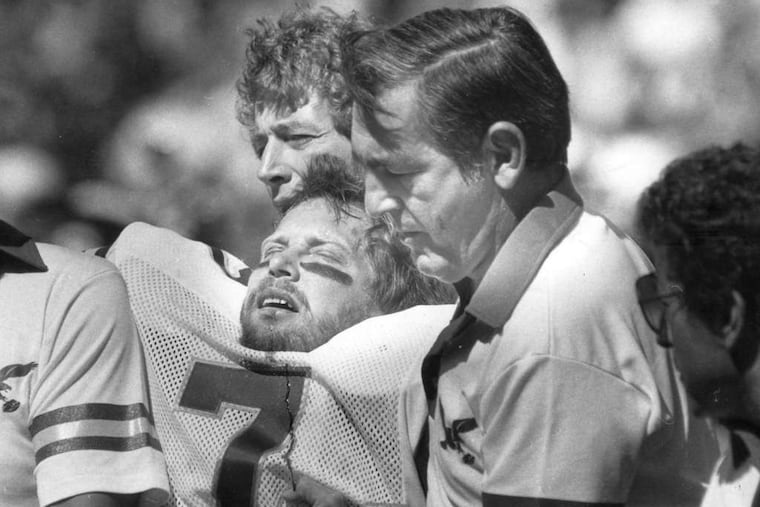
As Jaworski and the Eagles improved, the booing stopped and the player changed the context of the nickname. To watch Jaws cut up a defense with his rifle arm and reads, to see him scraped from the unforgiving Veterans Stadium turf after a Lawrence Taylor sack - and Taylor sacked him more than he did any other quarterback - and make a big pass the very next play was to watch a football-playing cousin of the infamous fish. Once, recalled Collins, in a game against the Bears here, Jaworski was blindsided by defensive end Mike Hartenstine, a former Penn State star from Bethlehem. "One of the most vicious shots I've ever seen in my entire life," said Collins.
The next morning, Collins got a phone call from his neighbor. "Can you come over and help dress me?" Jaworski asked. "I can't get my clothes on."
"Jaws," Collins says now, "is one of the toughest guys I've ever known."
But toughness doesn't imply smarts. In fact, says Cosell, "They're usually considered mutually exclusive." And when a 6-2, 185-pound guy stays around for 17 seasons, starting as some team's backup and ending as some other team's backup and starts a record number of times in between, it's fair to deduce that there isn't a Plan B out there, never mind an alphabet full of them.
Maybe we underestimated him, too, because he was such an open book. Or maybe it was that look he still gives you sometimes through those designer glasses of his, like a guy peering through the wrong prescription. Maybe it was all of it, the easy smile and chattiness, too. Maybe he even used it all as a tool to buy time and size things up.
Certainly, there is no indication at first glimpse that you are in the presence of any sort of business czar or tough guy. But every once in a while, you see the edge, like when he's back in the NFL Films studio and another defensive back runs alongside of a receiver after a catch on the big screen, herding him to the sideline rather than taking him on. Jaws blurts out that word again, as the smile devolves into disgust. In that moment, you think of Phil Hartman's depiction of Reagan in the old "Saturday Night Live" skit: in one moment Reagan looking like a amiable dunce as he meets Girl Scouts in the Oval Office; the next, he's pulling out a map of the world and explaining to generals his plot to conquer the world.
Jaws was scheming a full decade before he played his last game in 1989. first business was a health club that he and former teammate John Bunting bought into in 1979. He got involved in a few smaller ventures, too. As one player after another from that glory era went on to other chapters of their lives and moved away, Jaws was going the other way, stretching his roots deeper into the Delaware Valley. "Maybe I always sensed my mortality as a football player," he says. "It's going to end sometimes and I want to have something to fall back on. And I wasn't a big believer in investing in stocks and the stock market things like that. I was more hands-on. Feel, touch, see - physical assets."
He took chances, lost money, learned painfully, just as he had in the NFL. He had partners, he made enemies, he even got sued. But just as then, he worked hard at it. "I think fear is part of it," he says. "Fear of not being successful. It motivates me. I've always been one of those guys - never the biggest, the fastest, the strongest. But I was never going to be outworked. Maybe I learned that from my parents."
Hard work leaves by-products though, sometimes toxic ones. There are stories out there of Jaws the tyrant. When he and one business partner, Ken Kochenour, bought the Holiday Inn in South Philadelphia back in 1993, the deal swung on the sellers firing all 76 union employees. It led to a protracted legal hassle that lasted almost 3 years and damaged Jaworski's good-guy reputation, an episode that still makes him wince when it comes up. "That was an ugly time," he acknowledges. "But that's business, you know? And we ended up having labor peace with the union. At the end of the day, it worked out well. But it was a bumpy road getting there."
Jaworski and his partners sold the hotel in 1999, amid construction of both stadiums, for what he says was a significant profit. A year earlier, though, a Gold's Gym he had an ownership stake in also went belly-up, even as memberships were being sold. He received bad press then, too. And his 2009 purchase of Running Deer Golf Club in Pittsgrove, N.J., involved a lawsuit from the original owner and designer Ed Carman, who alleged a double-cross. "I'm not a nasty person," Jaworski says. "But I can make hard decisions. I'm not afraid to make hard decisions. I look at it this way: Every time that ball was in my hands, I had about 2.5 seconds to make a hard decision. Or pay for it. So I've never backed down from making the hard decisions."
The bodies on the big screen run forward, then backward, then forward again, all at breakneck speed. Jaws has his thumb on the button, and the button is getting a workout. Fast-forward, "Stop right there," he says. Fast-forward again, back it up and do it all over. The conversation revolves around whittling down the selection to an assemblage that is both fan-friendly and instructive. The idea is to show highlights with context, taking full advantage of Jaworski's years behind center, yes, but also his years of studying the game since.
"Did you watch last week's show?" Cosell asks.
"Not yet," says Jaws. "Why?"
"I thought there was too much talk," Cosell says. "Remember we talked about that? I think there was."
"Make me a DVD," Jaworski says. "I'll take a look."
There is no hint of hurt, objection, animosity. Greg Cosell, nephew of Howard Cosell, one of history's all-time talkers, has just told his boss he talks too much.
The boss' response is, Hmmm, let's take a look.
"Maybe it's because of the way I was brought up," Jaworski says. "But I don't want people to tell me what I want to hear. I have no problem with people challenging me. I respect other people's opinion, even when I don't agree with it. I want input. It makes me better. Makes me smarter. Makes me stronger."
Maybe this is what we did not see back in 1977, but what we have seen so much of since: this outlook, this constant push forward, this everyman approach.
"He's been successful enough to be egotistical, to be greedy, to be uncaring," says his old coach, Vermeil. "And he has chosen to be none of those."
It's why his picture hangs on the wall of so many dens, so many basements and TV rooms. People see Jaws, Cosell says, and it's as if their neighborhood buddy became a star, then bought a house next to your mom. "We do the radio show down at Valleybrook," says Cosell. "I'll get down there, he'll be eating and people will come over to talk to him. Never once have I seen him too busy for them. Never once has he said, 'Hey, I'm eating.' He just intuitively understands that, 'Hey, I'm one of you guys. Yeah, I made it big and I got a chance to play in the NFL, and I'm on TV and my income is obviously more than yours.' But there is never a wall between Jaws and everybody else. Never. He's totally approachable at all times."
Says Vermeil: "He never forgets where he came from. He never forgets where he is. He is so real. He is as he is. And he identified with the people from Philadelphia from the get-go."
Maybe that's it. We've seen a lot of athletes come and go in this town, some of them great. A few have adopted us, but not nearly as many as have run away, looked back at their time here as a big mistake. Very few have proceeded as if they should have been here in the first place. Very few embraced us as much as we embraced them.
Jaws did. Go to just about any other town in the United States and play word association with a local sports fan. Say Philadelphia. You will hear the name Ron Jaworski quickly. Maybe right after "boo," "snowballs" and "Santa Claus." Maybe somewhere in the middle of them.
But you will get to him sooner than Charles Barkley, who left the town in a huff, or Julius Erving, who came to the town with a title in tow. You will get there ahead of Norm Van Brocklin even, or even the late Reggie White. You will get there ahead of so many famous sports names who have lived here, loved us and been loved, but have always had some other place to return to.
And when you do mention Jaws, it will invariably evoke a smile, a positive response. "A winner but not a champion," is the way Collins likes to describe himself, and it's true of Jaws, as well. But Jaworski's triumphs here, on and off the field, contributed to this city in a way that a teamful of diamond-studded rings never could. People out there meet Jaws, and they think of us in a different light. A better light. "My last pass here was 1986," he says. "But wherever I go throughout the country, I'm Philadelphia. When I tell them I'm originally from Buffalo, they're surprised."
Does that bother him?
"Oh, man, I'm the president of the Philadelphia Chamber of Commerce," he says. "I really am. I love this town."