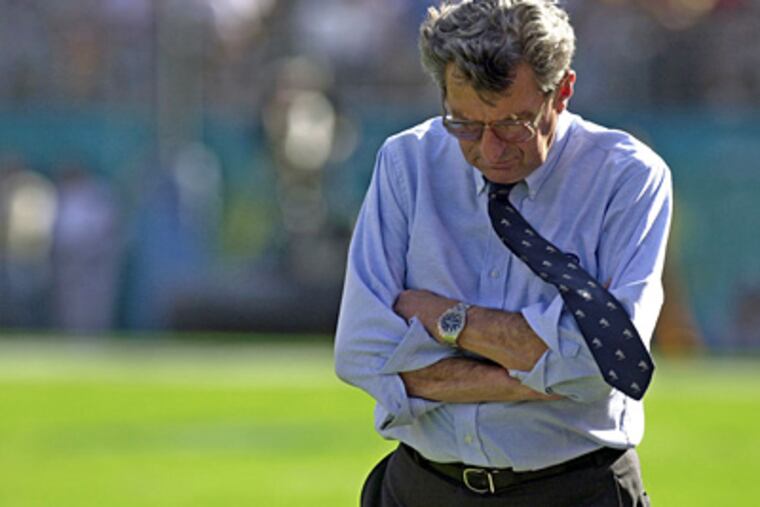
A New York Herald Tribune sports editor and columnist named Stanley Woodward was asked one day the best way to get to Penn State. "You drive to Harrisburg," Woodward said, "and swing 90 miles through the trees."
I swung through the trees those final 90 miles between Harrisburg and State College for the first time on a glorious September day in 1963. Evening Bulletin Penn State beat writer Frank Yeutter had dropped dead that summer, and I was awarded the job of covering coach Rip Engle's Nittany Lions for America's No. 1 afternoon paper.
It was a huge deal for me. I was not only going to cover a team that had recently sent Lenny Moore, Rosey Grier, David Robinson and Riverboat Richie Lucas to the NFL, but I would also be covering my boyhood idol. I had been in the stands with my dad for Joe Paterno's first game as a starting tailback for Brooklyn Prep in 1943, and for his last in 1944. A cousin, Bill Dagher, was a starting end for the best football team in the history of the small and long-ago-defunct Jesuit prep school, an institution that scored a Conlin family hat trick by flunking out my dad, myself and my younger brother Jim.
My cousin introduced me to Joe Paterno after a hard-fought 13-6 loss to Vince Lombardi's unbeaten St. Cecilia's of Englewood, N.J. "Good to meet you, Ace," Joe said.
I saw him play again his senior year at Brown. He was a quarterback in Engle's version of the winged-T that the coach would take with him to Penn State in 1950. Paterno bypassed law school to work on Rip's staff for so little money that he had to rent an attic room from line coach Jim O'Hora. When I showed up at a Friday-afternoon practice and introduced myself to the staff, Joe said, "Good to see you again, Ace…"
In 1966, Paterno replaced Rip Engle, who was in the early stages of dementia. Paterno had been an assistant for 15 years and was 4 months shy of his 40th birthday.
The Route 322 bypass was a work-in-progress then. Civilization ended around Newport on the Juniata River. At the foot of Seven Mountains — ahead of an ear-popping, engine-straining climb — an Amish man was always there on football-weekend Fridays. His horse and wagon parked against an embankment, he sold apple cider that was nectar of the gods. After a decade, I began to think of him as Charon, the ferryman in Greek mythology who transported souls across the River Styx to Hades. Not that State College, hunkered on the other side of Seven Mountains, was hell. But when you emerged in Potters Mills, on Centre County's valley floor, it was another country.
In time, Joseph Vincent Paterno would become the prince of a community that reminds me now of a 16th-century Italian-state. Perhaps he modeled Happy Valley after Siena, a center of thriving commerce, Renaissance art and literature with an army that slaughtered a much-larger force from neighboring Florence. Penn State's 27-0 slaughter of No. 2 Ohio State in 1964 was the 20th-century analog. And for 23 years of football weekends, I stopped at Charon's cart for some cider, then left the country for a day and a half.
In the 1969 season, which included an 11-0 record and second straight Orange Bowl victory, President Nixon awarded the national championship to the University of Texas. The polls went along. Penn State finished No. 2. But Paterno had the last word. In 1973, he delivered the Penn State commencement address, a rare honor for a college football coach. His line for the ages: "I'd like to know, how could the president know so little about Watergate in 1973, and so much about college football in 1969?"
Penn State football was no longer a cottage industry by then. Beaver Stadium expanded like a juiced big-league ballplayer. Winning became more of an imperative. On football Saturdays, State College became the third-largest city in the commonwealth. For a day, it was a Las Vegas casino with shoulder pads.
Paterno raised $13 million to build a library named for himself and wife Sue. They donated more than $4 million of their own money over time. And he didn't hide inside an ivory tower. His phone number was listed (just don't expect a human to answer), he walked daily from his home across campus to his practice-facility office and to the Big Beav on game days.
But as the years passed, as his victories, awards, honors and bowl invitations increased, a cocoon of inaccessibility began to wrap itself around the football program. The small core of media that came in from the big cities to schmooze with JoePa in the living room of sports information director Jim Tarman on Friday nights had become a horde. Paterno was stung several times when remarks he made in informal exchanges he considered off the record wound up in print. One night he said the reason he would not retire was "because it would leave college football in the hands of the Jackie Sherrills and the Barry Switzers." That brought the folksy, informal get-togethers with media people Joe trusted to an end.
They moved the media soiree to assorted venues including the Nittany Lion Inn, State College Hotel and posh Toftrees Resort. They became little more than excuses to stand around and ensure a kickoff hangover. Paterno would be escorted in early, would hang around for one drink and a few greetings. But no football talk. The days of going back to the Holiday Inn with the next afternoon's game plan in your head were long gone.
Under Engle, Friday afternoon's practices — mostly special-teams walk-throughs— were open. Under Joe, nothing was open. In his early years, the media had full run of the postgame locker room, which was about a half-mile hike from Beaver Stadium. But as the stadium was expanded and locker facilities were constructed there, selected players were trotted out in a controlled setting. Paterno became more and more annoyed and confrontational as the number of reporters he didn't know proliferated. After one game, in which the exchanges became increasingly waspish, he actually said he longed for the days when he could sit around the night before a game with writers he could trust and just talk football. By the time the Lions were drawing more than 100,000 fans and 20,000 recreational vehicles were lined up like two mechanized divisions about to invade Clearfield County, it was obvious those days were long gone.
By that time, it was tough to get a handle on what the hell was going on up there. Players began to transgress at such an alarming rate, it was starting to resemble the University of Miami or when Florida State's nickname had been bent into the "Criminoles." Alleged date rape… Dorm theft of electronics…Public brawls involving alcohol abuse….
Most of it was handled in-house. We thought. And when players did wind up facing charges, they were usually by the campus cops. And if the State College police were involved, the cases seemed to melt away. Joe's usual answer when questioned about such matters was on the order of, "We've got it under control and we will take appropriate action…."
It wasn't always that way.
In the rising tsunami that has washed the proud Penn State football program and Joe Paterno into the vortex of the worst command-and-control scandal in the history of college football — maybe the worst misfeasance and malfeasance in the history of any sport— it is hard to think back to those early years of innocence.
One Friday night in 1966, there was a press party at the Elks Club on the outskirts of State College. Penn State had been slaughtered by a great Michigan State team 2 weeks before. The Lions had their first white-out in that 42-8 road loss. But it was on the field, not the stands. "We're losing too many great athletes who want to come to Penn State," Joe told me during the next week. "We can't get them admitted, because we don't have a disadvantaged-students program. Even the Ivy League has one. If we don't start adding some speed to our squad, we're gonna have a tough time competing with the schedules we have down the road. You can write that if you want. Just don't say I said it."
So I wrote it. The implications were clear. Penn State was still a team mired in plodding mode at a time when a great influx of African-American talent on both sides of the football was dominating the game. The Penn State educator charged with keeping athletes in class and eligible was a former Lions football star and intercollegiate heavyweight boxer, Sever Toretti, who was also the assistant athletic director. He confronted me at that press party and ended a lively debate over my views on Penn State's lack of a disadvantaged-students program by popping me with a straight right to the chin.
One of us must have been very drunk, because I never felt it and we were pulled apart before I could counter. Must have made an impression, though. By 1971, Lydell Mitchell and Franco Harris were running wild for an 11-1 team that blew out Texas in the Cotton Bowl.
Baseball clubhouses used to have a prominent sign that read: "What You See Here, What You Hear Here, Let It Stay Here." They should have had that sign as an archway when you hit the State College town limits. As the cloak of secrecy surrounding all matters football shrouded Penn State with increasing opacity, there was commonwealth law; there was borough law; there was campus law.
And there was the only law that really mattered: Juris Paternoannis.
Joe Paterno stayed 10 years past his intellectual shelf life. He became old and infirm in a hurry, and you wonder how much of a grip JoePa had over the program once the sordid events first revealed in 1998 became covered over like mounds of animal droppings. The man I spent 15 private minutes with at the Phillies' minor league complex last December was a shell of the razor-sharp, wisecracking assistant coach who greeted me in 1963.
The residents of Happy Valley have long congratulated themselves for being fortunate enough to live in the Real Country, protected by Seven Mountains, Mount Nittany and a formidable army of 85 football players. But it is painfully obvious now, exquisitely so, that it is no country for very old, or very young, men.