Flyers video coach part of a new vanguard in NHL
Chris Pronger can remember when reviewing game tape to prepare for an opponent meant lugging around clunky VHS tapes. "You would have to sit there with the remote control and painfully fast forward to each shift if you were looking at something," Pronger said. "It could take you a solid hour."
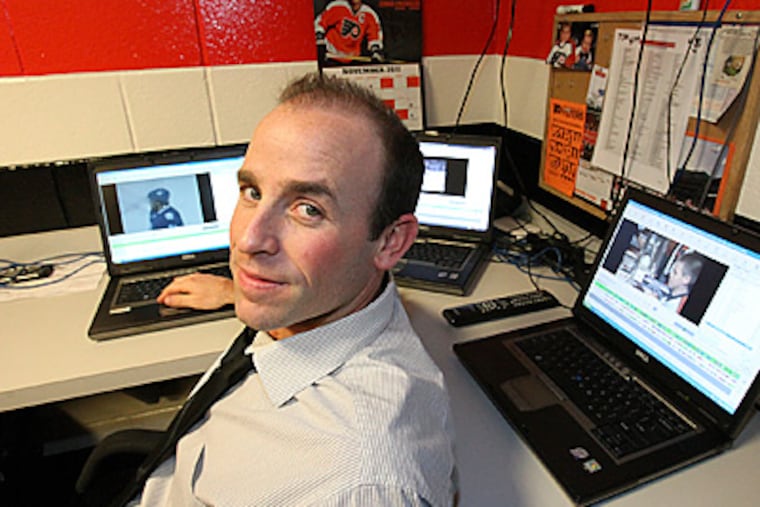
Chris Pronger can remember when reviewing game tape to prepare for an opponent meant lugging around clunky VHS tapes.
"You would have to sit there with the remote control and painfully fast forward to each shift if you were looking at something," Pronger said. "It could take you a solid hour."
That was only 10 years ago.
Times have changed. Technology has changed the way sports business is conducted on a daily basis - and hockey is no different from its major sporting brethren in that sense.
Starting in January, the Flyers will be able to set up each player with an iPad and they will be able to securely access a complete digital archive of their games, broken down by shift - as well as those of opponents, both upcoming and past. They will see everything in clear, crisp high definition and from the comfort of their home, hotel room, or team bus.
But handing out iPads to players isn't the only copycat trend circulating through the NHL these days.
An increased reliance on game footage for preparation and correction purposes has led nearly all NHL teams to hire a full-time video coach. Teams used to have an audio/video coordinator to prepare the footage, which then was broken down by a member of the coaching staff.
Now, former prominent hockey players are being hired as not only technologically savvy assistants, but as experts who can also prepare game plans and hone in on mistakes and tendencies.
Peter Laviolette once did it all himself, such as when he first started coaching the Islanders in 2001. No more. That's where assistant coach Adam Patterson, a former three-time Division I All-America at Eastern Michigan, comes in.
"I just realized that if you have a guy in place who knows a lot about hockey, knows every system there is, and watches more hockey than anyone else, they can be very efficient at what they do," Laviolette said. "Adam is terrific at what he does. He helps prepare this team on a nightly basis. We actually let him deliver the game plan. He truly is a part of the coaching staff, and not just a video coordinator. He's been given a lot of responsibility to help prepare the team."
Patterson, 37, is the son of former Flyers player and scout Dennis Patterson. The Detroit native joined the Flyers organization 10 years ago as a video coordinator with the Phantoms. He was promoted to Flyers video coach three seasons ago. A typical week consists of poring over 75 to 80 hours of video.
"They're breaking down so many games at one point that it might get confusing to a normal person," Laviolette said. "He watches this opponent, our next opponent, and the opponents two to three games away, in addition to our own games. He is a tremendous part of our staff."
The biggest part of Patterson's job is preparing for the next opponent. With sometimes three or four games in a week, that can get tedious. His work all leads up to 5:20 p.m. on game nights, when he leads a team meeting and unveils the game plan.
"I show them what the opponent does, but, more importantly, what we're going to do to counter or dictate the game," Patterson said. "A lot of teams play the same way, but if there is just a small detail, a set faceoff play or a set breakout that you can pick up on, [it] can make a big difference."
Patterson said he might watch 25 or 30 breakouts of a team or view up to 50 faceoffs, to look for patterns, tendencies or weaknesses.
"Anything that you can think of, we're tracking it in a game," Patterson said. "Then, we have the ability to go back and watch any game. It's all stored in a database, I can have it up on the screen in, like, 3 seconds."
During a game, Patterson is in constant communication with assistant coaches Craig Berube and Kevin McCarthy through earpieces each wears on the bench. Patterson can relay timely information about an opponent's setup or lineup changes. He also has footage of every period's game-changing plays available for inspection during intermissions.
"Coaches come in between the periods and want to see what just happened," Patterson said. "My job is the instant accessibility of that. We have a limited window, about 18 minutes to look at something and come up with a game plan, before they go and talk to the team."
After games, Patterson breaks down each player's shift and has them synched to computer work stations at the team's practice facility in Voorhees, N.J., where they can see each shift, hit, shot, goal or fight in privacy. On the road, Patterson packs all of his equipment in a heavy trunk that is loaded onto the team plane and wheeled around to wherever the coaches set up next.
Pretty soon, Patterson will be able to record meetings with audio, video and spot shadowing and zip them off to a player's laptop or iPad in seconds. That will be especially helpful for injured players not with the team and players with the AHL affiliate in Adirondack, whether for teaching moments or in case of a last-minute call-up.
Patterson said he was "shown the ropes" by former Eagles quarterback Ron Jaworski 3 years ago at NFL Films headquarters in Mount Laurel, N.J.
"It's a sign of the times," Patterson said. "None of this was available back in the day. It's definitely gone toward the way of the NFL. All of these kids coming in now are technologically savvy; they all have an iPad they can watch a game on."
At the same time, Patterson is grateful. He majored in communications and video production in college and now combines two passions on a daily basis. Pronger called Patterson the "best video guy in the league, hands down."
"A unique opportunity has opened up for guys like myself who played hockey," Patterson said. "If you have a little bit of computer savvy, it's really beneficial of the team. Teams are so well-coached now that you don't want to be caught unprepared. You need to have all of your bases covered."
read Frank Seravalli's blog,