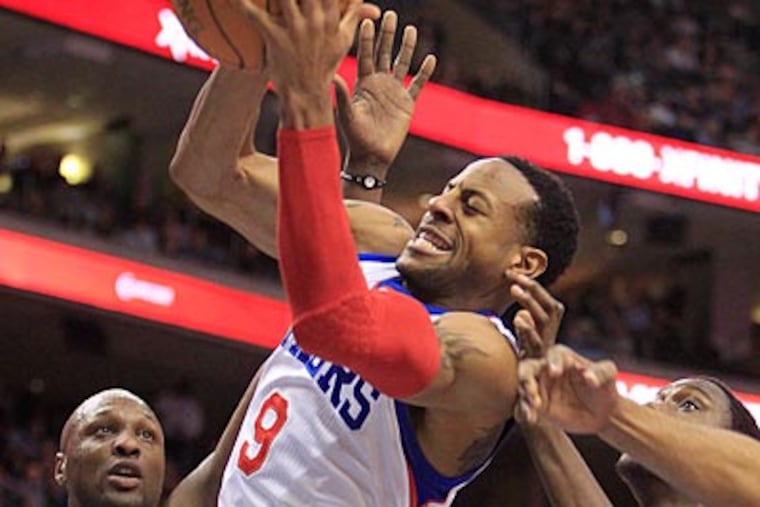
The 76ers have been here before.
Back in February 2001, the Sixers were 41-14, the best record in the NBA. After two consecutive seasons of paying their dues in the playoffs, the Sixers knew they were on their way to represent the East in the NBA Finals.
But All-Star center Theo Ratliff was again injured - this time with a wrist injury that would keep him out at least a month.
Coach Larry Brown, the "Grand Poobah" of basketball, had a decision to make.
With Allen Iverson as the linchpin and a roster full of players committed to their roles, those Sixers were fueled by a delicate balance of chemistry. The wrong disruption could have ripped it all down.
Brown could take a chance and hope the Sixers could maintain their momentum until Ratliff came back, which was questionable, or he could make a move to solidify their position.
Brown went for the prize. He included Ratliff in a package to the Atlanta Hawks for All-Star center Dikembe Mutombo.
Mutombo did indeed help the Sixers to the 2001 NBA Finals, which they lost to the Los Angeles Lakers in five games.
Afterward, the Sixers began their gradual decadelong slip into mediocrity.
Today, we have a Sixers team that has surprised the NBA by posting one of the best records in the league and jumping to the top of the Atlantic Division. Head coach Doug Collins' roster of non-superstars relies on the chemistry gained from selfless play and team unity even more than Brown's did.
Messing with that balance has even more potential pitfalls than it did in 2001.
But let's accept the fact that center Spencer Hawes is completely unreliable for the Sixers with his bum back and aching left Achilles' tendon. Hawes has missed 17 of the last 19 games and now, with a walking boot, is out at least until well after next week's All-Star break.
What we've seen from the Sixers in recent losses to the Miami Heat, San Antonio Spurs, Los Angeles Clippers and Orlando Magic is that this team, despite its record, is at a disadvantage when it comes up against teams with superior overall talent.
I think the Sixers, as currently constructed, will still win the Atlantic, but I can't see them getting beyond the second round of the Eastern Conference playoffs on heart and hard work alone.
Superior talent, such as that possessed by the Heat and Chicago Bulls, will prevail over the Sixers in a seven-game series.
So Sixers general manager Rod Thorn is faced with a similar dilemma to what Brown faced over a decade ago. He can stand pat and see how things play out or strengthen his team at the risk of disrupting its chemistry.
Still, there is a key difference from 2001. This team is not the best in the East.
Unless Thorn can miraculously acquire Dwight Howard from Orlando without simultaneously gutting his roster, I don't see a trade out there that will elevate the Sixers past the Heat or Bulls.
Brown knew he had a shot at the title. The risk was worth the reward.
Thorn has to know that, at best, he's talking about enhancing the Sixers' chances of, maybe, advancing to the Eastern Conference finals. Realistically, they cannot get by Miami or Chicago to go to the NBA Finals.
So if I'm Thorn, I'm holding my hand - unless there is a no-brainer trade.
Normally, I'm all for a team risking its future to take a shot at a title, but it has to be for a legitimate shot.
That's why I say, to this day, that the Mutombo trade was right, even though things quickly fell apart.
These Sixers are not at that point.
The expectation of this team coming into this season was that it would grow and mature with its young players and make a nice step up in the Eastern Conference hierarchy. Nowhere did challenging for the Eastern Conference factor into the equation.
Honestly, this season was supposed to be more about finding out whether the Sixers had the right mix of young talent that could be the nucleus for a title contender a few years down the road - when the Miami "Big 3" thing had begun to age or run its course.
At the end of the season, the Sixers were supposed to know what they had, what they needed, and what was the best way to go about filling the holes. I don't see how that plan changes, not in a lockout-shortened season that has put atypical variables into play.
More than half of these Sixers are 24 or younger. I'm still too intrigued by the potential of Jrue Holiday, Evan Turner, Thad Young or Nik Vucevic to package them in a deal for a rental who might help you last six games against the Heat instead of five.
Rebuilding must be done the correct way. It requires some patience, even for a city that hasn't won an NBA title since 1983.
Unless you are the San Antonio Spurs, who got future Hall of Fame forward Tim Duncan at the same time Hall of Fame center David Robinson returned from injury, or you are the Heat or Boston Celtics, who can work the system to bring in a "Big 3," you rarely jump from 50 losses to the NBA Finals within two seasons.
If the Sixers can make a trade that will increase their current chances while still adding to future growth, they should do it.
But a trade that potentially hurts the future just to look better while still losing in the playoffs to the Heat or Bulls is not the right move.
Send email to smallwj@phillynews.com.
For recent columns, go to www.philly.com/Smallwood.