One day. One shot. One chance to make it in MMA
It's a Saturday afternoon in Philly, and along an industrial stretch of Washington Avenue, a small army is assembling, an elite unit of square-jawed spartans who quietly slip down a narrow, heavily littered side street and approach a furniture store.
It's a Saturday afternoon in Philly, and along an industrial stretch of Washington Avenue, a small army is assembling, an elite unit of square-jawed spartans who quietly slip down a narrow, heavily littered side street and approach a furniture store.
Dozens have come from all over the country, their cauliflower ears peeking out under skullcaps, tattoos tracking down their arms.
One by one, duffel bags hoisted over their shoulders, they open a black steel door and disappear into what appears to be the side entrance of Falcone's Interiors. The small words written in red above the entrance, "Mixed Martial Arts," are the only clue to what is going on up a few flights of stairs inside. The rhythm of a speed bag, the crisp snap of a foot hitting a heavy bag echo down the staircase.
Upstairs, a man with a clipboard greets the 65 or so men who have gathered at Daddis Fight Camps. "It's not whether you win or lose in here," he says. "It's how you perform."
This was it, an audition of sweat and sore muscles, an "American Idol" for brawlers who want to make it in the world of mixed martial arts, to get a shot at fighting on television in the Bellator Fighting Championship, one of the top MMA circuits. They came from as far as California and Kentucky. They took time off from work or closed their own gyms to make the trip - all to find this black steel door on tiny South Bouvier Street.
This door can open up a new possibility, the chance to trade carpentry or landscaping for a televised payday by pounding an opponent in front of thousands of fans. If they're sick, nervous, or just plain off their game, dozens of other fighters are ready to take their spot.
They will have all of 3 minutes to impress the man with the clipboard, Sam Caplan, Bellator's talent scout and matchmaker.
"If someone blows us away, they could get a contract offer right here today," Caplan says before the session begins.
Come Monday, most will be back to punching a clock instead of a heavy bag.
"Sic" Vic Simms hurries onto the mat after his name is called. He has driven about 10 hours from Cincinnati with his girlfriend and a trainer. He's a plumber, a father of two who's well-skilled in the sport of "rasslin' " as he calls it. He's down on his knees, "Sic Vic" stitched across the back of his white lycra shorts, his thick, muscled frame poised to strike.
Simms knows that Caplan is just a few feet away. Caplan's looking for fighters with flair and frenzy, someone who entertains while he punishes. His opponent, Mike Otwell, knows what Caplan's looking for, too.
Seconds later, they're arching their backs and launching at one another through the air, landing on the mat with thuds, then rolling through moves like two crocodiles fighting over a chunk of meat. The crowd responds with the "oohs" and "ahhs" you'd hear at a fireworks display.
"I've just about slammed everyone I fought. That's my signature," Simms says later. "I think I did real well. Out of the 65 guys, I felt like I was in the top 10, if not the top 5."
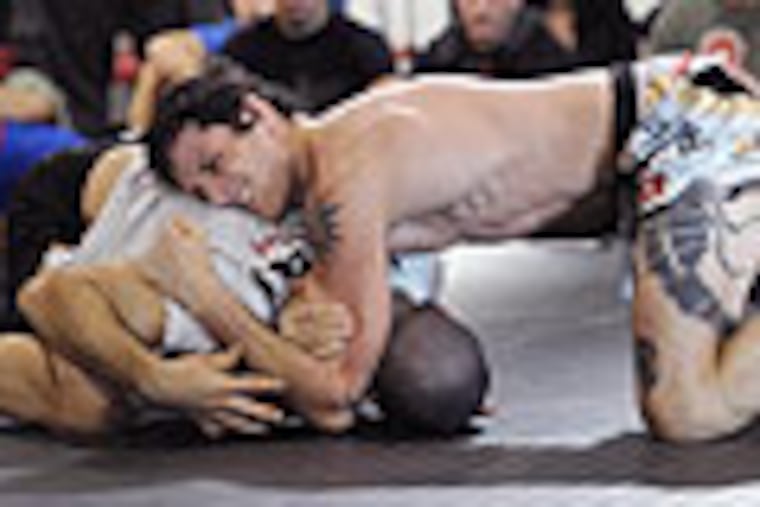
Two more names are called. For the next 4 hours, this is how it goes. Fighters square off in the steamy gym, one-on-one, attacking from their knees. They slap heads, tie their arms together to gain an advantage. There's a little blood but no punching allowed. Every now and then, in a tangle of elbows and knees, a fighter slips a forearm around his opponent's throat like a noose, or pressures a joint in a direction nature never intended.
With the pain increasing by the second, there are two options for a man who's quickly losing consciousness: Tap out and stop the match . . . or not.
"Ooh, he's out. He went nighty-night," Noel Smith, a Brazilian jiu-jitsu instructor from Maryland, says of a motionless fighter who's on the mat, out cold.
While Smith watches, other fighters pace back and forth, rolling their heads to loosen neck muscles and their nerves. Some hop back and forth from foot to foot, staring off into the distance. Some eye up their opponents. Almost all are strangers. Some throw combinations in the air, jabs and hooks and sweeping kicks to phantom heads and kidneys.
Onlookers - girlfriends, trainers, kids - ready cellphone cameras and whisper words of encouragement. There's a guy in a khaki suit with slicked-back hair, holding a video camera. Smith and other fighters want to know who he is, but he's not saying.
"Just here to see the fights," the man says with a smile.
The guy's probably in Philly to look for talent, just like the Chicago-based Bellator. MMA promoters have found gold among the growing stable of tough Philly fighters. Kensington native Eddie Alvarez, a former Bellator lightweight champion, is the most well-known. The circuit's bantamweight champion, Zach Makovsky, is a former Drexel University wrestler.
"There's just a lot of talent here. We've been doing it a long time here," says Brad Daddis, who opened his first MMA gym on Callowhill Street in 2000 and now has 1,000 students among three schools. "Fighting is part of the culture of Philly. Boxing is in our blood here."
Not long ago, there was no cusp for anyone pursuing mixed martial arts, mostly because mixed martial arts didn't exist. Wrestlers could win gold at the Olympics, but the world's oldest sport paid the bills only through coaching or clinics. The very best boxers could make (and lose) millions, and part-time brawlers slugged it out for a few bucks in "Toughman" competitions. Martial artists - from aikido to judo to taekwando - had their own competitions, their own gyms, their own rules that set them apart from one another. They won trophies and became instructors, and only a select few, like Bruce Lee and Chuck Norris, found fame.
Publicity stunts often pitted a boxer against a brown bear, or a real heavyweight boxer like Chuck "The Bayonne Bleeder" Wepner against a not-so-real professional wrestler like Andre the Giant. But nobody bothered to figure out who was the toughest fighter. These were guy fantasies, long, strange debates that filled up time on road trips, barstools, and graveyard shifts.
Could Bruce Lee beat Muhammad Ali? Could wrestling legend Dan Gable slam Chuck Norris to the ground and hurt him? Did former Hells Angels president Chuck Zito really knock out Jean-Claude Van Damme?
Then on a December night in 1993, somebody attempted to answer those questions with the first "Ultimate Fighting Championships." In a caged octagon in Denver, a bunch of contestants with different fighting styles were thrown together. Later, Arizona Sen. John McCain called it "human cockfighting" and tried to have it banned.
Ancient Romans would have loved it, though. That first UFC featured boxers, wrestlers, karate black-belts, and Royce Gracie, a Brazilian jiu-jitsu master whose family helped launch the event. There were few rules, and the matchups were bare-knuckled and bizarre: a 215-pound Dutch kickboxer beat a 430-pound sumo wrestler and then squared off against Gracie, an average-sized guy with no discernible muscles.
"He was skinny, he was weak, he wasn't strong at all. He was just like this nice kid," Steve Maxwell, who was ringside and who later became one of the first Brazilian jiu-jitsu instructors on the East Coast, says of Gracie. "I was scared to death. I just thought those guys were going to murder him."
Gracie's arms turned out to be like boa constrictors, though, and opponents were nearly defenseless against his jiu-jitsu skills. In that first UFC, he took kickboxer Gerard Gordeau down and easily choked him out, and his dominance in subsequent UFC tournaments helped popularize Brazilian jiu-jitsu, a practical martial art that emphasizes taking opponents off their feet, and uses joint locks and choke holds.
"It really started a revolution," says Maxwell, who wrestled at West Chester University and who regularly hosted the Gracies at his former gym, Maxercise, in Center City.
It took a few years for the UFC and other fledgling fight promoters to evolve from spectacle to sport, to showcase true mixed martial artists, the walking Swiss Army knives who today can win from any angle with an assortment of moves. Boxers learned wrestling takedowns. Wrestlers learned roundhouse kicks to the head. Everyone scrambled to catch up on Brazilian jiu-jitsu to compete with the Gracie clan. The jiu-jitsu crowd eventually had to learn how to throw a punch. Nowadays, MMA fighters have to know it all to get to the UFC or Bellator.
Some fighters at Daddis Fights Camps on this blustery winter afternoon were infants when Royce Gracie won that first title in Denver. They have grown up in an era during which MMA-focused gyms like Daddis have become more common while boxing gyms have become increasingly rare. On any given night, you can find a UFC or Bellator or Strikeforce event on television, with smaller leagues putting on fights all over the country.
All of these men, and the few women, inside Daddis Fight Camps on this afternoon are products of this modern MMA era, which means they're all pretty dangerous. They all know jiu-jitsu and boxing and some form of karate. There's no tough guy getting off the couch to try out because his buddies say he can take a punch.
"This is a big deal here today. This is how far we've come. There weren't even weight classes 20 years ago," says Jackson Galka, 29, a tall, lanky fighter who works as the academy director at Daddis.
Galka, with his floppy hair, clean-cut looks and English degree from Ithaca College, is the kind of guy some out-of-shape drunk might mistakenly try to tangle with. But on the mat, shirtless in his Muay Thai shorts, the spidery, tattooed featherweight is a tactician.
"I'm looking to re-establish myself," says Galka, who recently took time off after a back injury.
He travels to Daddis almost daily from the Art Museum area. A week after the Bellator tryouts in Philadelphia, he won a match in the Caged Fury Fighting Championships in Atlantic City. As a pro, he's 3-1 and feels he has an advantage over many opponents, a brains-over-brawn mentality inside the cage.
"I was never the fastest, toughest, strongest, or most athletic kid. But I've always felt very, very smart. So I try to train and compete as smart as possible," he says. "I know I'll never be the most athletic, but I want to be known as the smartest fighter out there."
During his grappling session at the Bellator tryouts, Galka didn't immediately "take it" to his opponent, he says, but eventually won the round.
Some fighters at the tryouts, like Northeast Philly's Anton Berzin, looked like bruisers at first glance. Berzin, 22, could be a bad guy in an action flick, a hulking figure who'd crack his knuckles, smirk, and then land a fist right to Indiana Jones' chin.
Berzin won a DNA coin toss. He got the flip side from that which leaves some of us short and balding with protruding bellies. He's 6-2, 220 pounds with a full set of abs, though he says he's never lifted a weight in his life. "I do roofing with my brother," he explains.
Berzin was born in Ukraine and lived in Vineland as a kid, the youngest of 10. He would have been a dominant athlete in high school, but he had to work instead. About 4 years ago, he walked into Rocco MMA on Grant Avenue, took a class, and instructor Adam Rocco knew he had a prodigy on his hands.
"Yes, I knew that very first day. Anyone who sees him knows he's in a different class," Rocco says.
Yet the afternoon's biggest show comes from one of its oldest competitors, a 6-3, 238-pound slab of muscle from Virginia named Johnny "The Tree Man" Curtis. Curtis, 41, compiled a record of 114-30 as a wrestler at George Mason University. He's using his ingrained skills to toss Californian Cody "The Moose" Goodale all over the mat. Onlookers back up as Curtis gets in on Goodale's legs, and the room shakes when the two crash to the mat.
Curtis wrestled for the U.S. National Team after college and coached a little, but there's no real professional wrestling league. That's why he owns a tree service. He knows his MMA clock is ticking.
"When you were finished wrestling, you went and became a coach or you did something else," he says, his chest still heaving with deep breaths.
Earlier in the day, Caplan suggested that he might pick an MVP from the tryouts. But as the sun sets on Washington Avenue and he walks among the fighters now attacking pads with combinations and flying feet, he doesn't name names. Instead, he urges the fighters to stay in touch, to request him on Facebook, and he promises to take a deeper look at some of them on the Internet.
"I want to thank all of you for coming. This was one of our most well-attended events," he told the sweaty, panting crowd around him. "I know it's expensive to fly here and expensive to stay here."
Some of the fighters are visibly disappointed, shaking their heads as they throw on hooded sweatshirts, wishing they could hit rewind. Some ask Caplan to pose for pictures and try to get a private word with him. Others are staying the night and look to grab a cheesesteak and a beer. Two fighters say they are getting in their cars and driving right back to Kentucky.
Even after the letdown, a few fighters stay behind, kicking and punching the heavy bags as the glow of auto-parts stores and street lamps light up Washington Avenue.
Bjorn Rebney, chairman and chief executive of Bellator, said he'll continue to host tryouts in Philly because of the talent he finds here, because there's always another future champion hitting a speed bag or jumping rope after everyone else goes home, a plumber who laces up his running shoes after work and knocks out 10 miles.
"We're looking for fighters who are willing to let their hands go, and more often than not, we're looking for excitement. We're looking for those guys looking to take chances," he says.
Later, Caplan woulsays privately that he was impressed with a handful of fighters, and eventually offered Galka a chance to fight on the undercard at Bellator 65 in Atlantic City on April 13.
Galka found out about it just a few days ago.
"I think I deserve to be there," he says. "This is the next landmark. I feel validated. It's going to be a lot of pressure, but I work well under pressure."