Remember when there was no ESPN?
Bill Rasmussen thought about the audience he would be addressing at Penn's Wharton School of Business.
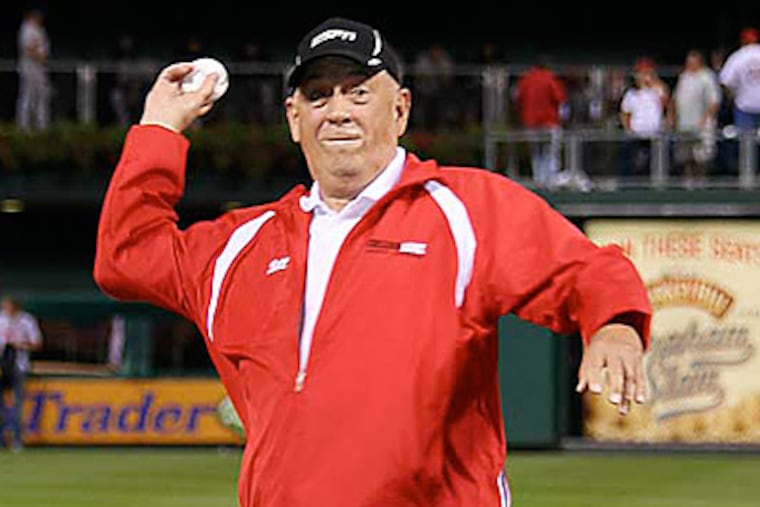
Bill Rasmussen thought about the audience he would be addressing at Penn's Wharton School of Business.
Unless there were some continuing-education students in their late 30s, most in attendance probably would never have known what it was like to not have ESPN.
Many may not know the cultural icon is actually named the "Entertainment and Sports Programming Network."
"It really might be more than half of Americans alive today," said Rasmussen, who in 1979 launched what was then considered the wacky idea of a 24-hour sports network. "If you were born in 1975, you were 4 years old when we went on the air.
"That's probably not being aware. If you were born in 1970, you were 9. So really everyone from 1970 on has had ESPN, and that's amazing."
Originally slated to be the keynote speaker at the second annual Wharton Sports Innovation Conference, Rasmussen, who has been called "The Father of Cable Sports," spoke to a smaller audience after a change of schedule.
But his message to the budding entrepreneurs was consistent.
"Anything is possible," he said, "and you don't have to know all the facts at first. If you have an idea to try to sell to someone, you better have the passion and enthusiasm for it.
"Why would I invest money into an idea if the person presenting it doesn't have the passion for it?"
Sometimes it's the type of passion that defies conventional thinking.
That's what happened on Sept. 7, 1979, when ESPN launched.
At the time, cable television was just hitting it big nationwide and original programming wasn't even the driving mindset.
So how Rasmussen, who a year earlier had been fired as communications director for the New England Whalers of the World Hockey Association, convinced the Getty Oil Company to invest had people in the industry laughing.
It might have been expected that Rasmussen, his son, Scott, and associates Ed Eagan and Bob Beyus, who dropped out early on, would not have had the clout to impress investors.
But even having a wealthy businessman like Ted Turner, who was looking to launch his own Cable News Network (CNN) in their corner did not eliminate skeptics.
"People would look at us like we were a three-headed monster," said Rasmussen, who by 1980 was not involved in the day-to-day operation of ESPN. "The cable industry saw itself as a signal-enhancement industry.
"They were mainly interested in a taking a signal from a place like Philadelphia and sending it to a remote area that could not get an over-the-air television.
"There were far more noes than yeses."
But Rasmussen had been in the sports industry since 1965 when he started as the sports director at WWLP-TV in Springfield, Mass. He was convinced he knew sports fans and their market potential.
"We had the idea that fans across the country would want to watch sports," he said. "When you think in terms of adding all sports fans together, it is the single biggest marketing force in the United States. It crosses every demographic known to mankind."
They pushed on. It was initially an idea for a regional sports network across Connecticut.
ESP, the original call letters, was incorporated in 1978 for $91. Gathering $30,000 from family and investors, they purchased a transponder, which allowed a 24-hour feed that was cheaper than sending signals via landlines.
They wanted to set up shop in Plainville, Conn., but an ordinance prevented satellite dishes. For $18,000, they got a parcel of land, which was previously a dump, in Bristol.
The face of sports had changed forever.
In 1979, ESPN billed itself as "The Total Sports Network," but by 1998, it had the clout to confidently call itself, "The Worldwide Leader in Sports."
Today, ESPN has dozens of original shows plus broadcast contracts with the NFL, MLB, NBA and the Barclay's English Premier League among others.
Ironically, the programming most responsible for giving it credibility in the early days - the opening rounds of the NCAA Tournament - is the one thing ESPN was never able to reacquire after it was lost.
But ESPN is broadcast on all seven continents and is reaching even more people through content on the internet. Some of its personalities have become as popular as the athletes they cover.
ESPN became a game-changer. It has infiltrated every communication medium possible.
It beat Turner's CNN to air by almost a year.
For better or worse, ESPN has helped alter the way the news, not just sports, is covered and presented.
That's a long way from late-night coverage of Australian Rules Football.
But despite its expansion beyond what even he fathomed, Rasmussen said the original mission of ESPN remains the driving force of the network.
"It's an interesting issue because you really have to go back to the technology when we started," he said. "We didn't even have fax machines. We just had the idea that fans across the country would want to watch sports.
"So from that perspective, except for the addition of all the technology that has been added over the years, ESPN's original mission remains the same today.
"We wanted to do sports. We wanted to impart as many live games and sports news as we could around the clock.
"There are still only 24 hours in a day. We originally thought we might have one or two networks. It turns out they have now has 52 networks all around the world. But it's still the same basic premise."
Contact John Smallwood at smallwj@phillynews.com.