The men behind the Philly Sports Hall of Fame
Ken Avallon asked a simple question: Why not us? He had just read a May 17, 2002, Inquirer article written by Frank Fitzpatrick, who wondered why there was no Philadelphia Sports Hall of Fame.
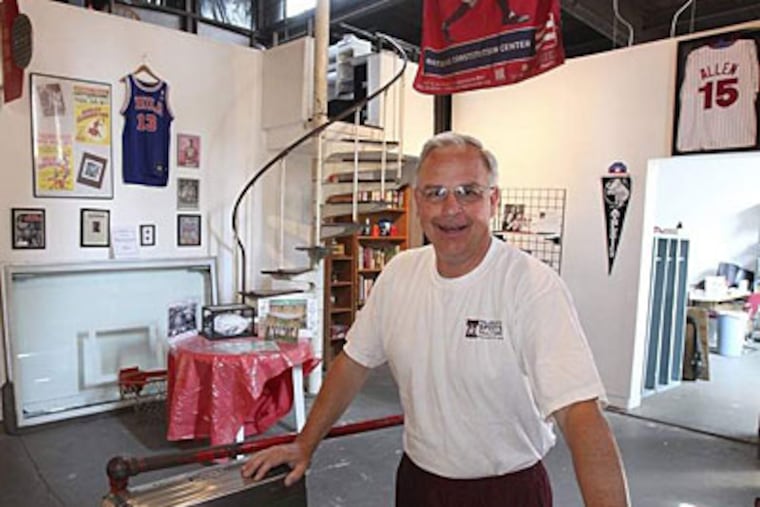
Ken Avallon asked a simple question: Why not us?
He had just read a May 17, 2002, Inquirer article written by Frank Fitzpatrick, who wondered why there was no Philadelphia Sports Hall of Fame.
Avallon did some research and discovered that, in fact, there was no such Hall.
"There was a Big 5 Hall of Fame, a Philadelphia Jewish Sports Hall of Fame, but not one for the city," Avallon said. He got together with some family members and friends, talked about it for a few weeks and decided it was time to start one.
So that's what they did.
The Charter Class was inducted in 2004. Class IX is about to be announced. There's a simple qualification for candidates — they must either be from the Philadelphia area, or have played in the area.
Already, the Hall has inducted 121 individuals, five teams, one organization, one venue and one event. And eventually, Avallon, the Hall's president, hopes to have an actual building for all the memories.
—
Avallon was born in the Northeast, grew up in Abington Township and went to La Salle. In real life, he is a technology consultant. And like the friends he talked with a decade ago about forming the Hall — which functions as an all all-volunteer organization — he is a Philly sports fan. Of the eight friends who signed the initial charter, five remain with the organization.
They took about a year to draw up the charter after consulting with various Halls of Fame around the country. They put out a news release in 2003 to announce their plans, and the Hall almost immediately took off. They got the great Pat Williams, the former Sixers GM and current Orlando Magic VP, to emcee the first induction ceremony in February 2004. That night, they had 270 people. By the third year, they had more than 600. The 2012 induction ceremony is set for Nov. 8 at the Sheraton Society Hill.
Avallon said their best move was when he called Williams. An absolute natural for the job, Williams has been running the Hall's induction ceremony ever since (save one year when Dan Baker was a more-than-capable fill-in). "That gave us instant credibility, having Pat in our corner," Avallon said.
So did having a Charter Class that included Wilt Chamberlain, Robin Roberts, Joe Frazier, Harry Kalas, Bob Clarke, Tom Gola, Chuck Bednarik and Richie Ashburn.
"Al Shrier pulled me aside that first night and said `You know what you did to yourself: you signed up to run a wedding every year," Avallon said. "I hadn't thought of that. Through the years, we have had `I can't sit with so and so' or 'Make sure I'm close to this person."'
Ten years ago, Avallon and his friends started with a simple idea. They never envisioned what it has become.
—
Despite the names involved, the Hall is hardly a lavish operation. "We're basically self-funded," Avallon said. "The event itself always gets a nice sponsorship. Every year, the four professional teams support us, the colleges support us. The University of Tennessee supported us when Reggie White went in. The Packers supported us (when Herb Adderley went in). The Dodgers supported us when Tommy Lasorda went in."
Now, they just need a year-round gathering place. In the long run, after all, if a Hall is going to be a Hall … it really needs a hall.
"From a museum perspective, that's a completely different ballgame," Avallon said. "In some ways, we're kind of victims of our own success. People come to our banquet and they naturally assume `Just put a museum together."'
It is just not that simple. Through the years, Hall organizers have had four or five real serious discussions about a museum, another half dozen not quite as serious.
Right now, Avallon said, they are talking with the people at Xfinity Live as a potential partner.
"They are looking to put in a second phase down there," he said.
They could go there with the Hall. They could build a museum elsewhere. They could find an existing building. But, even if they found something acceptable, that isn't nearly sufficient for the long run.
"We have been doing a lot of research over the years," Avallon said. "The toughest thing for us to come up with is a real viable, sustainable, revenue-generating business. The museum is not a revenue-generating business. Even the Please Touch Museum, all the money they had, they had to get a new capital campaign."
The lessons of other cities have not been lost on Avallon and his group. In New York, there was a Sports Museum in New York that managed to raise $93 million. "And closed their doors in 8 months," Avallon said.
What the Hall backers have found is that money from admissions for museums usually covers just 15 and 20 percent of the revenue needed to operate. The rest of it comes from programs, grants and endowments.
According to Avallon, some of the city's power brokers, including Ed Rendell, Lew Katz and Ed Snider, are involved in trying to create a long-term solution.
"It's more than just an idea at this point, but there's really not much of a timeline," Avallon said. "We're really just kind of putting numbers together."
These days, the Hall's facility is on 5th Street in Northern Liberties, right around the corner from Finnigan's Wake. They have collected memorabilia from the Vet (turnstiles, ticket windows, lockers, signs), the Spectrum, the Palestra and the Saint Joseph's Fieldhouse, among other places.
"We'll put together kind of a mock exhibit, something you might see in a museum, somewhat scaled down," Avallon said. "We'll visually and electronically document the whole thing."
They basically are building virtual exhibits, so that when they get a chance to move into a permanent location, they will be ready immediately.
"We're just about a turnkey operation to get those exhibits set up," Avallon said.
—
A decade ago, the Philadelphia Sports Hall of Fame was just an idea. Now, it has become very much of the sports culture.
"I'm biased of course, but when I look at the breadth and depth of the sports and history here in Philly, I challenge anybody to give me a town better or more colorful," Avallon said.
And it is not as if they are running out of good names.
The nominees this year include Doug Collins, Andrew Toney, Eric Lindros and Mike Piazza.
"One of the coolest things for us is to kind of being able to do some research," Avallon said.
That is how they found 2012 nominee, John McDermott, a golfer and a Philly guy. He won the U.S. Open in 1911 and 1912, becoming the first American to win his country's national championship.
"Some are forgotten," Avallon said. "It's nice for us to be able to bring that name back a little bit."
They are bringing so many names back, some from yesteryear, others from yesterday. And eventually, the Hall will also include those have who just retired, those who are still playing, and those who have not even begun to play.
Click here for a complete list of the inductees into the Philadelphia Sports Hall of Fame.