Dick Jerardi: What I saw at the most controversial game in basketball history
It was late summer 1972. I had been wandering around Europe for a few weeks. Why not stop in Munich to see the final days of the Olympics? What could go wrong? That is how I found myself in Rudi-Sedlmayer-Halle, in the second row of the stands behind the basket where Doug Collins was shooting the most pressure-packed free throws in basketball history.
It was late summer 1972. I had been wandering around Europe for a few weeks. Why not stop in Munich to see the final days of the Olympics? What could go wrong?
That is how I found myself in Rudi-Sedlmayer-Halle, in the second row of the stands behind the basket where Doug Collins was shooting the most pressure-packed free throws in basketball history.
—
I don't remember exactly when I planned to arrive in Munich, but I do remember wondering if I would be going at all when I read about what was going on in the Olympic Village. Did anybody know the word "terrorism" before that September? The world changed forever when those eight men hopped over that fence and took those 11 Israeli athletes and coaches hostage, eventually killing two in their rooms and nine more in the fiasco of a rescue attempt at Fürstenfeldbruck, the NATO airbase outside of Munich.
If the Olympics had been canceled, it would have been a rational decision. I would have missed my chance to see them, but I — along with everybody else — would certainly have understood. Games really did not seem to matter all that much. But the games, it was decided, had to go on.
So I ended up in Munich sometime that final week of the '72 Olympics. Details are hazy, but I do remember haggling for tickets in a public square downtown. I remember watching specks run down the track in the 110-meter hurdles final from atop a tower adjacent to the main stadium, but I also got tickets to several events in the stadium. I saw the end of the decathlon in the rain, and watched that imposter run into the stadium ahead of marathon winner Frank Shorter.
I also got tickets to the basketball semifinals and finals. The U.S. crushed Italy in one of the semifinal games, 68-38, while Russia beat Cuba, 67-61, in the other semi.
So I was there that night as the U.S. went for another Olympic win in what had always been a preordained gold medal. Since basketball was introduced at Berlin in 1936, the United States had won all seven gold medals. Their record was 63-0. Few of those games had even been competitive. I assumed this one would be no different.
Then, the game began. It became clear to me after a few minutes this was going to be different. It wasn't that the Russians were that good. They really weren't. They were mechanical and slow, but also irritating and effective.
But they did have the Belovs, Sergei and Alexander.
Twenty years later, Sergei would be inducted into the Naismith Memorial Basketball Hall of Fame, his international acclaim recognized in America. That night in Munich, he was a fully developed 28-year-old professional and clearly the best player on the floor. He finished with 20 points in a game in which the teams would combine for 101. He was playing against college kids. And it showed.
Alexander was just 21 and not a major factor that night — until the finish. But I saw him a few years later in Baltimore when the Russians were touring. Had it been a different time, he could have played in the NBA. He was a real talent. Sadly, he died in 1978 at just 26.
What struck me during the game — and has always stayed with me — is that the Americans were playing a style straight out of the 1950s. The American game had long since become a free-form, fastbreaking, pressing, athletic marvel, epitomized by the Boston Celtics in the NBA and John Wooden's great UCLA teams in college.
But the U.S. coach was Hank Iba, a man from another era whose NCAA champions at Oklahoma A&M had come in the late 1940s. He was a brilliant coach but his time had passed, and the U.S. was playing just like the Russians wanted them to play: slow, methodical, boring.
It was incredibly frustrating as a fan. (And I was a fan that night; it would be years before I got into a business where rooting is out.)
The best American amateur player, UCLA's Bill Walton, did not even try out for the team. It was just four years after U.S. track-team members Tommie Smith and John Carlos had staged their black-gloved protest in Mexico City. The Vietnam War was still raging, Watergate was about to explode. It was a different time in America.
Everybody figured the Americans would not need Walton. Everybody was wrong.
The Russians led from the start. As each minute passed, the frustration among the American team and their fans grew. So did the tension. There is nothing like defending perfection. Coached a different way, the Americans likely would have won on the square. But that night, the Russians were the better team. Then, the Soviet team began to choke, the moment apparently too big for them.
I can still see their faces in the final agonizing minutes. The Russians had played better for most of the game, but they simply did not know how to win. As the game headed into the final frantic seconds, the Russians still led. They had the ball and a one-point lead, but it seemed as if nobody on their team wanted the ball in his hands.
Alexander Belov got his shot blocked by Maryland's Tom McMillen. Belov then got the rebound and inexplicably tried to throw it from the baseline to the foul line with under 10 seconds left in the game. Collins anticipated the pass, knocked it free, got control of it and then took off for the basket.
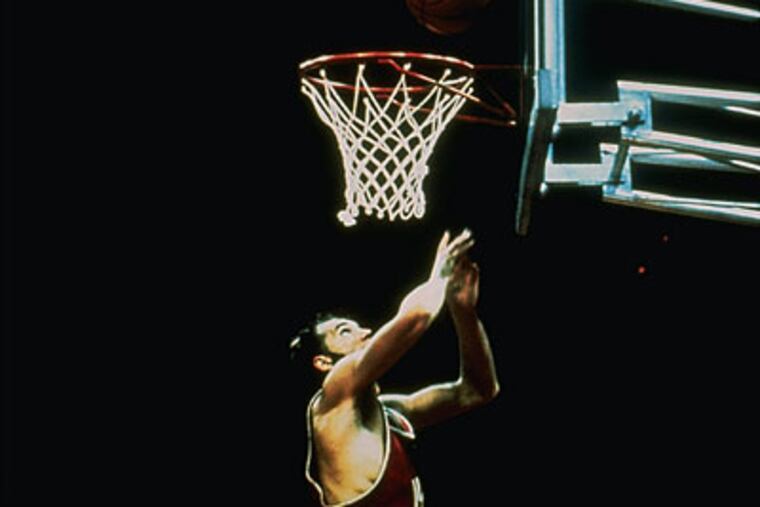
He was undercut as he went in for a layup. His shot almost went in anyway. Alexander Belov may very well have goaltended on the shot. Collins went flying into the basket support, maybe 25 feet from where I was sitting. There were 3 seconds left in the game, 3 seconds that have been replayed over and over for the last 40 years.
—
Think about the pressure on Collins. He had nearly been knocked out by the foul. His team trailed, 49-48. His country had never lost an Olympic game.
And yet I remember the look on Doug's face: completely calm, completely confident.
Three dribbles. Swish. Three dribbles. Shooting motion. Horn blows from scorer's table. Swish. The U.S. had its only lead of the game.
I figured the game was over. Collins was going to be a hero for all time, the kid from Illinois State who saved the gold.
Then, chaos.
I knew international rules were different than ours in how timeouts were awarded. I didn't know then exactly how different. For one thing, players could not call timeout in international games. Nor could time be called when the ball was in play. To get a timeout, a coach had to notify the scorer's table through a buzzer. The timer would then notify the on-floor official, a convoluted system almost ensuring miscommunication, especially with so many languages at an Olympics.
The Russian coach apparently thought he had signaled for a timeout while Collins was shooting the free throws and would get the timeout sometime before the ball became live. Thus, the horn as Doug was shooting his second free throw, signaling the timeout. The timeout request apparently was never relayed to the officials so they waved off the horn. The second free throw counted.
The Russians threw the ball into their backcourt and took a few dribbles. One of their coaches charged on to the court and demanded the timeout. The refs inexplicably acknowledged him and stopped play.
They decided to reset the clock to 3 seconds and have the Russians inbound again. I remember distinctly seeing the scoreboard clock read 50 seconds as the ball came inbounds, again deep in the backcourt. The officials had gone too quickly and the clock had not been reset. It was still counting down to 3 seconds. As soon as the ball came in, the timer again hit the horn because the clock had not been reset. The Americans thought the game was over and celebrated. Only, it wasn't.
—
I remember being as confused by the chaos on the court as I was by the American style of play. Given a third chance to inbound the ball, the Russians finally employed the correct strategy. McMillen had been guarding the ball, but, inexplicably, backed off into no man's land. He said later he thought the official was telling him to back off. Ivan Edeshko, presaging Grant Hill 20 years later at the Spectrum, threw a perfect 90-foot pass to Alexander Belov.
The 7-4 Tom Burleson should have been covering Belov. But he was on the bench, so the task was left to the 6-7 Jim Forbes, with 6-3 Kevin Joyce rushing back to help. Belov caught the ball and cleanly laid it in. The Russians had won, 51-50.
I don't remember the end-game chaos as much as I remember thinking the game never should have been close. It was poorly played, poorly coached and borderline unwatchable.
Nobody remembers that because of the controversy. Given the emotions involved and the chaos at the end of the game, I certainly understand why the Americans did not accept their silver medals. To this day, though, I really think the only thing cheated that night was the game. Yes, the Americans were victims of dreadful timeout rules and completely incompetent game administration. Unfortunately, there was as much panic on the sideline as there was on the court.
As I headed into the night, I was bewildered by everything that had gone down. But I never forgot that game.
So when I was in Barcelona 20 years later for the Daily News, I made certain to be in the building for the gold-medal game, even though the late, great Phil Jasner was covering it for the paper.
The game, everybody knew, was not going to be close. There were no surprises. It was a blowout. The greatest team ever assembled in any sport had done precisely what it was supposed to do.
After the game, I remember walking up to U.S. coach Chuck Daly outside the locker room, asking him if he knew that he had not called a timeout during the entire tournament. He winked and told me that was his only goal. Here was a coach who knew what to do and what not to do. Style of play and end-games were never part of the equation in 1992.